
Table of Contents
The discovery phase of a project is a systematic process for de-risking complex engineering initiatives before committing significant capital. It’s not a series of kickoff meetings; it’s a structured investigation to align technical feasibility, business objectives, and regulatory hurdles before development begins. This process transforms a high-risk venture into a predictable, manageable program.
Most complex projects don’t fail due to mid-stream engineering crises. They fail because of flawed assumptions made before a single component is ordered. Skipping a formal discovery phase is the primary source of these assumptions, leading directly to budget overruns, schedule slips, and products that miss market requirements. A structured discovery process is the most effective tool for mitigating these failure modes.
By investing a fraction of the total project budget upfront, you can pinpoint critical failure points when they are cheap and easy to fix. This is about preventing expensive rework late in the development cycle, thereby protecting your most valuable assets: capital and time-to-market.
Why the Discovery Phase Is Your Most Critical Investment
Staring down a complex hardware or robotics project can feel like a high-stakes bet. But the truth is, most of these projects don’t fail because of some mid-stream engineering crisis. They fail because of bad assumptions made before a single component was even ordered.
Skipping a formal discovery phase is the number one source of those flawed assumptions. It’s a direct path to the budget overruns, schedule slips, and products that just plain miss the mark. A structured discovery process is your best tool for heading off those disasters.
By investing a small fraction of the total project budget upfront, you can pinpoint critical failure points when they’re still cheap and easy to fix. This is all about preventing that soul-crushing, expensive rework late in the game, protecting your two most valuable assets: your capital and your time.
The Business Case for De-Risking
The core problem a discovery phase solves is uncertainty. It forces a disciplined, honest look at the project’s foundational pillars:
- Technical Feasibility: Move past datasheets to validate component choices, map integration complexity, and identify architectural dead-ends before they become costly rework.
- Business Viability: Ensure the engineering effort is locked onto concrete business goals. Validate that the product solves a real-world problem and has a clear path to monetization.
- Regulatory & Compliance: For regulated industries like med-tech (ISO 13485), aerospace (DO-178C), or automotive (ISO 26262), this is non-negotiable. Discovery unearths mandatory requirements early, preventing compliance failures that could derail the entire project.
By validating these three areas, you ensure the team is building the right product, the right way, from day one. It’s a proactive approach that dramatically accelerates time-to-market by eliminating the churn and redirection that plague poorly planned projects.
Data-Driven Success
The industry is moving away from treating discovery as a “nice-to-have” and recognizing it for what it is: a mandatory lever for success. The data backs this up in a big way.
Research from the renowned Nielsen Norman Group paints a stark picture. Teams that ran a formal discovery reported 83% project success on their last initiative. For teams that skipped it? Only 52%.
Let that sink in.
Performing discovery cut the risk of project failure by 75% and boosted the chance of success by 59%.
And it doesn’t have to be a long, drawn-out process. Crucially, 58% of these successful discovery phases were wrapped up in two weeks or less—a timeline that fits perfectly with the fast pace of robotics or embedded-firmware development.
The Anatomy of an Effective Discovery Phase
Think of the discovery phase not as a free-form brainstorming session, but as a structured investigation. Its job is to systematically dismantle a complex product idea into a series of answerable questions, turning hazy concepts into a concrete, actionable plan. It’s all about generating hard data—market, technical, and financial—so you can make informed, defensible decisions before committing serious capital.
A well-run discovery phase is built on a handful of core activities, each one specifically designed to tackle a different kind of risk. It’s a disciplined process that gets you out of the clouds of theory and into the weeds of actually building a successful product.
This process acts as a strategic lever, directly impacting your ability to mitigate risk, protect capital, and get to market faster.
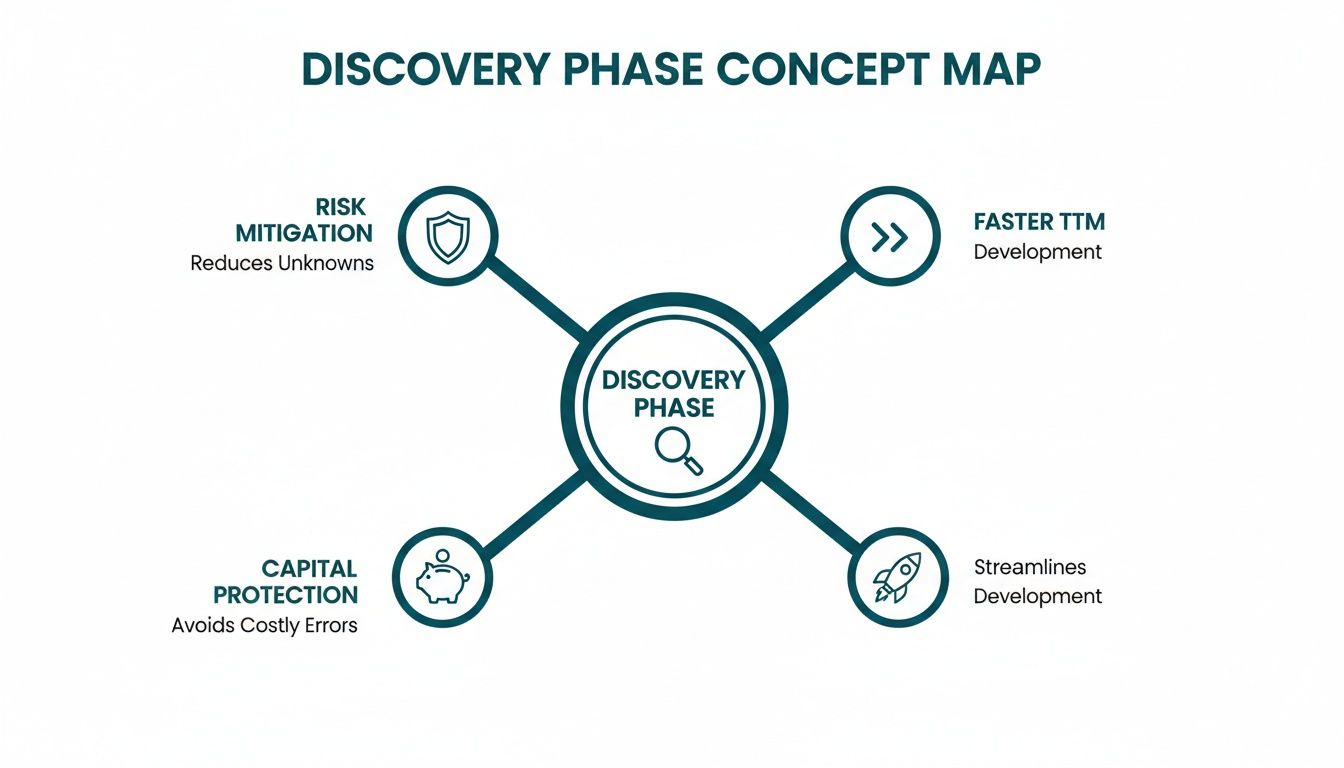
Every activity we’re about to cover feeds directly into these business outcomes. This is how you ensure that the upfront investment in planning translates directly into less project uncertainty and a much higher chance of success down the road.
To truly grasp the value of these activities, it helps to see how they connect directly to tangible business outcomes. Each step is a deliberate effort to de-risk the project and create a solid foundation for development.
Core Activities and Business Impact in Discovery
| Discovery Activity | Objective | Primary Business Impact | Example Application (Medical Device) |
|---|---|---|---|
| Stakeholder Interviews | Translate business goals into specific, measurable engineering requirements. | Prevents costly rework by ensuring the product being built is the product the business actually needs. | An executive wants an “intuitive” surgical tool. Interviews reveal this means it must have a battery life of at least 8 hours, a weight under 400 grams, and be sterilizable via autoclave 500 times. |
| Technical Feasibility | Validate core technologies and identify potential architectural dead ends early. | Avoids investing in a technical path that is unworkable, saving hundreds of thousands in wasted R&D. | The team tests a novel sensor for a diagnostic device, discovering it’s too sensitive to ambient temperature changes. They pivot to a more robust sensor before designing the entire system around a flawed component. |
| DFM Review | Ensure the product can be built reliably and cost-effectively at the required scale. | Protects profit margins and ensures product availability by preventing designs that are too expensive or impossible to manufacture. | A DFM review flags that the internal layout of a patient monitor would require complex, manual assembly. The housing is redesigned for automated assembly, cutting labor costs by 30%. |
Each of these steps builds on the last, systematically converting assumptions into validated facts. This structured approach is what separates successful product launches from those that get stuck in development hell.
Stakeholder Interviews and Alignment
The very first step is turning high-level business goals into engineering specs an engineer can actually build from. This means structured interviews not just with the C-suite, but with key people in marketing, sales, manufacturing, and even field service. Trust me, each of them holds a critical piece of the puzzle.
Problem → An executive wants a “best-in-class” industrial robot. For an engineering team, that statement is completely useless.
Diagnosis → Through targeted interviews, you dig deeper. “Best-in-class” really means achieving a 99.9% pick-and-place accuracy at 3 cycles per second. It also has to operate in dusty environments defined by IEC 60529 (an IP54 rating). On top of that, the service team points out that the mean time to repair (MTTR) absolutely must be under 30 minutes. That’s a critical non-functional requirement that could have easily been missed.
Solution → Suddenly, you have specific, measurable criteria. The engineering team has clear targets to design against, avoiding the expensive churn of building based on vague assumptions. The dialogue also brings constraints to the surface, like the need to use an existing component supplier to keep costs down.
Technical Feasibility Assessment
This is where the product vision smacks into engineering reality. It’s a hands-on investigation to prove out your critical technology choices and spot potential dead ends in your architecture before you build on top of them. This isn’t just about reading datasheets; it’s about building rough prototypes and actually testing core functions.
Use Case: Autonomous Agricultural Rover
Imagine a startup developing a rover to navigate orchards on its own. The discovery phase is where they have to validate the proposed sensor package.
- Initial Assumption: A standard LiDAR and camera system will work just fine for navigation.
- Feasibility Testing: The team cobbles together a simple test rig and runs it in a real orchard. They find out fast that direct sunlight blinds the camera sensors at certain times of day. Even worse, the LiDAR has a hard time telling the difference between thin, dense leaves and solid tree trunks.
- Outcome: The assessment proves the initial plan is a bust. The team pivots to explore sensor fusion, combining LiDAR with RADAR (which couldn’t care less about light or leaves) and adding an inertial measurement unit (IMU) for good measure. This crucial discovery prevents them from building an entire platform on a flawed navigation system, saving hundreds of thousands in rework. Our engineers at Sheridan Technologies use a similarly rigorous approach in our product development process to de-risk complex hardware projects from the start.
Design for Manufacturability (DFM) Review
A product that can’t be built affordably and reliably at scale is a commercial failure, no matter how brilliant the design. A preliminary DFM review during discovery is non-negotiable for preventing costly, soul-crushing redesigns late in the game.
This process involves getting manufacturing engineers in the room to analyze the initial concept for production headaches.
A classic failure mode is designing a medical device with complex, tightly packed internal components that are a nightmare to assemble or service. A DFM review flags this early, forcing a redesign of the housing or internal layout to ensure success on the production line.
Here are the key questions you need to be asking during a DFM review:
- Component Selection: Are the parts we’ve picked readily available from multiple suppliers, or are we designing in a massive single-source risk?
- Assembly Complexity: Does this design need complex manual assembly steps that will inflate labor costs and create quality control problems?
- Material Choice: Is the material we chose compatible with our intended manufacturing process (like injection molding or CNC machining) and any regulatory requirements (like biocompatibility for ISO 10993)?
By systematically tackling these areas—what stakeholders need, what’s technically possible, and what can actually be built—the discovery phase gives you the critical data needed to build a solid foundation. It’s how you directly attack the business and technical risks that are baked into any complex product development initiative.
Key Deliverables That Drive Project Success
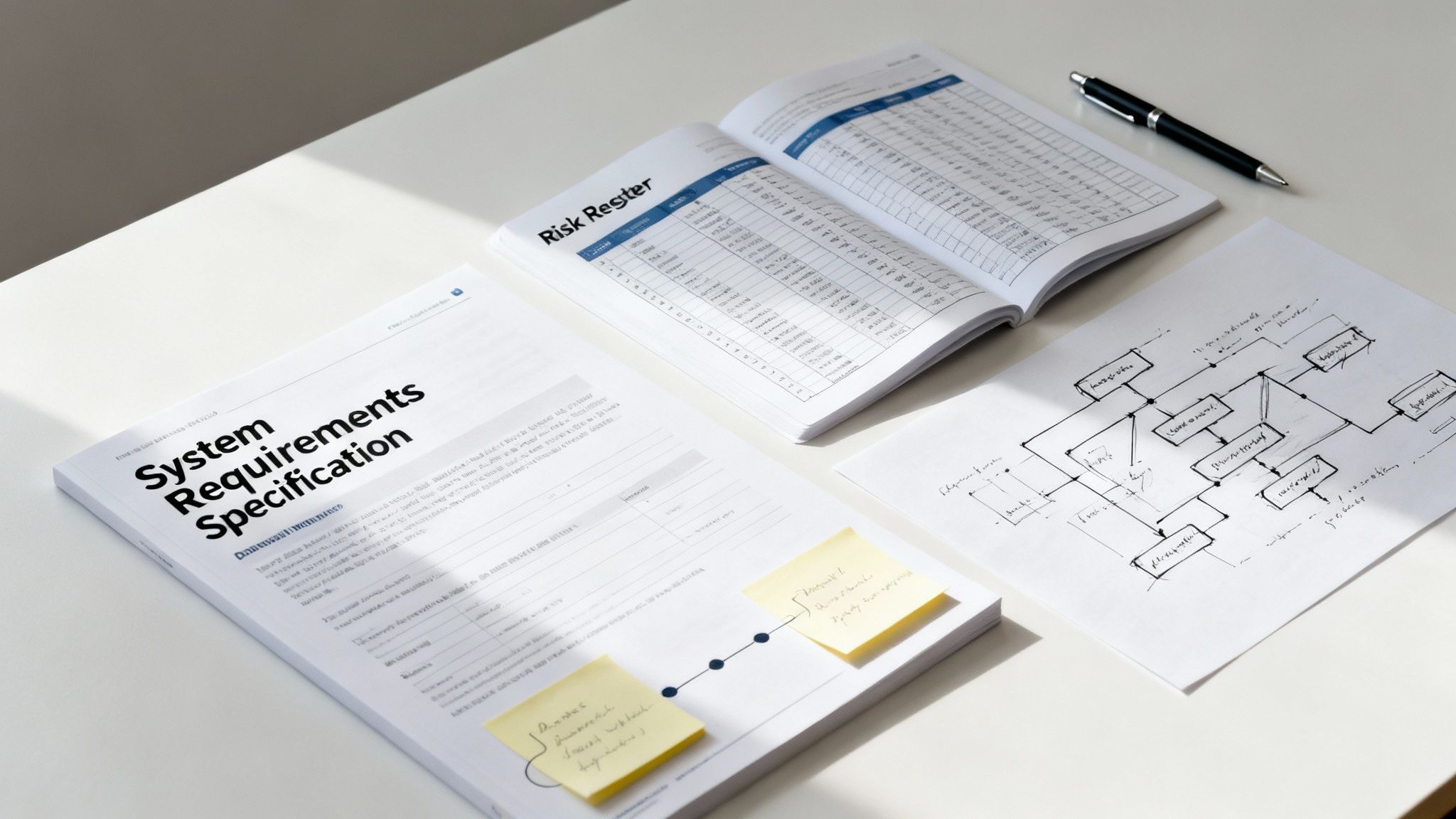
A discovery phase without concrete, actionable artifacts is just a series of expensive conversations. To make sure that doesn’t happen, the whole process needs to end with a set of core deliverables. These documents aren’t just formalities; they are the actual blueprints that turn a high-level idea into a buildable, de-risked project.
These outputs force everyone to get on the same page, create alignment between stakeholders, and give the engineering team the exact guardrails they need to start building. Skimping on these deliverables is a direct invitation for scope creep, blown budgets, and the kind of late-stage technical fires that can cripple a project entirely.
System Requirements Document (SRD)
Think of the SRD as the single source of truth for what the system absolutely must do. Its job is to translate fuzzy business goals into specific, measurable, and testable engineering requirements. A huge part of this initial deep dive is the ability to clearly define the scope of work, drawing firm lines in the sand for everyone involved.
A well-crafted SRD carefully breaks requirements down into distinct categories:
- Functional Requirements: These define the core behaviors of the system. For a robotic arm, this would mean pinning down specifics like, “achieve a positioning accuracy of ±0.02mm” or “lift a maximum payload of 5 kg.”
- Non-Functional Requirements: These describe the system’s operational personality. This covers things like performance (“achieve a full cycle time of less than 800 ms“), reliability (“maintain an MTBF of 10,000 hours“), and security (compliance with certain cybersecurity frameworks).
- Constraints: These are the hard-and-fast limits you can’t negotiate. For a medical device, a constraint might be a maximum power consumption limit or the mandatory use of biocompatible materials compliant with ISO 10993.
Without a solid SRD, you’re basically asking the engineering team to guess, and that almost guarantees the final product won’t be what stakeholders actually wanted.
Initial Risk Register
For any complex hardware project—especially in regulated spaces like med-tech or aerospace—an initial risk register isn’t optional. This document is where you systematically identify, analyze, and plan for potential threats before they blow up your project.
The point of a risk register isn’t to eliminate all risk, that’s impossible. It’s about making risks visible and manageable. It turns unknown monsters in the dark into known variables you can actually do something about.
For a medical device, this process is formalized under the ISO 14971 standard (Application of risk management to medical devices). The register would sort risks into buckets, such as:
- Technical Risks: A novel sensor failing to perform accurately under real-world clinical conditions.
- Market Risks: A competitor suddenly launching a similar product with a killer feature.
- Manufacturing Risks: A critical component being sourced from a single supplier with notoriously long lead times.
- Regulatory Risks: Failing a key FDA submission because your testing data was incomplete.
Each risk gets a severity and probability score, along with a clear mitigation plan. This isn’t a “set it and forget it” document; it’s a living artifact that gets updated throughout the entire project.
System Architecture Options and Trade-Offs
There’s rarely one “right” way to build a complex system. A good discovery phase should generate at least two or three high-level architectural concepts, each with a brutally honest analysis of its trade-offs. This deliverable stops the team from locking into a single path too early, before they understand all the downstream consequences.
Let’s take a battery-powered industrial sensor as an example:
- Option A (Performance-Optimized): This design uses a powerful microcontroller and a high-speed wireless protocol. The trade-off? It delivers lightning-fast data but kills the battery in six months and drives up the bill of materials (BOM) cost.
- Option B (Cost-Optimized): Here, we use a cheaper microcontroller and a simpler communication method. The trade-off is a 30% lower BOM cost, but the data processing is slower, and the firmware becomes a lot more complex to write.
- Option C (Longevity-Optimized): This one goes with an ultra-low-power MCU and LoRaWAN for communication. The trade-off is an incredible 5-year battery life, but it comes with serious data rate limitations and higher network infrastructure costs.
Laying out the options this way lets everyone—from the CEO to the lead engineer—make an informed decision based on what truly matters most. Is it speed to market? Unit cost? Or long-term operational reliability? This analysis also has to bake in manufacturability; understanding key Design for Manufacture and Assembly principles is vital for judging how each architecture will affect production costs and your ability to scale. Find out more at https://sheridantech.io/2026/01/05/design-for-manufacture-and-assembly/.
By producing these tangible deliverables, the discovery phase builds the essential framework for a predictable and successful development cycle. It ensures that when the team dives into detailed design, they’re building on a rock-solid foundation of validated requirements, understood risks, and deliberate architectural choices.
Rescuing a Stalled Robotics Project: A Real-World Scenario
It’s one thing to talk about the discovery phase in theory. It’s another to see it in action, especially when a project is already in trouble. A discovery phase isn’t just for starting a project off right; it’s a powerful tool for pulling a project back from the brink.
Let’s look at a real-world situation we’ve seen happen. A venture-backed startup is building an autonomous warehouse drone. The initial pitch was incredible, investors were excited, but fast forward nine months, and the project is dead in the water—and way over budget.
The drone’s navigation is dangerously unreliable. Its battery life doesn’t even last half of a required shift. Investor confidence is cratering.

The Problem and Diagnosis
The core issue wasn’t a single catastrophic failure. It was a cascade of smaller problems, all stemming from one original sin: they skipped the discovery phase entirely. The team was so eager to build something and show progress that they dove straight into development.
- Flawed Assumptions: They picked sensors based on impressive specs from a datasheet, but they never tested them in the actual warehouse environment. That warehouse was a chaotic mess of metallic shelving and RF interference that made the sensors practically useless.
- Architectural Mismatch: The team grossly underestimated the processing power needed for real-time sensor fusion and pathfinding. They chose a microcontroller that was constantly maxed out, which was a major reason for the drone’s erratic navigation.
- No Power Budget: They never did the math. Components were added one by one without anyone analyzing their combined impact on the battery. The system was fundamentally unsustainable from an energy perspective.
The project was failing because it was built on a foundation of pure guesswork. Without the guardrails of a discovery phase, every technical decision was a shot in the dark.
The Solution: A “Rescue Discovery”
With the entire venture on the verge of collapse, the leadership team greenlit an emergency two-week “rescue discovery.” This wasn’t about placing blame. It was a disciplined, data-driven sprint to build the factual baseline that should have existed from day one.
This condensed discovery process zeroed in on three critical activities:
- Re-validating Performance Targets: The team ran intensive workshops with the actual end-users—warehouse operators and logistics managers. The goal was to move beyond the initial “wish list” and define the real minimum viable performance requirements.
- In-Situ Environmental Testing: Engineers took the sensor suite into the target warehouse and ran a battery of tests. They mapped out the RF interference zones and quantified exactly how much the metallic structures degraded the signals, finally generating real-world performance data.
- Detailed Power Consumption Analysis: Every single component was put on a test bench. The engineers measured its precise power draw under different loads. This data was used to create the project’s first-ever comprehensive power budget.
The Outcome: A Data-Backed Recovery
The rescue discovery didn’t magically solve the drone’s problems overnight. What it did do was produce a concrete, data-backed recovery plan that replaced guesswork with facts.
The findings were stark, but they were clear.
The analysis proved the current sensor suite was never going to work in that environment and that the microcontroller was critically underpowered. The power budget revealed that even with heroic optimization, the system could never meet the required flight time.
Armed with this hard data, the team completely revised the system architecture. They chose a new sensor suite with technology less susceptible to RF interference and upgraded to a more powerful microcontroller that could handle the computational load.
This evidence-based plan was absolutely crucial for restoring investor confidence.
The project, once stalled and facing cancellation, was put back on a predictable path to success. Within four months, a redesigned prototype was successfully completing pilot runs in the warehouse. The rescue discovery didn’t just fix a few bugs; it saved the entire company by enforcing the discipline that was missing from the start. This kind of strategic intervention is at the heart of the work we do on complex robotics engineering projects.
Common Discovery Phase Pitfalls and How to Avoid Them
Even with the best of intentions, a discovery phase can go sideways fast, burning through time, cash, and goodwill. If you want to get it right, you need discipline and a clear-eyed view of where things typically break down. Treating discovery as just another box to check is the fastest way to guarantee it fails, leading you straight into the very problems you were trying to prevent.
I’ve seen a few key mistakes pop up again and again over the years. Knowing what they are is the first step to building a process that actually works and delivers real strategic value.
The Checkbox Discovery Pitfall
This is the big one. It’s when a team just goes through the motions. They hold the meetings, they create the documents, but there’s no real critical thinking involved. The goal becomes completing the phase, not actually achieving clarity and de-risking the project.
Problem → A team dutifully interviews stakeholders but never challenges assumptions or digs into conflicting needs. They slap together a requirements document that’s really just a wish list, ticking the “requirements gathered” box without creating any real alignment.
Diagnosis → This is a process problem, not a technical one. The discovery is missing a strong facilitator, clear goals for each activity, and a culture where it’s safe—and expected—to ask tough questions.
Solution → Don’t just “do discovery.” Implement a structured framework with clear success criteria for every single deliverable. For requirements, that means forcing hard conversations. Use a prioritization method like MoSCoW (Must-have, Should-have, Could-have, Won’t-have) to move from a vague wish list to a committed, realistic scope.
Stakeholder Silos and Exclusions
Another classic mistake is failing to bring the right people into the room. It’s all too easy to focus on the executives and engineering leads while completely forgetting about the downstream teams—manufacturing, sterilization, or field service—who will have to live with the product.
Use Case: The Costly Medical Device Redesign
A medical device company was developing a brilliant handheld diagnostic tool. The engineering and product teams worked in a tight little bubble, designing a sleek, high-functioning device. The one group they never spoke to? The hospital’s sterilization technicians.
When the final prototype was unveiled, the techs spotted a fatal flaw in seconds. The device’s intricate housing had tiny crevices that made it impossible to sterilize according to hospital protocols (and FDA guidelines). The result was a six-month, six-figure redesign.
This entire mess was completely avoidable. They just needed the right people in the conversation from day one.
Mitigation Strategy:
- Stakeholder Mapping: Right at the start, use a RACI (Responsible, Accountable, Consulted, Informed) matrix to map out everyone who needs to be involved, not just the usual suspects.
- Cross-Functional Workshops: Make it mandatory for downstream teams to participate in key review sessions. Their boots-on-the-ground knowledge is where you’ll find the hidden landmines.
To get ahead of issues like this, you can also build early risk identification directly into your process. Techniques like Mastering Project Pre-Mortems with AI can be a powerful way to strengthen your project’s foundation.
Ignoring the Financial Impact
At the end of the day, a discovery phase is a financial tool. It’s not just about fuzzy feelings of success; a well-run discovery has a measurable impact on your budget and timeline. Industry data consistently shows that after a proper discovery, budget estimates hit within 15% accuracy. Compare that to the 200–300% overruns we often see when teams jump straight into coding.
It doesn’t stop there. Projects with a solid discovery phase see 60% fewer changes during the development chaos and have 40% higher success rates overall. This isn’t just about avoiding pitfalls; it’s about strategically setting your project up to win.
Justifying the Investment in a Discovery Phase
Getting budget approval for a discovery phase means reframing the conversation with leadership. It’s not a preliminary expense; it’s a direct, high-return investment in de-risking the entire project. The dialogue has to shift from “how much does it cost?” to “how much expensive, catastrophic failure will it prevent?” And luckily, the data on project failures makes a stark, financially-grounded argument for you.
Without a rigorous discovery phase, any complex engineering project is a massive financial gamble. A McKinsey analysis of large IT projects found that, on average, they blew past their budgets by 45% and delivered 56% less value than what was promised. That’s not a fluke—it’s the predictable outcome of building a product on a foundation of unverified assumptions. The common thread in these disasters is nearly always a lack of initial clarity, which is the exact problem discovery is designed to solve. Find out more about why a discovery phase is so crucial for project success.
Quantifying the Return on Investment
The ROI of discovery isn’t found in what you build, but in the catastrophic costs you avoid. Let’s look at two very different scenarios: a simple IoT device and a complex surgical robot.
- Simple IoT Device: You earmark $50,000 for discovery, which is about 10-15% of your $400k total budget. During that phase, your team identifies a flawed component choice. Had this been found after tooling was complete, it would have forced a $150,000 board re-spin and a six-week schedule delay. Right there, the upfront investment delivered a 3x return in avoided hard costs, and that’s not even counting the market opportunity you would have missed.
- Surgical Robot: On a $5 million project, a $500,000 discovery investment feels substantial. But what if that process uncovers a critical flaw in the system architecture—one that would have completely invalidated a $2 million FDA submission down the road? The savings aren’t just monumental; they’re existential. This isn’t just about ROI; it’s about preventing a company-killing setback.
A Data-Driven Financial Model
Framing discovery as an insurance policy against failure gives executives a financial model they can understand and support. The numbers consistently back this up: every $1 invested in upfront planning and de-risking saves roughly $5 in frantic, expensive rework later on.
A typical discovery investment is about 10–15% of the total project budget. This modest upfront cost routinely saves 3–5 times its initial expense by systematically killing rework, scope creep, and launch failures before they can burn through serious capital.
When you present discovery through this lens—quantifying the direct costs of rework, the schedule delays from bad requirements, and the market penalties for a botched launch—the justification becomes incredibly compelling. It stops being a line item to be cut and becomes a strategic imperative for any serious engineering effort. For the executive team, this data-driven argument shows clear financial upside and proves you’re being a responsible steward of their capital.
Moving from Discovery into Development
All the brilliant work done during discovery is only worth something if it translates into flawless execution. That transition from planning to actually building something is a make-or-break moment. It’s the point where you either accelerate your momentum or watch it fizzle out.
This critical handoff demands a formal, disciplined process. You can’t just toss a folder of documents over the fence and hope for the best. To make sure nothing gets lost in translation between the strategic “why” of discovery and the tactical “how” of engineering, we use a gate review.
The Gate Review Process
Think of the gate review as a formal meeting where the core team presents the crown jewels of the discovery phase to key stakeholders. This means walking them through the System Requirements Document, the Risk Register, and the final System Architecture you’ve landed on.
The objective here is crystal clear: get a formal “go/no-go” decision. This is the moment stakeholders officially commit resources and give the green light to start development. It’s not just a presentation; it’s an accountability checkpoint.
This review is the final guardrail before you start spending serious capital. It forces everyone into a clear, documented consensus, heading off that classic failure where a team starts building a product that never had genuine buy-in or a shared vision to begin with.
A clean handoff is everything. The engineering team needs to walk out of that review with zero ambiguity about what they’re supposed to build. This isn’t just about handing over a list of requirements; it’s about explaining the rationale behind the big architectural choices and detailing the specific plans to tackle the high-priority risks we uncovered.
Building Momentum for Launch
When you nail the gate review, it gives the whole project a massive shot of adrenaline. The team now has a validated plan and crystal-clear deliverables, which gives them the confidence to move fast and be decisive. They aren’t working off assumptions anymore—they’re executing a de-risked, stakeholder-approved blueprint.
This structured transition is how you turn the ambiguity of a new idea into a predictable, manageable engineering program. It takes the solid foundation you built during the discovery phase of a project and uses it to create immediate forward momentum, setting the stage for an efficient development cycle and, ultimately, a successful launch.
If your project is stalled or you are preparing for a complex new product initiative, a professional discovery assessment can clarify the path forward and de-risk your investment. Contact Sheridan Technologies to discuss how a structured discovery process can establish the solid foundation required for success.