
Table of Contents
IoT in healthcare is no longer an emerging trend; it’s a core component for modernizing care delivery. For decision-makers, it represents the strategic shift from reactive, appointment-based treatments to a proactive, continuous model built on real-time data. By connecting patients, clinicians, and medical devices, well-architected IoT solutions directly address systemic challenges like spiraling operational costs, clinical inefficiency, and avoidable adverse events.
Why IoT Is a Strategic Imperative in Modern Healthcare
Healthcare operators face immense pressure from fragmented data systems, unsustainable operational costs, and a care model that often waits for a problem to escalate. This isn’t a technology problem at its core—it’s a data latency and availability problem. Critical decisions are made based on snapshots of patient health taken days or weeks apart, and complex hospital logistics are managed with incomplete information. This is a recipe for inefficiency and suboptimal patient outcomes.
From Inefficiency to Intelligence
Problem → Diagnosis → Solution → Outcome Structure:
- Problem: Fragmented data and reactive workflows lead to high costs and poor patient outcomes. Clinicians lack timely, contextual data.
- Diagnosis: The root cause is a lack of continuous, real-time data flow from patients and operational assets. Decisions are based on outdated information.
- Solution: Implement a connected ecosystem where devices—from a patient’s wearable biosensor at home to a smart infusion pump in the ICU—continuously stream operational and physiological data. This automates data collection and provides a live, unified view.
- Outcome: The organization transitions from reactive “firefighting” to proactive and predictive interventions. Clinicians can act on early warning signs, and administrators can optimize resource allocation based on live data, reducing waste and improving patient safety.
IoT in healthcare is fundamentally about getting ahead of risk and creating operational leverage. It’s about using live data to make smarter clinical decisions faster, get the most out of expensive equipment, and finally move from a reactive model to one that is predictive and preventative.
The Business Case for Connectivity
Market validation for this shift is clear. According to Grand View Research, the global IoT in healthcare market was valued at USD 53.65 billion in 2024 and is projected to reach USD 169.99 billion by 2030, reflecting a compound annual growth rate (CAGR) of 21.2%. This level of investment is driven by tangible ROI, not hype. You can find more details in this report from Grand View Research.
This investment funds solutions that deliver measurable business impact:
- Risk Reduction: Remote monitoring of post-discharge patients allows clinical teams to intervene before a minor issue requires an expensive hospital readmission.
- Cost Control: Real-time asset tracking eliminates hours of wasted clinical time searching for equipment like infusion pumps, directly improving staff efficiency and asset utilization.
- Improved Outcomes: High-fidelity data from connected devices enables highly personalized treatment plans and empowers patients to actively participate in managing their chronic conditions.
Ultimately, adopting IoT is a strategic necessity for building the data infrastructure required for a more efficient, resilient, and patient-centric healthcare system.
Architecting a Resilient IoT Healthcare Solution
Building a medical IoT solution that stands up to the rigors of clinical use isn’t just about connecting a sensor to the cloud. It’s a deliberate, multi-layered engineering effort. Every component, from the firmware on the device to the analytics platform in the cloud, involves critical trade-offs that directly impact reliability, security, scalability, and ultimately, patient safety.
For engineering leads and product owners, getting this architectural blueprint right from the start is the key to avoiding costly rework and delivering a system that can handle the real world. A typical IoT healthcare architecture breaks down into four essential layers, and success hinges on making them work together seamlessly, not just perfecting each one in isolation.
Connected devices are a direct response to some of healthcare’s most persistent problems: soaring costs, operational bottlenecks, and a care model that’s more reactive than proactive.
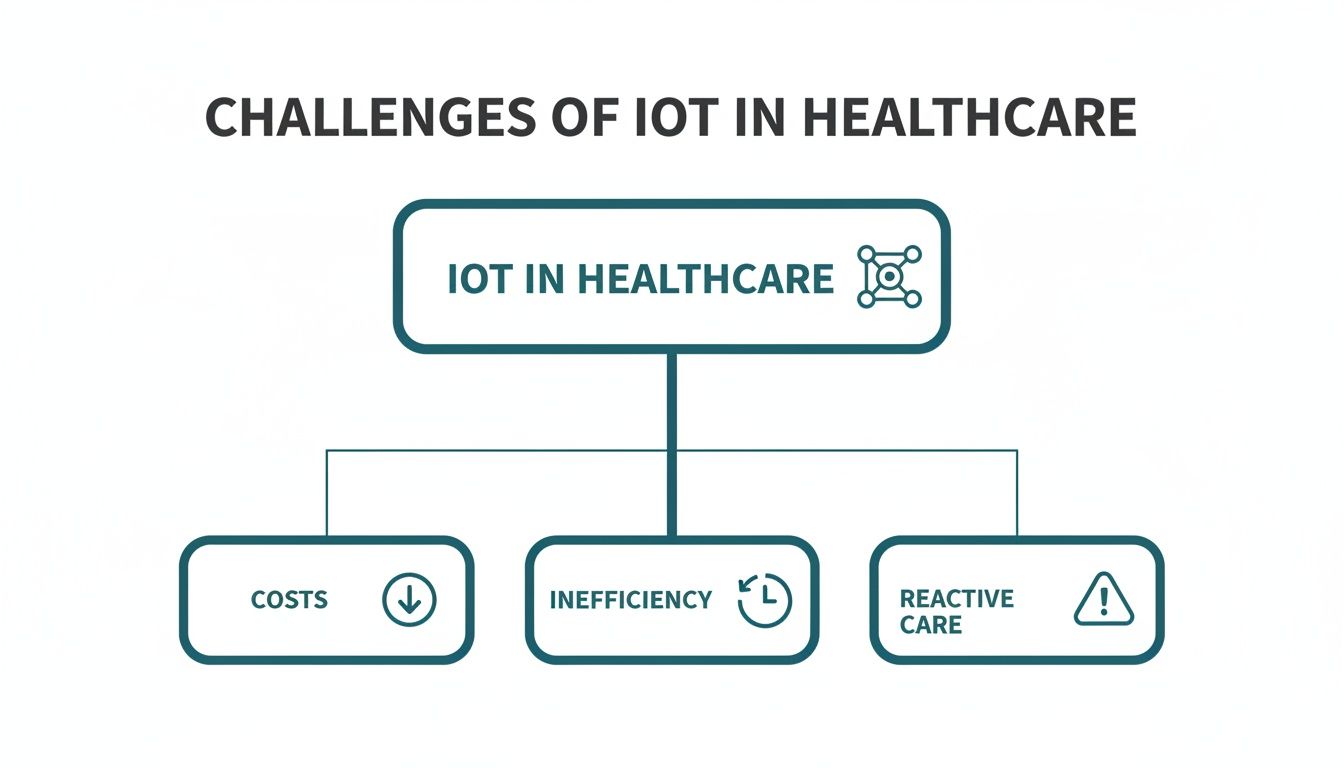
This is where the rubber meets the road—using technology to create data-driven workflows that solve foundational challenges in how care is delivered.
The Device Layer: Sensors and Firmware
Everything starts with the device itself. This is the physical layer, composed of sensors, actuators, and the embedded firmware that makes it all run. The core engineering challenge here is a constant balancing act between functionality and the hard constraints of power, size, and cost.
For a wearable continuous glucose monitor, the sensor must maintain high accuracy and reliability. Concurrently, the firmware must be ruthlessly optimized for low power consumption to maximize battery life, often requiring deep expertise with low-power microcontrollers and real-time operating systems (RTOS).
The Connectivity Layer: Bridging the Gap
Once you’ve captured data, you have to send it somewhere—securely and reliably. The choice of connectivity protocol is one of the most pivotal decisions in the entire architecture. There’s no single “best” option; the right choice is completely dependent on the specific use case, and getting it wrong can be disastrous.
A key failure mode in IoT healthcare solutions is selecting a connectivity protocol mismatched to the application’s needs. Choosing a high-bandwidth protocol like Cellular LTE for a low-data, battery-powered sensor introduces unnecessary cost and power drain, jeopardizing the entire business case.
Engineers have to weigh the trade-offs between range, power draw, data throughput, and cost.
Connectivity Protocol Trade-Offs for Medical IoT Devices
Choosing the right wireless protocol is a foundational decision with significant downstream consequences. The table below breaks down the most common options and their trade-offs, helping you match the technology to the clinical or operational need.
| Protocol | Typical Range | Power Consumption | Data Throughput | Common Use Case |
|---|---|---|---|---|
| Bluetooth Low Energy (BLE) | ~10-100 meters | Very Low | Low (~1 Mbps) | Wearables, glucose monitors, and other personal health devices connecting to a smartphone or local hub. |
| Wi-Fi (802.11) | ~50-100 meters | High | High (11+ Mbps) | In-hospital devices like infusion pumps and patient monitors that require high bandwidth and are near access points. |
| Cellular (LTE/5G) | Miles | High | Very High | Remote patient monitoring devices in areas without reliable Wi–Fi, or mobile medical equipment. |
| LoRaWAN | Kilometers | Extremely Low | Very Low (kbps) | Asset tracking in large hospital campuses or non-critical environmental sensing where battery life is paramount. |
Ultimately, the goal is to pick the protocol that meets the data requirements with the lowest possible power and cost footprint for your device’s operating environment.
Edge and Cloud Layers: Where Data Becomes Insight
The final pieces of the puzzle determine where your data gets processed. This isn’t an either/or decision; it’s about putting computation where it makes the most sense.
Edge computing means processing data right on the device or a nearby gateway. This is non-negotiable for applications that demand near-instant responses. For example, an arrhythmia detection algorithm in a smart pacemaker can’t wait for a round trip to the cloud; it has to make a decision in real-time, right there on the edge.
On the other hand, the cloud platform provides nearly limitless storage and computational muscle. It’s the perfect place for large-scale data aggregation, running complex trend analyses, and training machine learning models on patient populations. The trade-off is latency. You get powerful analytics at the cost of immediacy.
For many solutions, a hybrid approach is the answer, combining the instant response of the edge with the powerful, cost-effective analytics of the cloud. To dig deeper into the engineering behind these systems, this practical guide to IoT application development offers a comprehensive look at the lifecycle and technologies involved. Architecting these data layers correctly from day one is absolutely critical for creating effective IoT healthcare solutions.
Putting Theory Into Practice: IoT Use Cases with Real-World Impact
An architecture blueprint is one thing, but seeing it in action is another. For any decision-maker, the bottom line is simple: how do these IoT healthcare solutions actually lead to better patient outcomes and a stronger business? It’s time to move from the abstract to the concrete and look at two high-impact areas where IoT isn’t just a feature—it’s the core engine driving value.
These examples show a clear line from a persistent problem to a tangible, measurable result, proving how connected devices can solve some of healthcare’s most stubborn challenges.
Use Case #1: Remote Patient Monitoring for Chronic Conditions
- Problem: Chronic conditions like diabetes and congestive heart failure drive high costs and hospital readmissions. The traditional model of periodic office visits misses critical day-to-day fluctuations that signal a pending crisis.
- Diagnosis: Clinicians lack the real-time physiological data needed for proactive intervention. They are forced to be reactive, often after a patient’s condition has already declined, leading to preventable emergency room visits.
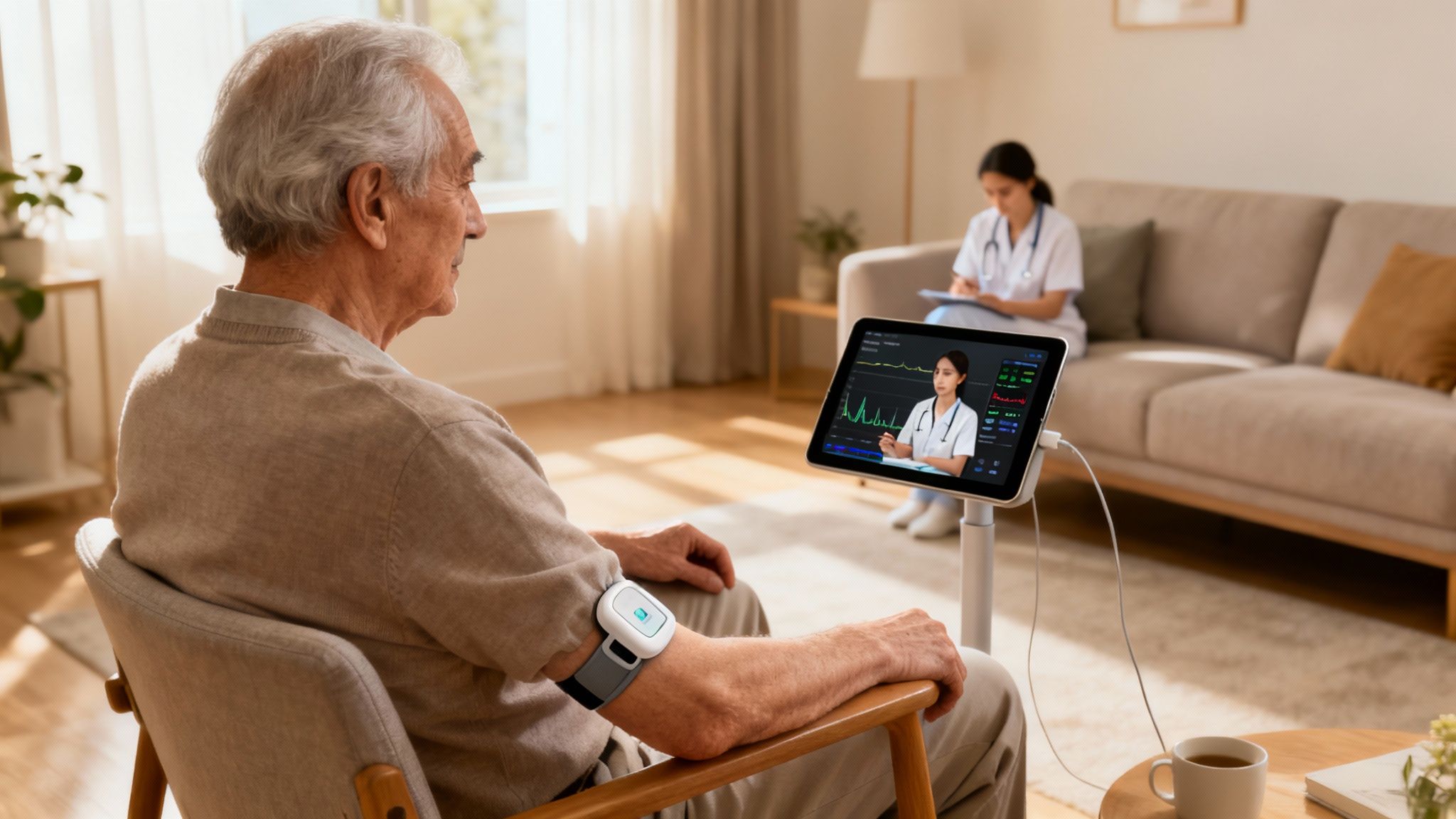
- Solution: Deploy Remote Patient Monitoring (RPM) using IoT devices in the patient’s home (e.g., continuous glucose monitors, smart blood pressure cuffs). These devices automatically transmit vital signs to a central clinical platform, closing the data gap and enabling continuous oversight.
- Outcome: A diabetes management program using CGMs can significantly reduce hypoglycemic events. This proactive model improves patient safety and reduces the financial burden of acute care. The demand is significant; RPM is a primary driver of the global IoT in healthcare market, with some projections showing that these technologies can reduce unnecessary hospital visits by as much as 38%.
Use Case #2: Smart Hospital Operations and Asset Tracking
- Problem: In large hospitals, clinical staff waste significant time—up to an hour per shift—searching for mobile medical equipment like infusion pumps or ventilators. This reduces direct patient care time and contributes to staff burnout.
- Diagnosis: The root cause is a lack of real-time asset visibility. Manual tracking systems are slow, inaccurate, and incapable of managing thousands of mobile assets in a dynamic environment.
- Solution: Implement an IoT-based real-time location system (RTLS). Low-power tags (using BLE or LoRaWAN) are attached to equipment. A network of sensors creates a live map, showing staff the precise location of every tagged asset on a workstation or mobile device.
- Outcome: The business impact is immediate. Search times are reduced from minutes or hours to seconds, freeing up clinical staff. Asset utilization data allows hospitals to optimize fleet size, potentially reducing capital expenditures on new equipment by 10-15%. Automated alerts for preventative maintenance schedules also improve equipment uptime and patient safety.
These use cases prove that IoT healthcare solutions aren’t about adding tech for its own sake. They are highly targeted tools that solve real problems by delivering the right data to the right people, precisely when it matters. To see how these capabilities are being enhanced by even more advanced autonomous systems, explore these groundbreaking agentic AI use cases in healthcare.
Navigating Critical Security and Compliance Risks
Bringing an IoT healthcare solution to market opens a significant front of security and regulatory risks. For technical leaders and decision-makers, addressing these risks is not a final-stage checkbox; it is the foundation of a viable product. Failure here can result in catastrophic data breaches, significant regulatory fines under frameworks like HIPAA, and loss of market access.
Successfully launching requires a two-front strategy: rigorous adherence to regulatory frameworks governing medical technology and a defense-in-depth security posture from silicon to cloud. A security failure is almost always a compliance failure.
Embedding Compliance into the Development Lifecycle
Compliance cannot be an add-on. For medical devices, frameworks like HIPAA, IEC 62304, and ISO 13485 must be integrated into the development process from inception.
- HIPAA (Health Insurance Portability and Accountability Act): This U.S. law mandates protection for patient data. For an IoT solution, this means all Protected Health Information (PHI) must be encrypted in transit and at rest, backed by strong access controls and detailed audit logs.
- IEC 62304: This standard defines the software development lifecycle for medical device software. It enforces a structured, risk-based process for design, coding, testing, and maintenance to ensure patient safety is the primary consideration.
- ISO 13485: This is the quality management system (QMS) standard for medical devices. It requires documented processes for everything from design inputs and risk analysis to supplier management and post-market surveillance, ensuring consistent quality and traceability.
Ignoring these standards is not an option for commercial market entry.
Adopting a Security-by-Design Mindset
The attack surface of a medical IoT device extends from physical tampering to sophisticated cloud breaches. A reactive, “patch-it-when-it-breaks” security model is untenable. A “security by design” philosophy is required, where threats are anticipated and defenses are built into every layer of the architecture.
This process starts with comprehensive threat modeling before a line of code is written.
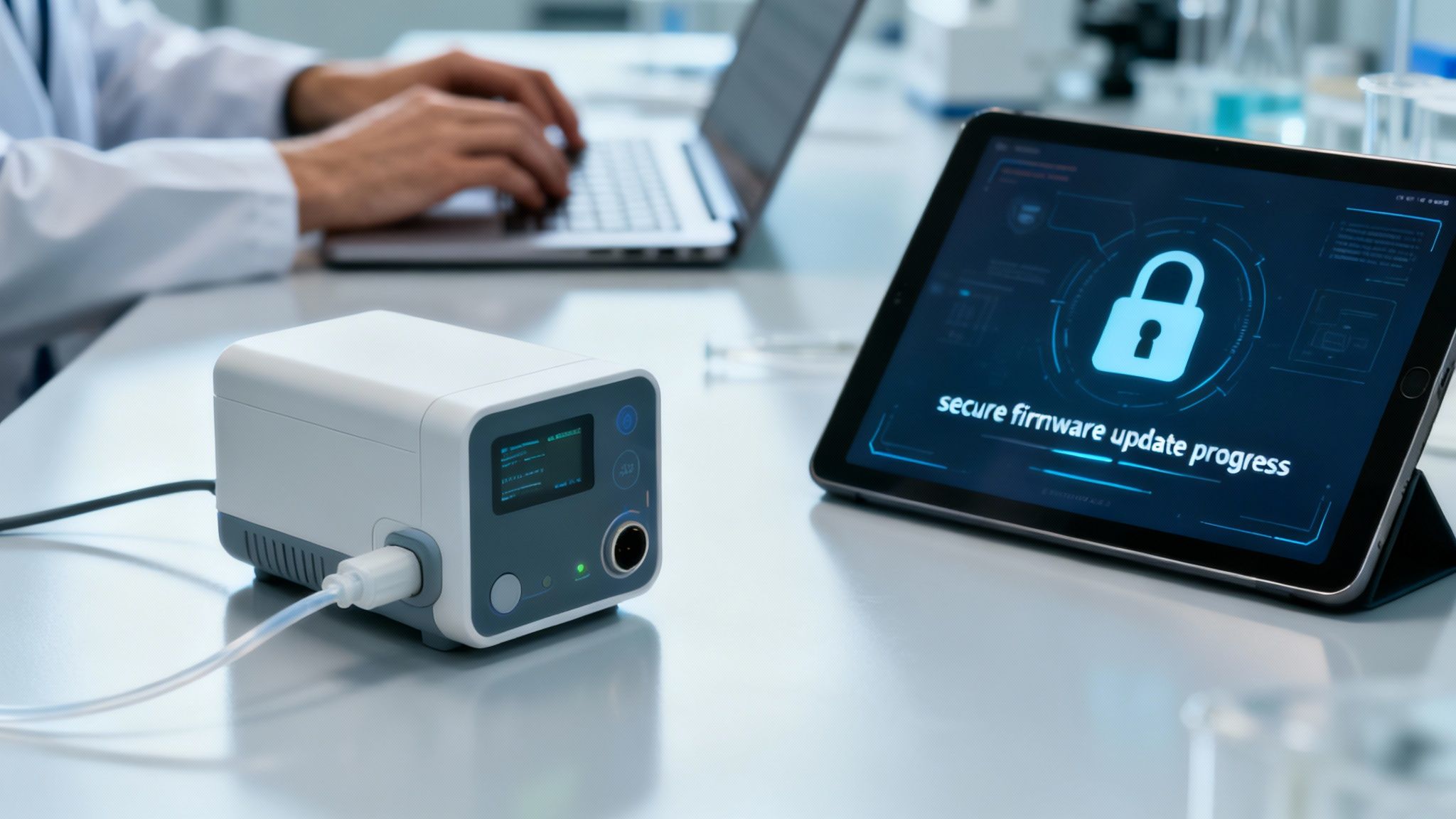
A common failure mode is treating device security as an afterthought. Vulnerabilities in firmware are significantly more difficult and expensive to patch once devices are deployed in the field. A secure boot process, validated by firmware signing, is a non-negotiable first line of defense against unauthorized code execution.
Key security controls include:
- Secure Boot and Firmware Signing: Ensures the device only runs authenticated, untampered firmware, preventing the loading of malicious code.
- End-to-End Encryption: Data must be encrypted from the sensor to the cloud processing endpoint to protect it from interception and ensure confidentiality.
- Robust Identity and Access Management: Every device, user, and API call must be authenticated and authorized based on the principle of least privilege, limiting the blast radius of a potential compromise.
For a deeper technical dive into these crucial measures, our guide on security in embedded systems provides actionable engineering insights.
Ultimately, robust security is not just a technical feature—it’s a core business enabler that builds trust with patients, providers, and regulators.
Your Actionable Roadmap for Implementation
Taking an IoT healthcare solution from concept to a market-ready product is a multi-stage process. Without a structured roadmap, projects are prone to costly rework, schedule overruns, and a final product that fails to solve the intended clinical problem.
This four-stage framework is designed to de-risk development and accelerate time-to-market.
Stage 1: Strategy and Use Case Definition
This initial phase is about alignment. Before any engineering work begins, you must define the why. What specific clinical or operational problem are you solving? What are the business objectives? This requires direct engagement with end-users—clinicians, administrators, and patients—to validate core assumptions.
Key activities include:
- Problem Diagnosis: Specify the precise pain point. For example, reducing 30-day readmission rates for congestive heart failure patients.
- Requirements Gathering: Document all functional and non-functional requirements, from data accuracy and battery life to regulatory constraints under frameworks like IEC 62304.
- Business Case Development: Build a financial model quantifying the expected return on investment (ROI), total cost of ownership (TCO), and the solution’s competitive advantage.
Stage 2: Technology Selection and Prototyping
With a clear strategy, the focus shifts to engineering. Select the components for your technology stack and build a functional prototype to validate the technical approach. This is a critical stage for engaging expert partners to avoid common pitfalls. Decisions on sensors, connectivity protocols (e.g., BLE vs. Cellular), and the edge/cloud processing balance are finalized here. The goal is a “looks-like, works-like” prototype for stakeholder feedback.
For a deeper dive into this vital stage, check out our guide on moving from a prototype to a production-ready product.
Stage 3: Pilot Program and Validation
A prototype proves the technology works in a lab. A pilot program proves it works in the real world. This validation gate involves testing the device in a limited, controlled clinical environment to gather data on performance, usability, and integration with existing workflows.
A common mistake is to get excited by a successful prototype and rush straight into a full-scale launch. The pilot program is your best defense against discovering hidden integration nightmares, fatal usability flaws, and operational friction before they become expensive, large-scale disasters.
Feedback from the pilot is used to refine the device, firmware, and software before committing to mass production.
Stage 4: Scaled Deployment and Operations
This final stage involves transitioning to a full-scale deployment. This requires finalizing the design for manufacturability (DFM), securing the supply chain, and establishing processes for ongoing operations. The “service” component of your IoT solution—including device provisioning, secure over-the-air (OTA) firmware updates, and long-term device monitoring—becomes paramount.
The services segment is a major component of the IoT healthcare market for a reason: implementation and long-term support are complex. Market research indicates strong growth in this area, underscoring the demand for expert services. You can explore more data on IoT in healthcare market trends.
Where Do You Go From Here?
Successfully launching an IoT healthcare solution requires a disciplined integration of strategic vision, rigorous engineering, and operational excellence. The path from concept to a compliant, market-ready device is complex, but the strategic value is undeniable. Connected devices are foundational to a more proactive, efficient, and resilient healthcare system.
Success hinges on a holistic view. It requires a resilient architecture that balances edge and cloud computation, a security-by-design mindset, and a compliance strategy that treats regulations like HIPAA and IEC 62304 as essential guardrails.
Bringing It All Together
The most successful IoT projects are built on a structured path: define the clinical use case, validate with a controlled pilot, and then scale. This methodical approach is the most effective way to de-risk development and ensure the final product delivers a measurable impact for both patients and the business.
The ultimate goal of any IoT healthcare solution is to create a seamless flow of data that helps people make better decisions. That could be a clinician stepping in before a crisis, an administrator optimizing how assets are used, or a patient getting a better handle on their chronic condition. The engineering, security, and compliance are the pillars that make that seamless flow possible.
By embedding these principles into your process, you can build scalable, secure systems that generate real returns, improve patient outcomes, and create a sustainable competitive advantage. The teams that master this integrated approach will lead the future of connected healthcare.
If you are navigating the complexities of building a secure, scalable, and compliant IoT healthcare solution, an initial assessment can help de-risk your project and shorten your path to market.
Frequently Asked Questions
Even with a clear roadmap, implementing an IoT healthcare solution raises critical operational, technical, and financial questions. Here are answers to common challenges faced by decision-makers and engineering leads.
How Do You Actually Make All This New IoT Data Work With Existing Hospital Systems?
This is a critical integration challenge. Hospitals operate on a complex mix of legacy systems (EHRs, PACS, LIS) from various vendors. A flood of new IoT data risks creating more data silos, defeating the purpose of a unified view.
The root of the problem is a lack of universal data standards. While progress has been made with standards like HL7 and FHIR (Fast Healthcare Interoperability Resources), many IoT devices still use proprietary data formats.
The solution is a deliberate interoperability strategy:
- Standardize at the Source: Configure IoT gateways or devices to output data using standards like FHIR from the outset.
- Implement a Translation Layer: Use a middleware platform or cloud ETL service (like AWS Glue or Azure Data Factory) to ingest proprietary data formats and transform them into a standardized format compatible with EHRs and analytics platforms.
- Design with APIs: Build your solution around a secure, well-documented API to allow other systems to pull data in a controlled and consistent manner.
What’s a Realistic Strategy for Going from a Pilot to a Full-Scale Deployment?
Scaling from a 20-device pilot to a 2,000-device enterprise deployment requires a different operational model. Manual processes used during the pilot will not scale. You must plan for scale from day one, focusing on automation.
- Zero-Touch Provisioning: Devices must be able to securely and automatically connect to the network, download configurations, and register with your platform upon power-up, without manual intervention.
- Centralized Device Management: A single platform is needed to monitor fleet health, push secure over-the-air (OTA) firmware updates, troubleshoot issues remotely, and revoke credentials for compromised devices.
- Scalable Cloud Architecture: The backend infrastructure must handle variable data loads. Using serverless architectures and auto-scaling cloud services allows the system to dynamically adjust compute resources to demand, optimizing costs.
How Do We Justify the Cost and Calculate the ROI?
Calculating the return on investment (ROI) for an IoT project requires quantifying both direct cost savings and indirect benefits like risk reduction and improved clinical outcomes.
A rock-solid ROI model has to put a number on both the hard and soft benefits. Hard benefits are easy—things like spending less on rental equipment or cutting down on staff overtime. But the soft benefits, like the value of preventing a single patient fall or the economic impact of lowering hospital readmission rates, are often where the biggest returns are hiding.
A credible business case must include:
- Total Cost of Ownership (TCO): A complete accounting of hardware, software, implementation services, connectivity fees, and ongoing maintenance.
- Operational Efficiency Gains: Quantify the value of time saved by clinical staff (e.g., time no longer spent searching for equipment, multiplied by a fully-loaded hourly rate).
- Cost Avoidance: Calculate savings from preventing adverse events, such as reduced hospital-acquired infections or penalties for readmissions.
- Improved Clinical Outcomes: Model the financial impact of better patient health, such as the economic value of a shorter average length-of-stay or preventing an acute event for a remotely monitored patient.
By combining these value streams, you can build a comprehensive business case that demonstrates the full impact of the investment.
At Sheridan Technologies, we live and breathe the firmware, hardware, and software that power secure, scalable, and compliant IoT healthcare solutions. If you need to de-risk your development process and get to market faster, our team is ready to help you build a solution that delivers real clinical and business value. Schedule a consultation with our engineering leads to talk about your project.