Table of Contents
Your technical teams are buried in repetitive, manual work that’s killing project velocity and inflating operational costs. When we talk about business process automation solutions, we’re referring to the systematic use of technology—Robotic Process Automation (RPA), low-code platforms, and intelligent document processing—to execute recurring tasks and workflows. The goal is to free up engineering talent for the high-value work they were hired to do, reduce risk, and build scalable operational systems.
Moving Beyond Manual Bottlenecks
Many high-stakes engineering environments run on surprisingly manual processes. Firmware testing, supplier qualification, and design document reviews often depend on individuals coordinating through a chaotic mix of emails, spreadsheets, and siloed applications.
This approach doesn’t just create delays; it introduces significant business risk. Human error creeps in. Process visibility disappears. The core problem is that manual workflows are brittle and don’t scale. As project complexity or volume increases, the system breaks down.
Common Failure Points in Technical Operations
Your engineers and operators are hitting these bottlenecks daily, directly impacting speed to market and product reliability.
- Fragmented Supplier Coordination: Manually tracking component lead times, compliance documents (e.g., RoHS, REACH), and purchase orders across dozens of vendors creates delays and increases the risk of using non-compliant parts.
- Repetitive Firmware Test Sequences: Having senior engineers execute hundreds of routine test cases by hand for every build is slow and prone to error. It’s a massive drain on your most valuable resources, pulling them from complex debugging and innovation.
- Manual Document and Drawing Reviews: Circulating CAD files or technical specifications for approval via email invites version control nightmares, missed feedback, and design cycles that stretch on for weeks longer than necessary.
The primary goal of business process automation isn’t just to execute the same tasks faster. It’s to build resilient, repeatable systems that reduce the cognitive load on expert teams, minimize unforced errors, and produce auditable, reliable results.
This strategic shift is a market-wide movement. According to Global Market Insights, the global intelligent process automation market size was valued at USD 14.2 billion in 2023 and is projected to grow at a CAGR of 14.3% from 2024 to 2032. This growth is fueled by organizations recognizing they can no longer afford the cost of workflow inefficiency.
Real-World Scenario: Automating Medical Device Development
A medical device startup developing a new infusion pump faced critical delays. Their supplier coordination process was managed in a single, chaotic spreadsheet. Worse, their firmware validation required two engineers to manually run test scripts for 48 hours after every build, creating a two-day feedback loop that stalled progress.
- Problem: Manual supplier tracking and firmware testing created a severe bottleneck, putting their FDA submission deadlines at risk.
- Diagnosis: The critical path was blocked by low-value, high-volume tasks that were magnets for human error. Key compliance data was scattered across inboxes, and test results were inconsistent.
- Solution: They implemented two targeted business process automation solutions. First, an automation script was built to poll supplier portals for updated lead times and compliance certificates, automatically flagging discrepancies. Second, they used a test automation framework to execute the entire firmware validation suite overnight, triggered automatically by a new code commit.
- Outcome: The changes didn’t just accelerate the timeline; they fundamentally improved the development cycle, contributing to a 30% faster time-to-market. The automated system eliminated data entry errors in compliance tracking and delivered consistent, reliable test results every morning. This strengthened their verification and validation package for regulatory review under frameworks like ISO 13485.
To understand how modern AI extends these capabilities, see this guide to AI-powered workflow automation.
Mapping and Prioritizing Core Workflows
For a technical leader, the operational landscape is a complex web of overlapping workflows: firmware builds, PCB layouts, mechanical prototyping. A rapid mapping exercise can illuminate the highest-volume, most error-prone tasks, providing a clear target for an initial automation sprint. The process involves identifying manual steps, scoring them based on business impact, and ranking the top candidates.
Rapid Process Mapping
You don’t need complex software to begin. A whiteboard and a swimlane diagram are sufficient to capture who does what, their required inputs, and their outputs. It is critical to include both system triggers and manual handoffs.
Here is a practical breakdown:
- List every manual step in the current workflow.
- Note the systems or tools used at each stage and any cross-team dependencies.
- Measure the average cycle time and frequency of each manual task.
- Interview the people performing the work to gather feedback on pain points and common exceptions.
This exercise produces a process map that immediately flags friction points.
| Task | Volume (per week) | Avg. Time (per task) | Notes |
|---|---|---|---|
| Supplier compliance check | 200 | 15 min | High error rate; manual data entry |
| Firmware test result logging | 50 | 30 min | Manual handoff to QA; transcription errors |
Volume and time metrics quickly expose the most inefficient processes.
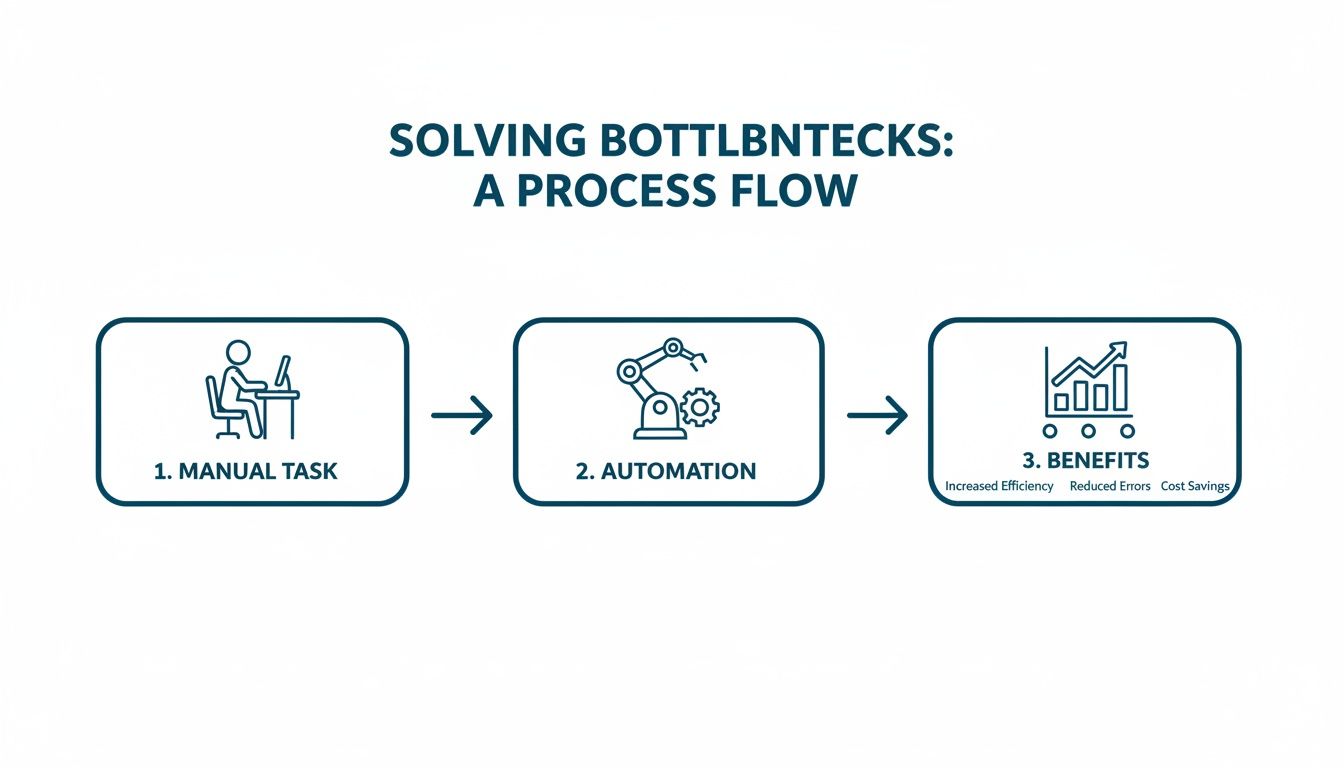
This visual represents the objective: transforming manual handoffs into an efficient, automated flow that reduces error rates and cycle time.
Scoring Workflows for Business Impact
With a map in hand, assign a score to each workflow based on volume, manual time consumed, and error frequency.
- Task Volume: Directly correlates to potential ROI.
- Manual Time: Uncovers hidden labor costs.
- Error Rate: Speaks directly to quality, rework, and risk.
A simple scoring matrix can rank priorities. However, this quantitative data must be balanced with real-world constraints like data access, regulatory compliance (e.g., ISO 13485), and resource limitations. Automating a complex calibration routine requiring deep manual interpretation without weighing the tradeoffs is a common failure mode.
A practical rule is to focus on bottlenecks where you can realistically reduce cycle time by over 30%. That’s where you will see immediate, undeniable impact.
From Diagnosis To Action
Once your top bottleneck is identified, it becomes the target for an initial pilot sprint. Define success metrics, allocate resources, and assign clear ownership.
Examples of high-impact wins include:
- Sensor calibration automation that reduces manual adjustment loops.
- Test sequence handoff orchestration to eliminate delays from communication failures.
- Automated order entry validation that cuts data entry errors by over 50%.
If you’re interested in the specifics of launching such a project, our guide on the discovery phase of a project provides a detailed roadmap. For a structured approach to selecting your first target, using a decision framework for prioritizing which business processes to automate first can be highly effective.
Constraints and Failure Modes
- Informal Workflows: Do not overlook “off-the-books” processes. This is where recurring exceptions hide, and they frequently derail automation pilots.
- Outdated Maps: Ensure process maps are current. An outdated map based on old tools or teams is worse than no map at all.
- Peak Loads: Ignoring peak load conditions that cause error rates to spike can lead to building a brittle system.
- Stakeholder Gaps: Skipping stakeholder interviews almost guarantees an inaccurate map.
Process mapping is not a one-time exercise. Revisit and refine maps regularly to keep automation efforts aligned with operational reality.
Choosing the Right Automation Approach: Build vs. Buy
After pinpointing a process for automation, you face a critical decision: purchase an off-the-shelf platform or build a custom solution. This choice has significant implications for budget, team flexibility, and long-term maintenance.
A vendor solution often promises a faster start. Platforms specializing in Robotic Process Automation (RPA) or intelligent document processing come with pre-built connectors and interfaces designed for rapid deployment. However, that speed can come at the cost of flexibility and the risk of vendor lock-in.
Conversely, building a custom solution provides complete control—the only way to achieve a perfect fit for a specialized workflow or one core to your intellectual property. You can design the automation engine to integrate flawlessly with existing systems. The tradeoff is a longer initial build time and a greater maintenance burden on your engineering team.
Making the Call: A Strategic Decision
Deciding which path to take requires weighing several factors beyond the upfront price tag.
| Criteria | Vendor Platforms (Buy) | Custom Development (Build) |
|---|---|---|
| Time to Deploy | Faster initial setup (weeks to months) | Slower initial build (months to a year+) |
| Total Cost | Lower upfront cost, recurring licensing fees | Higher upfront development cost, no licensing fees |
| Flexibility | Limited to platform capabilities and APIs | Infinitely customizable to specific needs |
| Maintenance | Handled by vendor; updates can be disruptive | Managed in-house; requires dedicated resources |
| Scalability | Often tied to tiered pricing models | Scalability is designed into the architecture |
| Competitive Edge | Levels playing field; not a differentiator | Can create durable, proprietary advantages |
Vendor platforms offer speed for common problems, while custom solutions provide control for unique, strategic challenges.
Real-World Tradeoff Scenario
Consider an industrial OEM with two distinct automation needs. First, processing thousands of standardized supplier invoices monthly. Second, automating a quality control workflow for its IoT-enabled machinery, a process involving proprietary sensor data and custom alert logic.
- Problem: The invoice process is a generic, high-volume task. The QC workflow is unique, mission-critical, and tied directly to their competitive edge.
- Diagnosis: A one-size-fits-all approach is suboptimal.
- Solution: For invoice processing, a leading RPA tool is the logical choice. The process is standard, deployment is fast, and ROI is almost immediate. For the IoT workflow, building a custom engine is superior. It allows for a secure, highly optimized system that fits their unique operational needs without exposing sensitive machine data to a third-party platform.
- Outcome: A hybrid strategy maximizes ROI and protects strategic assets.
Key Insight: A hybrid approach is often optimal. Use vendor tools for standardized processes and reserve custom development for proprietary workflows that create a competitive advantage. For a deeper dive, explore our insights on software development consulting.
This hybrid strategy aligns with market trends. The intelligent process automation (IPA) market is projected to grow significantly, fueled by AI and machine learning. This enables companies to automate complex, domain-specific tasks in areas like embedded systems and manufacturing—where custom solutions excel. Discover more insights about the intelligent process automation market.
Diagnosing Common Failure Points
- Vendor Lock-in: Over-reliance on a single vendor’s proprietary tools can make it costly and difficult to switch or integrate with other systems.
- Scope Creep (Custom Builds): Without disciplined project management, a custom solution’s features can spiral, exceeding deadlines and budgets.
- Weak Change Management: A brilliant tool is useless if teams are not prepared for new automated workflows and do not adopt them.
The decision should be based on your organization’s core competencies. If geared for rapid operational rollouts, a vendor platform may be suitable. If you have a strong in-house engineering team and the process is central to your business, a custom build is likely the better long-term investment.
Integrating Automation with Your Existing Platforms

The real power of business process automation solutions is unleashed only when they are integrated into core operational platforms—your ERP, PLM, and MES. This involves building resilient data pathways between systems that were not designed to communicate. Success creates an intelligent, cohesive workflow; failure results in a brittle, error-prone system that becomes a maintenance nightmare.
Architecting Resilient Integrations
When connecting a new automation tool to a legacy system, the top priority is building a connection that will not break when the underlying systems change.
- Use Versioned API Endpoints: Always connect to a specific, versioned API (e.g.,
/api/v2/inventory). Tying automation to a generic endpoint is a liability; the vendor can and will make breaking changes. - Build a Translation Layer: Use middleware or an integration platform to act as a translator between systems. This decouples your automation from the specific data fields in your ERP or PLM. If one side changes, you only update the map, not the entire process.
- Implement a Secure API Gateway: All traffic between systems should pass through a single, secure gateway for authentication, rate limiting, and logging. This provides centralized control and monitoring, critical for security and compliance.
Avoid “point-to-point spaghetti,” where every system is directly wired to every other. A hub-and-spoke or event-driven architecture is far cleaner. Systems communicate with a central bus, not directly with each other, simplifying maintenance and scaling.
Real-World Use Case: Medical Device Quality Control
A medical device client operating under strict ISO 13485 regulations faced a bottleneck in their quality inspection process. A technician would take measurements from a test rig and manually enter the data into the quality module of their MES.
- Problem: Manual entry was slow, tedious, and a compliance risk. A single typo could create a major issue in the Device History Record (DHR) during an audit.
- Diagnosis: A complete air gap existed between the test equipment and the system of record.
- Solution: We built an automation workflow. A script on the test rig’s controller captured measurement data in real-time and pushed it to a secure API. The API then formatted the data and injected it directly into the MES, creating an accurate inspection record.
- Outcome: The integration eliminated manual data entry, reducing a 15-minute task to under 10 seconds. More importantly, it guaranteed data integrity for the DHR, reducing audit risk and strengthening their compliance posture.
Managing Integration Risks and Constraints
- Data Schema Drift: This occurs when a system’s data structure changes without notification to dependent systems. A translation layer and robust error handling are essential mitigations.
- Security Vulnerabilities: Every API is a potential attack vector. Use secure gateways and adhere to the principle of least privilege—grant an integration only the minimum permissions required. For complex architectures, engaging specialists in managed IT services is often prudent.
- Change Management Failure: Technology is only one part of the solution. If users do not adopt the new process, the project will fail.
- Early Alignment: Bring system owners (ERP, PLM, MES) together before development begins to agree on goals, data ownership, and support responsibilities.
- Role-Specific Training: Show users how their specific daily tasks will change. Make it relevant to their job.
- Phased Rollout: Start with a pilot group or a single product line to work out issues in a controlled environment and build momentum.
Measuring Impact and Scaling Automation
Launching your first automation is the starting line, not the finish. Without clear metrics, an initiative is likely to stall as a niche pilot. The goal is to move from isolated wins to a scalable program by tracking the right KPIs to build a solid business case for expansion.
Leading and Lagging Indicators for Business Impact
Effective measurement dashboards balance two types of metrics to provide a complete picture of performance.
Leading Indicators (Operational Metrics): Real-time measures of how the automation is functioning. They are your early warning system.
- Task Throughput: Transactions processed per hour/day.
- Cycle Time Reduction: The delta between pre- and post-automation process completion time. A 40% reduction is a strong initial target.
- Error Rate Improvement: The percentage drop in manual errors, directly impacting rework costs and quality.
Lagging Indicators (Financial Metrics): The metrics that confirm long-term value and are essential for calculating ROI.
- Cost Savings: Calculated from reduced labor hours, lower error-related costs, and decreased material waste.
- Cost Per Transaction: Total process cost divided by the number of transactions; should trend downward.
- Return on Investment (ROI): Compares the net profit from automation against its implementation and ongoing maintenance costs.
The most effective dashboards visually link these indicators. A chart showing how increased task throughput (leading) correlates with a falling cost per transaction (lagging) tells a powerful story.
Real-World Scenario: Scaling Automation at an OEM
An industrial OEM client successfully deployed five targeted business process automation solutions in their supply chain and quality departments. The initial pilots were successful, but they hit a wall.
- Problem: The first automations were siloed. The executive team was hesitant to approve more investment without a clear, scalable ROI model.
- Diagnosis: The project lead was reporting task-level metrics but had not connected them to broader operational expenditures (OPEX). They needed to show how scaling from five to fifty bots would impact the bottom line.
- Solution: We helped them establish a governance model to manage the automation pipeline. New processes were evaluated using a standardized scoring system that prioritized both impact and feasibility. Using the initial pilots as a baseline, they projected cost savings across a new batch of 50 processes.
- Outcome: Over the next twelve months, the team scaled from five to 50 automated processes. The cumulative effect was a 20% reduction in departmental OPEX, securing executive buy-in for a company-wide rollout.
Managing Tradeoffs and Governance for Scale
Scaling introduces new complexities. A lightweight Center of Excellence (CoE) can provide necessary oversight without becoming a bureaucratic bottleneck.
- Speed vs. Governance: Without centralized review, you risk creating a chaotic mess of unmanaged, undocumented bots, which creates significant technical debt.
- Maintenance Backlog: As the automation portfolio grows, so does the maintenance burden. Budget proactively for this; a common rule of thumb is to allocate 15-20% of the initial development cost annually. Failure to do so results in brittle automations that erode trust in the program.
Next Steps: From Analysis to Action
Successful business process automation follows a logical path: analyzing high-impact workflows, making a strategic build-vs-buy decision, integrating with core systems like ERP and PLM, and measuring business impact. The journey transforms operations from reactive and manual to proactive and systematic. However, it is not without risks, including resistance to change, technical debt from poorly managed pilots, and overlooked security gaps.
Chart Your Course
Here are immediate, actionable next steps:
- Initiate an Automation Audit: Select a top-ranked process candidate for deep analysis. A proper audit will validate assumptions or uncover hidden complexities before significant resources are committed.
- Launch a Focused Pilot: Execute a small-scale, tightly-scoped pilot. This low-risk sandbox allows you to test the solution, gather real-world performance data, and build momentum with an early win.
- Assemble a Cross-Functional Governance Team: Create a small group of stakeholders from operations, IT, and business units to oversee the pilot and plan for scaling.
Your first automation project sets the tone for everything that follows. A well-defined, quick win is infinitely more valuable than a speculative “big bang” project. It builds credibility and proves the concept with tangible results.
An expert assessment can accelerate this process and mitigate common risks. A consultation with Sheridan Technologies can help you audit workflows, define a pilot scope, and build an automation strategy designed to scale.
Common Questions from Technical Leaders
When exploring business process automation, several critical questions consistently arise.
How Should We Estimate the Total Cost of Ownership (TCO)?
An accurate TCO calculation must account for costs beyond the initial software license or development bill.
- Implementation and Integration: Account for the internal and external hours spent on system integration, data migration, and initial workflow configuration. For complex ERP or PLM integrations, this can represent 30-50% of the first-year cost.
- Ongoing Maintenance and Support: Budget 15-20% of the initial project cost annually for vendor support contracts or dedicated engineering time for bug fixes and updates.
- Training and Change Management: This includes creating documentation, running role-specific workshops, and providing post-launch support to ensure process adoption.
What Are Realistic ROI Timelines for Automation?
The timeline depends on the complexity of the process being automated.
- Simple, high-volume tasks: ROI is often achievable in under six months.
- Complex, cross-functional workflows: A 12- to 18-month timeline is more realistic before seeing a net positive financial impact.
A medical device manufacturer automated its Device History Record (DHR) compilation. By eliminating manual data entry errors, they reduced audit preparation time from weeks to days. The ROI was realized in under 10 months, primarily from risk reduction and recaptured engineering hours.
A well-defined pilot project is the best strategy. Select a high-impact, low-complexity process to score a quick win, demonstrate value, and build the momentum needed for larger projects with longer payback periods.
Navigating automation demands a clear strategy. Sheridan Technologies provides targeted assessments to help map your workflows, calculate a realistic TCO, and build a phased implementation roadmap that delivers measurable results.
To start your automation journey with a clear path forward, Schedule a brief, no-obligation consultation.