Table of Contents
Software development consulting services are often miscast as a way to hire temporary coders. This view misses its strategic function: to de-risk complex projects, accelerate speed-to-market, and scale technical capability without the long-term overhead of permanent hires. Used correctly, it transforms a development budget from a cost center into a competitive advantage.
Why Software Development Consulting is a Strategic Decision
For leaders in high-stakes fields like medical devices, robotics, or aerospace, internal teams operate under immense pressure. Projects often stall due to niche skill gaps, unforeseen architectural challenges, or the friction of navigating complex regulations. This isn’t a symptom of a weak team; it’s the reality of resource constraints in demanding environments.
Software development consulting provides the focused, external expertise needed to break through these roadblocks. A high-value consultancy acts as a strategic partner, deploying specialized knowledge to solve specific, high-impact problems that an internal team is not equipped to handle alone.
From Tactical Fix to Strategic Advantage
Viewing consulting as a tactical fix—a contractor to fill a seat—undervalues its potential. The true return on investment comes from leveraging consultants to execute projects that would otherwise be too risky, slow, or resource-intensive. For example, a primary reason to engage experts is to build applications on a solid security foundation, mastering software development security best practices to mitigate vulnerabilities before they manifest.
The strategic benefits are measurable:
- Risk Reduction: Consultants with deep domain experience, such as in IEC 62304 for medical devices, implement a compliant development lifecycle from the outset. This significantly reduces the risk of regulatory rejection, a potentially catastrophic business event.
- Accelerated Market Entry: Specialized teams can be deployed to rescue a stalled project or rapidly execute a well-defined MVP, compressing timelines in ways that internal teams juggling multiple priorities cannot.
- Cost and Overhead Control: You gain access to elite talent for critical project phases without the long-term financial commitment of full-time salaries and benefits, preserving organizational agility.
This strategic shift is reflected in market trends. The global software consulting market is projected to grow from USD 393.56 billion in 2025 to USD 1,143.30 billion by 2034, at a CAGR of 12.58%. This growth underscores the increasing reliance on external specialists to navigate intense competition and technical complexity, particularly in mature sectors like North American finance, healthcare, and manufacturing. A detailed analysis is available in this software consulting market growth report from Precedence Research.
Use Case: Medical Device Firmware Rescue
- Problem: A medical device startup’s flagship connected infusion pump fails pre-submission testing. The in-house team excels at application software but lacks deep expertise in low-level firmware and embedded systems. The project is behind schedule with critical architectural flaws compromising data reliability.
- Diagnosis: An external consultancy conducts a technical audit. They immediately identify firmware race conditions and a software development lifecycle (SDLC) that fails to meet IEC 62304 requirements. The documentation is inadequate for a regulatory audit.
- Solution: The consultants refactor the unstable firmware modules to eliminate race conditions, implement a compliant SDLC with rigorous, FDA-compliant testing protocols, and generate the necessary documentation for the submission package.
- Outcome: The product passes validation, achieves regulatory clearance, and launches on schedule. The company secures its market position by deploying the right expertise at the critical moment.
Structuring the Engagement: Services and Models
Selecting a software development consulting partner requires aligning the engagement model with project objectives, risk tolerance, and scope definition. A mismatch in this area is a common cause of budget overruns, missed deadlines, and friction between internal and external teams.
Engagements typically fall into one of three models, each suited for a different problem set. Identifying the correct model is the first step toward a successful partnership.
Types Of Consulting Services
The appropriate service model is dictated by the end goal—whether you need a strategic roadmap, a team to execute a specific build, or targeted expertise to augment your existing staff.
- Strategic Advisory: For high-level planning: technology roadmaps, architecture audits, feasibility studies, and process optimization. The objective is to establish a solid technical and strategic foundation before committing to full-scale development.
- Project-Based Execution: The classic model for a defined outcome: an MVP, a modernized legacy system, or a hardware prototype. The client defines the “what,” and the firm owns the “how,” managing the project from inception to completion.
- Staff Augmentation: Best used when a solid plan and strong internal leadership are in place, but specific skill gaps or capacity constraints exist. Consultants embed within the client’s team, reporting to internal managers to fill a temporary need.
This decision tree helps clarify when to engage a consultant based on internal skill gaps.
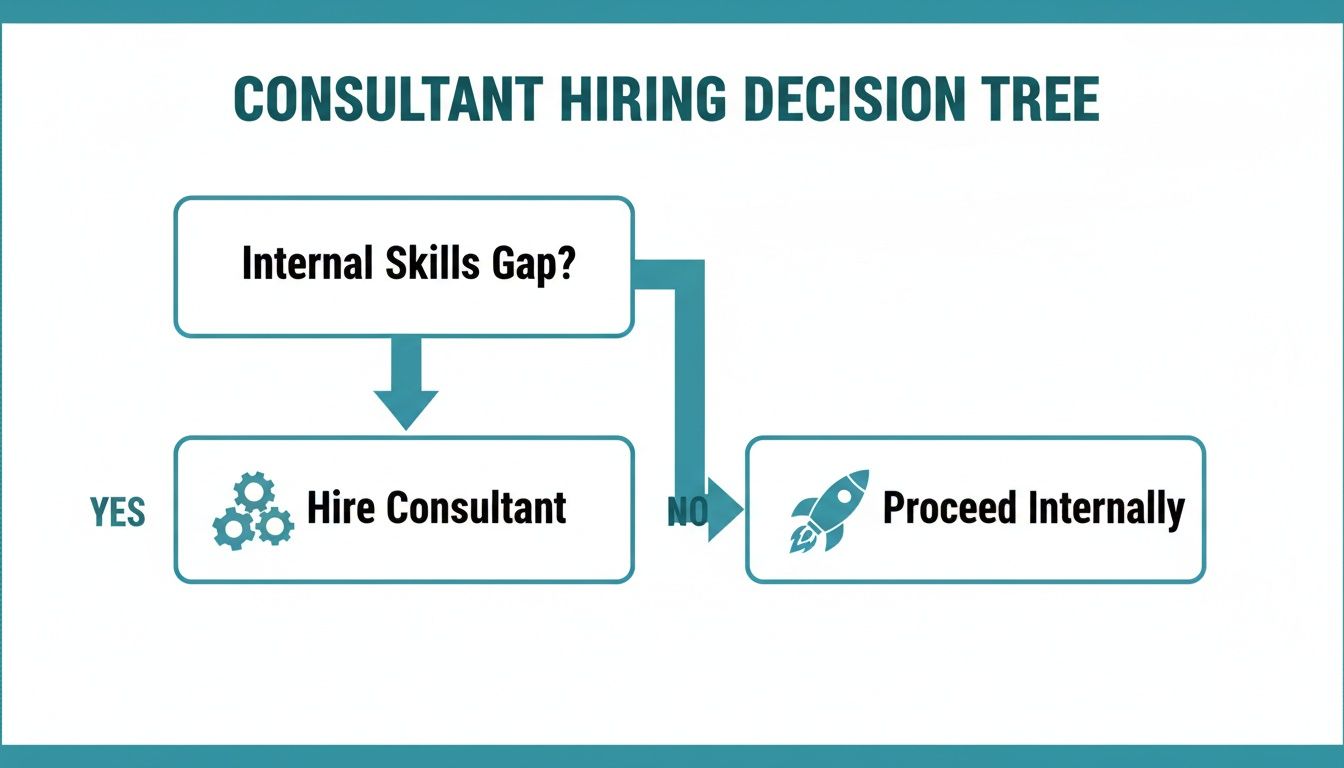
The flowchart reinforces a key principle: consulting is a strategic response to a specific, identified gap in capability or capacity, not merely an alternative to direct hiring.
Common Engagement Models and Their Tradeoffs
After defining the type of help needed, the next decision is the commercial model, which dictates how risk is allocated between the client and the consulting firm. For a broader view on engagement structures, it’s useful to examine adjacent fields like sales enablement consulting, which also emphasizes structuring engagements to achieve specific business outcomes.
A core tenet of successful consulting is aligning the commercial model with the project’s level of uncertainty. Forcing a fixed-price model onto an R&D project with undefined scope is a recipe for conflict.
The table below breaks down the most common models, highlighting their optimal use cases and inherent risks.
Comparing Software Consulting Engagement Models
This table outlines the tradeoffs between common engagement models, enabling decision-makers to select the best fit for their project’s scope, budget, and flexibility needs.
| Engagement Model | Best For | Key Advantage | Potential Risk |
|---|---|---|---|
| Fixed-Price | Well-defined projects with stable requirements, such as a specific feature build or a version-one MVP. | Budgetary certainty. The total cost is known upfront, simplifying financial planning and stakeholder approval. | Inflexibility. Scope changes require formal, often slow and costly, change orders. May incentivize the vendor to cut corners to protect margins. |
| Time & Materials (T&M) | Projects with evolving requirements, R&D initiatives, or where the full scope is undefined at the outset. | Maximum flexibility. Allows for pivoting priorities, refining features, and adapting to new information as the project progresses. | Budgetary uncertainty. Costs can escalate without rigorous scope management. Requires strong project governance and high trust. |
| Retainer | Ongoing needs for advisory services, system maintenance, or access to a specialist for a predetermined number of hours per month. | Guaranteed access to expertise. A dedicated resource is available without the overhead of a full-time employee. | Potential for underutilization. Unused hours may be forfeited, leading to payment for idle time. Requires clear, ongoing objectives. |
Each model serves a distinct purpose. The key is to match the model to the project’s reality, not vice versa.
Use Case: T&M for R&D vs. Fixed-Price for MVP
- Problem: A robotics startup must develop a novel perception algorithm for its warehouse robot. The technology is experimental, and the path to achieving performance targets will involve significant trial and error.
- Diagnosis: A fixed-price model is unsuitable. Accurately estimating the effort required is impossible. A vendor would either have to price in a massive risk premium or would be incentivized to deliver a suboptimal solution to stay within budget.
- Solution: The team selects a Time & Materials (T&M) engagement structured in two-week sprints. This allows the product owner to set priorities for each sprint based on the previous one’s findings, enabling the consulting team to focus on technical innovation without being constrained by a rigid scope.
- Outcome: The T&M model provides the necessary agility for a complex R&D project. While the final cost is not predetermined, it is directly correlated with progress, allowing the startup to steer development toward the most viable solution based on empirical results.
The Business Impact of Strategic Consulting
Engaging a software development consultant is an investment in business outcomes, not just lines of code. Technical proficiency is table stakes; the real value is measured in risk mitigation, speed-to-market, and cost control. The critical question for a decision-maker is not, “What will they build?” but, “What tangible business results will this engagement drive?”
The right consultant transforms a project from a cost center into a strategic investment with a defensible ROI.
Mitigating Risk Before It Derails Your Project
In high-stakes industries, a single technical or regulatory oversight can derail timelines and budgets. Strategic consulting proactively addresses these risks by integrating deep domain knowledge and proven methodologies from day one.
This proactive strategy includes:
- Design for Manufacturability (DFM): Ensuring a hardware product is designed for efficient, cost-effective production to prevent expensive re-tooling and component sourcing issues.
- Design for Testability (DFT): Architecting diagnostics and testing frameworks into the system, which is critical for validating complex firmware in regulated environments like medical devices (IEC 62304) or aerospace (DO-178C).
- Architectural Audits: Identifying and resolving potential bottlenecks in scalability, security, or performance before significant code is written, thereby averting costly, late-stage refactoring.
By front-loading risk analysis and implementing robust design principles, organizations reduce the likelihood of late-stage failures that threaten project viability. This is particularly crucial in sectors where a product recall or regulatory rejection can have severe financial and reputational consequences.
Accelerating Speed To Market
Time is a non-recoverable resource. In competitive markets, speed is often a primary determinant of success. Consultants act as a catalyst, compressing timelines that internal teams, constrained by competing priorities, cannot achieve.
Deploying a specialized team to a stalled project enables rapid root-cause analysis and execution of a focused rescue plan. This ability to deploy experts on demand, bypassing hiring and onboarding delays, can shorten project schedules by months. This acceleration is a key driver of many successful digital transformation solutions.
Controlling Costs Through Precision and Flexibility
The most expensive error in software development is building the wrong product, followed closely by having to rebuild due to poor initial planning. Consulting helps control costs by ensuring the right expertise is applied at the right time, minimizing rework and maximizing the value of every dollar invested.
Enterprise software development represents a significant portion of this landscape, projected to capture a 39.4% share of the USD 524.16 billion global market in 2025, which is expected to nearly double by 2032. This growth highlights the vital role of expert consulting in translating business vision into reality. In regulated industries, optimizing for testability and manufacturability from the outset can reduce downstream costs by as much as 30%. More data is available from the software development market from Coherent Market Insights.
Use Case: Industrial IoT Modernization
- Problem: An industrial equipment manufacturer’s legacy control system is unreliable, inhibiting the integration of modern IoT features. This results in frequent downtime and blocks potential revenue streams.
- Diagnosis: A consultant’s audit reveals a monolithic architecture and obsolete components, making incremental updates unfeasible.
- Solution: The consulting partner develops a phased modernization strategy, starting with a new, stable firmware base and incrementally adding IoT connectivity. A flexible team of embedded systems and cloud specialists is deployed to execute the plan.
- Outcome: The manufacturer is able to support existing customers while developing new capabilities. The project reduces the original development timeline by 40% and is projected to cut future maintenance costs by 25%, transforming a high-risk overhaul into a controlled, value-driven initiative.
Consulting Use Cases in High-Stakes Industries
The value of specialized software development consulting services is most evident in high-stakes, regulated industries like medical devices, robotics, and aerospace, where a single software failure can have catastrophic consequences. These environments demand deep, domain-specific expertise.

Medical Devices: Rescuing a Stalled FDA Submission
- Problem: A medical device company’s FDA 510(k) submission for a new diagnostic imager is blocked. The firmware, ported from a legacy device, is failing validation. The in-house team lacks deep experience with the IEC 62304 standard, and their documentation is not audit-ready. The project is six months behind schedule, burning capital and jeopardizing the company’s market position.
- Diagnosis: An external consulting team conducts a rapid technical audit. They identify critical gaps in the Software Development Life Cycle (SDLC), including a lack of unit testing, no formal risk analysis as required by ISO 14971, and poor requirements traceability. The firmware is plagued by race conditions causing intermittent data corruption—a critical failure for a diagnostic device.
- Solution: The consultants implement a compliant, audit-ready SDLC. They introduce automated testing frameworks, conduct the missing formal risk analysis, and refactor the firmware to eliminate race conditions. They generate the detailed documentation required to demonstrate regulatory compliance. For more on this topic, see our guide on navigating the complexities of medical device development services.
- Outcome: The project is turned around, passing all internal verification and validation tests. The complete, compliant submission package is cleared by the FDA, allowing the company to avoid further delays, launch its product, and meet its revenue targets.
Robotics: Accelerating Warehouse Automation
- Problem: A robotics startup is developing an autonomous mobile robot (AMR) for warehouse logistics. Their software team excels at cloud-based fleet management but struggles with low-level mechatronics. Integrating the perception system with motor controllers is proving difficult, causing them to miss deadlines with a key pilot customer.
- Diagnosis: A consulting partner with expertise in robotics and embedded systems identifies the root cause: a poorly designed communication protocol between the main processor and the microcontrollers. Furthermore, the motor control board is not using a hard real-time operating system (RTOS), resulting in unpredictable latency.
- Solution: The consultants architect and implement a robust, low-latency communication bus using an industrial-grade protocol. They port the motor control firmware to a suitable RTOS to guarantee deterministic performance. This allows the startup’s team to focus on their core competency—high-level fleet logic—while the consultants solve the complex mechatronic integration.
- Outcome: The robot’s performance and reliability improve dramatically. The startup successfully completes its pilot program, secures a multi-year contract, and is well-positioned for its next funding round. The engagement shortens their time-to-market by an estimated nine months.
How to Select The Right Consulting Partner
Choosing a software development consulting partner is a critical decision. The right partner acts as a force multiplier, mitigating risk and clearing the path to success. The wrong one can lead to budget overruns, missed deadlines, and product failure.
A rigorous vetting process is essential, focusing on three areas: verifiable technical depth, process maturity, and genuine understanding of your business context.

Assessing True Technical Depth
Technical expertise must be a precise match for your project’s needs. A generalist firm is rarely equipped for complex, high-stakes development.
Probe their skills with specific questions:
- Specialists vs. Generalists: Can they demonstrate a deep, proven track record in your specific technology stack, such as embedded C++ or high-reliability firmware, or are they a “we do everything” shop?
- Team Composition: Who will actually be performing the work? Insist on speaking with the senior engineers who will be assigned to your project, not just the sales team.
- Relevant Experience: Request case studies for projects with similar technical challenges, architecture, and constraints. A team that has only built web applications is not prepared to develop a hard real-time robotics controller.
Evaluating Process Maturity and Governance
A brilliant engineering team with a chaotic process will deliver a chaotic product. Process maturity, especially in regulated industries, is a strong indicator of their ability to deliver reliable, maintainable, and compliant software.
A mature consulting partner can articulate their development lifecycle with precision. They don’t just claim to be “agile”; they can detail their specific approach to risk management, documentation, and quality assurance, referencing frameworks like ISO 13485 or DO-178C where relevant.
Evaluate their project management and quality control methodologies. A well-defined discovery phase of a project is a positive signal, indicating they prioritize alignment and risk identification before development begins.
Gauging Business and Industry Acumen
The best consultants understand they are solving a business problem, not just a technical one. This requires an understanding of your market, customers, and operational environment.
A partner with strong business acumen will:
- Ask insightful questions about your business objectives and ROI expectations.
- Demonstrate knowledge of your industry’s specific challenges, from supply chain constraints to regulatory landscapes.
- Proactively discuss the trade-offs between cost, speed, and features within the context of your business goals.
If their focus is exclusively on technology and they show little interest in the “why” behind the project, it’s a red flag. They may deliver a functional product, but not necessarily a successful one.
Red Flags to Watch For
Identifying warning signs early can prevent a failed partnership. Be vigilant for these common red flags during the vetting process.
Vendor Vetting Red Flags
| Red Flag | Why It’s a Problem | What to Look For Instead |
|---|---|---|
| Vague Proposals | A proposal lacking specific deliverables, timelines, and milestones suggests a lack of diligence or may be an attempt to obscure future costs. | A detailed Statement of Work (SOW) with phased deliverables, clear success metrics, and a transparent pricing model. |
| Over-reliance on Junior Talent | The “bait-and-switch” where senior talent is presented during the sales process but junior developers perform the work, leading to quality and schedule issues. | A clear staffing plan that names the senior-level architects and engineers dedicated to your project. |
| Inability to Discuss Failure | A firm unwilling to discuss past projects that encountered difficulties is either inexperienced or lacks transparency. Failure provides valuable lessons. | An honest discussion about past challenges, the lessons learned, and the risk mitigation strategies now in place. |
| One-Size-Fits-All Process | An insistence on a rigid process indicates an inability to adapt to your project’s specific context, regulatory requirements, or team dynamics. | A flexible yet structured methodology that can be tailored to your project’s unique requirements and constraints. |
Ultimately, identifying these warning signs is about protecting your investment. A transparent, experienced, and adaptable partner will welcome tough questions and have solid answers ready.
Our Partnership Approach to Project Success
Engaging a software development consulting partner is more than filling a technical gap; it’s about securing a team that actively de-risks your project and is accountable for its successful launch. True partnership transcends staff augmentation; it involves embedding experts who operate as a fully invested extension of your own team.
This philosophy guides our approach. Instead of a static bench of generalist developers, we utilize a Dynamic Expert Network to assemble elite, on-demand teams with specialists precisely matched to each phase of your project. This flexible model allows us to deploy the exact expertise required—from an embedded C++ specialist to a regulatory compliance expert—at the precise moment it’s needed, without the financial drag of a large, fixed team.
The Sheridan Technologies Engagement Workflow
Our process is designed to ensure success by front-loading critical thinking and establishing measurable goals before development begins. Each partnership follows a structured, transparent path to eliminate ambiguity and deliver maximum value.
This workflow functions as a risk-mitigation framework. By validating assumptions early and maintaining tight feedback loops, we avoid the costly rework and scope creep that frequently derail complex hardware and software projects.
Our engagement structure typically includes:
- Initial Technical Assessment: We begin with a deep-dive session led by a senior engineer to understand both the technical requirements and the underlying business drivers. This initial audit identifies immediate risks, architectural weaknesses, and opportunities for optimization.
- Strategic Roadmapping: Based on the assessment, we co-create a detailed Statement of Work (SOW) that outlines phased deliverables, clear milestones, and explicit success criteria. This serves as a shared blueprint for success, aligning all stakeholders.
- On-Demand Team Assembly: We select a project team from our network of vetted specialists. A single, accountable program lead serves as your dedicated point of contact, coordinating all aspects from firmware and hardware to suppliers and contract manufacturers.
- Agile Execution & Transparent Reporting: We operate in focused sprints with regular, candid communication. You receive full visibility into progress, challenges, and budget status, ensuring no surprises. Our focus is on tangible delivery, not just billable hours.
- Seamless Handover & Support: Upon project completion, we ensure a smooth transition, providing comprehensive documentation, conducting knowledge transfer sessions with your in-house team, and establishing any necessary ongoing support to ensure the product’s long-term success.
Our end-to-end service model—from initial firmware development to design-for-manufacturability and supply chain readiness—is built on a single principle: achieving a successful outcome, not just completing a task. We integrate robust design-for-test principles from day one, ensuring the final product is reliable, compliant, and ready for the market.
This partnership approach transforms consulting from a service into a strategic asset, providing the technical capability, process discipline, and business acumen required to turn your most challenging projects into significant successes.
Straight Answers to Tough Questions
When considering a consulting partner, practical questions about intellectual property and cost are paramount.
Who Owns the Intellectual Property?
This is a non-negotiable term that should be clearly defined in the Master Services Agreement (MSA) or Statement of Work (SOW). The standard and proper arrangement is that the client owns 100% of the intellectual property (IP) created specifically for the project upon final payment.
The nuance lies in “background IP.” An experienced firm will often leverage its pre-existing libraries, tools, or frameworks to accelerate development. This is beneficial, saving time and cost. The contract should grant the client a perpetual, royalty-free license to use this background IP as an integrated part of the final delivered product. The firm retains ownership of its tools, but you gain unrestricted rights to use the system they built for you.
What Really Drives Project Cost?
The cost of a consulting engagement is primarily determined by three factors: team composition, project duration, and risk allocation.
- Team Composition: The blend of principal architects, senior engineers, and niche specialists directly impacts the rate. You are paying for experience, which translates to speed and quality.
- Duration and Scope: A tightly defined, three-month project has a more predictable cost than a year-long R&D initiative with evolving requirements.
- Risk Allocation: A fixed-price contract inherently costs more because the consulting firm assumes the risk of unforeseen complexities. Conversely, a Time & Materials (T&M) model shifts that risk to the client, which is why the hourly rates are typically lower.
A common mistake is to focus solely on the hourly rate. The true measure of value is the total project cost relative to the outcome. An expert team that costs 30% more per hour but delivers in half the time with minimal defects provides a significantly higher ROI.
Your project’s success hinges on deploying the right expertise at the right time. Sheridan Technologies specializes in assembling elite, on-demand teams to de-risk complex technical challenges and ensure you get it right the first time.
If you are facing a technical hurdle or need to validate a new product concept, let’s have a pragmatic discussion. Schedule a complimentary Project Rescue Assessment or Technical Feasibility Audit with one of our senior engineers today.