Table of Contents
AI solutions for small businesses are no longer a future-state luxury; they are operational tools that drive efficiency, reduce risk, and create a competitive advantage. For technically literate leaders and operators managing constrained resources, AI offers a direct path to automating low-value workflows, improving forecast accuracy, and augmenting team capabilities without a linear increase in headcount. This guide provides a pragmatic framework for evaluating and implementing AI solutions that deliver measurable business impact.
Why AI Is a Strategic Imperative, Not a Tech Trend
For years, the conversation around artificial intelligence was dominated by large-scale, capital-intensive projects at the enterprise level. This created a perception that AI was out of reach for small and mid-sized businesses (SMBs) focused on core operations. That landscape has fundamentally changed.
The primary problem for most growing businesses is not a lack of ambition but operational friction. This friction manifests as manual processes, siloed data systems, and reactive decision-making based on lagging indicators. While manageable at a small scale, these inefficiencies create significant operational drag as a business grows, capping its scalability and consuming valuable team resources on repetitive tasks.
From Operational Drag to Strategic Advantage
The solution is not complex, theoretical modeling but the targeted application of practical AI tools to solve specific, high-impact business problems. Instead of hiring more personnel for manual data entry, a business can deploy an AI-driven system to automate invoice processing and accounts receivable management.
This shift is accelerating. SMBs are adopting emerging technologies at a rapid pace, with a recent 2025 survey indicating that 63% of small businesses already using AI deploy it daily. The reported outcomes are tangible: savings of over 20 hours and between $500-$2,000 per month. These are not vanity metrics; they represent a significant tipping point. For 77% of these users, restricting AI use would directly impede their growth. The full findings here detail the breadth of this operational movement.
The strategic value of AI for an SMB is its function as a force multiplier. It enables a lean team to achieve an operational output and a level of data-driven precision previously accessible only to larger competitors with greater resources.
To move from theory to action, it is essential to map common business challenges to specific AI solutions. This framework helps cut through the noise and identify high-value opportunities within existing operations.
Mapping AI Solutions to Common SMB Pain Points
This table provides a diagnostic tool for aligning operational challenges with relevant AI categories and their expected business impact.
| Common SMB Pain Point | Relevant AI Solution Category | Primary Business Impact |
|---|---|---|
| High Administrative Overhead & Human Error | Process Automation (RPA, NLP for document processing) | Cost control, risk reduction (compliance, accuracy), improved employee focus |
| Inefficient Inventory & Supply Chain Management | Predictive Analytics (Demand Forecasting) | Reduced carrying costs, improved cash flow, increased supply chain reliability |
| Inconsistent Quality Control | Computer Vision (Automated Inspection) | Decreased defect rates, enhanced brand reputation, reduced rework costs |
| Overwhelmed Customer Support Teams | Customer Engagement AI (NLP-powered Chatbots, Sentiment Analysis) | Improved scalability (24/7 support), faster response times, actionable customer insights |
By identifying your most pressing pain point in the first column, you can immediately see which category of AI offers the most direct solution and what kind of bottom-line impact to expect. This is the first step toward a more strategic, less reactive operational model.
Real-World AI Use Cases for SMBs
Abstract discussions of AI hold little value for operational leaders. Justification for investment requires a clear line of sight to tangible problem-solving. AI’s core function is to transform raw operational data into predictive, actionable intelligence that directly impacts the bottom line, shifting the organization from a reactive to a proactive posture.
Consider this common industrial scenario:
- Problem → A small manufacturing firm experiences unpredictable production stoppages due to equipment failure. This results in costly downtime, missed delivery deadlines, and damaged client relationships.
- Diagnosis → The firm’s maintenance protocol is entirely reactive. Technicians are dispatched only after a machine fails, initiating a scramble for parts and repair personnel that extends the downtime.
- Solution → A predictive maintenance system is implemented. Low-cost IoT sensors are attached to critical machinery to monitor operational parameters like vibration, temperature, and power consumption. An AI model analyzes this real-time data stream, identifying subtle anomalies and patterns that are precursors to failure.
- Outcome → The system flags at-risk components and automatically generates a maintenance work order before a failure occurs. This strategic shift results in a 30% reduction in unplanned downtime and a 15% decrease in annual maintenance costs, directly improving production throughput and operational reliability.
This example illustrates the core value proposition: converting data into foresight. This same principle applies across diverse business functions.
Intelligent Inventory and Supply Chain Management
For distributors and e-commerce businesses, inventory management is a constant balancing act. Overstocking ties up capital and incurs storage costs, while understocking leads to lost sales and customer dissatisfaction. AI-powered demand forecasting introduces a new level of precision.
By analyzing historical sales data, seasonality, market trends, and exogenous variables (e.g., local events, weather patterns), AI models can predict future demand with high accuracy. This enables businesses to optimize stock levels, automate reordering processes, and reduce the financial drag of excess inventory.
A mid-sized distributor implementing an AI forecasting tool can typically reduce inventory carrying costs by 20-40% while simultaneously decreasing stockout incidents by up to 50%. This translates to a direct improvement in cash flow and customer satisfaction.
Automated Quality Control with Computer Vision
For any business producing a physical product, quality consistency is paramount. Manual inspection is slow, subjective, and prone to human error. A single missed defect can lead to expensive recalls and significant reputational damage.
Computer Vision, a branch of AI, provides a superior alternative. High-resolution cameras capture images of products on a production line, and an AI model trained on a dataset of “good” and “defective” examples can inspect hundreds of items per minute with superhuman consistency.
- Failure Mode Detection: The AI identifies micro-fractures, color deviations, or misalignments invisible to the human eye.
- Continuous Operation: The system operates 24/7 without fatigue or degradation in performance.
- Root Cause Analysis: By aggregating data on defect types and frequency, the system provides operators with the insights needed to identify and rectify the underlying production issue.
NLP for Customer Support and Marketing Automation
For service-oriented businesses, managing customer inquiries is a major operational cost center. Natural Language Processing (NLP) enables computers to understand, interpret, and generate human language, automating a wide range of routine interactions. For a deeper dive, explore our guide on business process automation solutions.
An NLP-powered chatbot can handle high volumes of tier-1 inquiries (“What is my order status?”) instantly and around the clock. This frees human agents to focus on complex, high-value customer issues that require critical thinking and empathy. AI can also analyze unstructured text from customer emails, reviews, and support tickets to identify emerging trends or shifts in sentiment, providing invaluable market intelligence. To see how this applies to digital strategy, a definitive guide to AI Search Engine Optimization can reveal powerful applications.
These are not futuristic concepts; they are practical applications of AI technology solving real-world business challenges today.
A Pragmatic Roadmap for AI Implementation
Initiating an AI project without a structured plan is an efficient way to burn capital with little to no operational return. A phased, methodical approach is not bureaucratic overhead; it is a proven framework for de-risking the investment and ensuring the final solution delivers measurable value. This process enables iterative validation and cost control at each stage.
The core logic is to move systematically from a defined business problem to a validated technical solution.
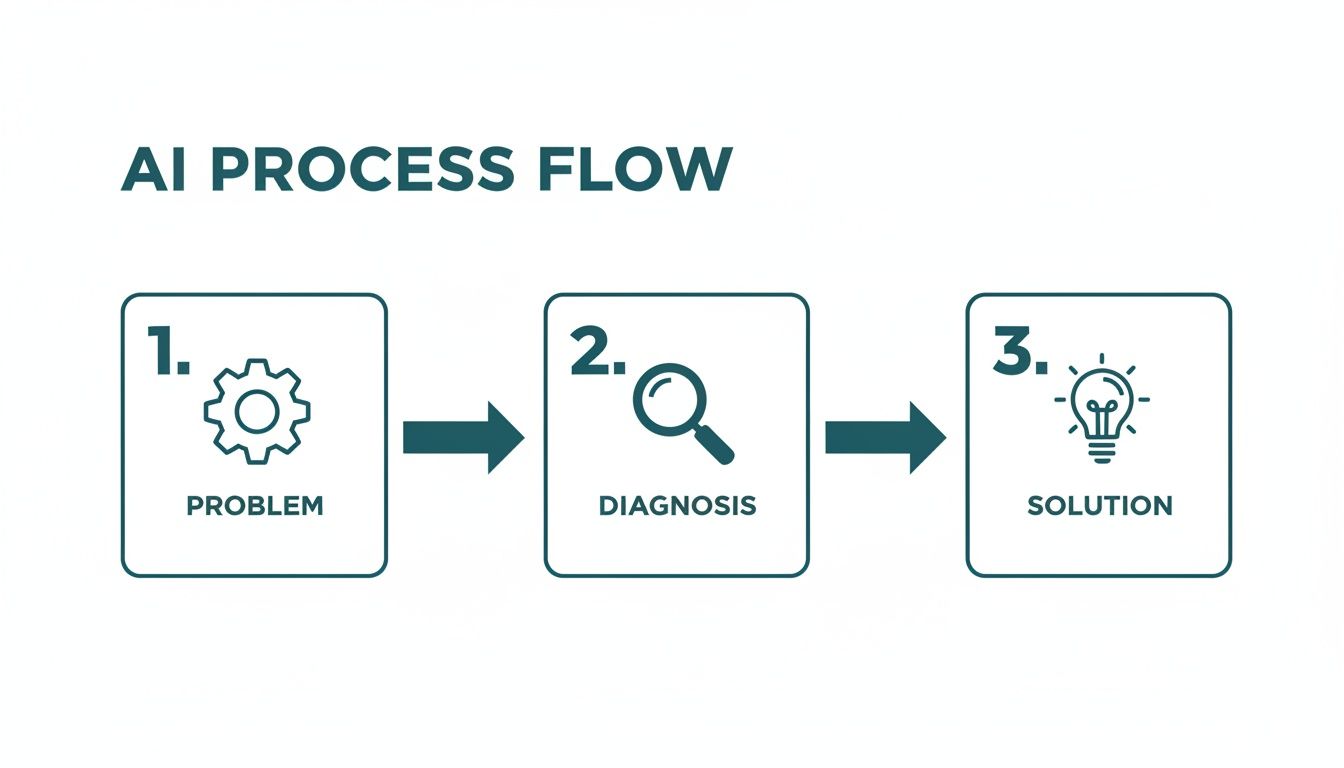
This structure mandates a problem-first approach, using data for diagnosis before architecting a targeted AI solution.
Phase 1: Problem Definition and Scoping
The most common failure mode for AI projects is starting with a technology rather than a business problem. Before evaluating any tool, clearly define the operational challenge. The ideal initial projects offer high impact for relatively low complexity.
Begin by asking targeted questions:
- Which specific, repetitive task consumes the most staff-hours?
- Where in our process flow do the most costly human errors occur?
- What is the single operational bottleneck that, if removed, would most significantly increase revenue or decrease costs?
Resist the temptation to address multiple problems simultaneously. Select one well-defined issue, such as automating accounts payable invoice processing or forecasting stockouts for your top 10 SKUs. Establish clear, quantifiable success metrics from the outset (e.g., “reduce invoice processing time by 40%” or “decrease stockouts for key products by 50%”).
Phase 2: Data Readiness Assessment
An AI model’s performance is entirely dependent on the data it is trained on. A rigorous assessment of your data is a critical prerequisite. This involves evaluating not just data volume, but its quality, accessibility, and relevance.
Your assessment must confirm:
- Quality: Is the data accurate, complete, and consistent? The principle of “garbage in, garbage out” is an immutable law in machine learning.
- Accessibility: Is data located in structured databases or is it locked in unstructured formats like PDFs and disparate legacy systems?
- Relevance: Does the available data contain the signals necessary to predict the desired outcome?
A key trade-off often emerges here between data privacy and model performance. Leveraging more granular customer data might improve a recommendation engine’s accuracy but introduces compliance risks under regulations like GDPR. This is a business decision with technical implications.
Phase 3: Integration Planning and Pilot Execution
With a defined problem and validated data, the next step is to plan the integration of the AI solution into your existing technology stack. Map every touchpoint: How will the AI ingest data from your CRM or ERP? Where will its output (e.g., a prediction, a classification, an automated report) be sent?
This planning is a core component of successful digital transformation solutions, ensuring new technology augments rather than disrupts existing workflows.
A pilot project is non-negotiable. It provides a controlled, small-scale environment to test the solution, validate ROI projections, and identify potential failure modes before a full-scale rollout.
For example, a predictive maintenance model would be piloted on a single production line, not the entire factory. This limited deployment allows for measurement of real-world accuracy, assessment of its impact on team workflows, and resolution of integration bugs with minimal operational disruption.
Key Considerations for Each AI Implementation Phase
| Implementation Phase | Key Objective | Primary Risk to Mitigate |
|---|---|---|
| Phase 1: Scoping | Define a high-impact, low-complexity business problem with quantifiable success metrics. | Scope creep or solving the wrong problem, leading to misallocated resources. |
| Phase 2: Data | Verify data quality, accessibility, and relevance for the chosen problem. | Poor data quality leading to an inaccurate or biased AI model (“garbage in, garbage out”). |
| Phase 3: Pilot | Test the solution on a small scale to validate technical performance and business value. | Integration failures or the solution underperforming in a live operational environment. |
| Phase 4: Scaling | Deploy the proven solution more broadly with robust governance and monitoring. | Model performance degradation over time (concept drift) without proper MLOps practices. |
This table provides a high-level framework; addressing these points early mitigates significant downstream risk.
Phase 4: Scaling and Governance
Once a pilot has proven its value against the predefined success metrics, you can plan the full-scale deployment. This requires more than simply expanding access; it necessitates a robust governance plan.
Your governance plan must address:
- Model Monitoring: How will you continuously monitor the model’s performance in production to detect degradation or drift?
- Maintenance Cadence: Who is responsible for retraining the model with new data, and on what schedule?
- User Training & Change Management: How will employees be trained to use the new tool and interpret its outputs correctly?
Without clear governance, even a high-performing AI model will degrade in value. Proactive management is what transforms a one-time AI project into a durable, value-generating business asset.
Choosing Your AI Strategy: Build vs. Buy
After identifying a high-impact problem, the next critical decision is the acquisition strategy for the AI capability. For an SMB, this choice has significant implications for budget, timeline, required expertise, and long-term strategic control. The primary options are buying a pre-built solution, building a custom one, or pursuing a hybrid approach.
The most common entry point is buying an off-the-shelf SaaS tool. The primary advantage is speed to value. A pre-built solution, such as an automated accounting platform or a customer support chatbot, can often be deployed in days or weeks. This converts a large capital expenditure into a predictable operating expense.
However, this speed comes with trade-offs. Customization is typically limited, requiring you to adapt your business process to the software’s workflow. Furthermore, you are entrusting your operational data to a third party, introducing security and compliance risks that require thorough vetting.

The Case for Building a Custom Solution
The alternative is to build a custom AI solution. This path is more resource-intensive, requiring significant upfront investment, specialized talent (data scientists, ML engineers), and a longer development cycle. For many SMBs, these requirements can be prohibitive.
However, for a core process that represents a key competitive differentiator, a custom solution can be a strategic force multiplier. It allows you to create a tool perfectly tailored to your unique operational logic and proprietary data. This bespoke AI becomes a defensible strategic asset that you own and control, one that evolves with your business and cannot be easily replicated by competitors.
The build vs. buy decision is fundamentally strategic. If the AI is addressing a commoditized, non-core business function, buy it. If it targets a process central to your company’s unique value proposition, building it can create a durable competitive advantage.
A Hybrid Approach: The Pragmatic Middle Ground
A third, increasingly viable strategy is the hybrid model. This involves engaging a specialized firm to build a custom application on top of an established enterprise AI platform, such as Microsoft Azure AI or Google Cloud AI. This approach significantly de-risks the development process.
You leverage powerful, pre-built infrastructure and foundational models, which drastically reduces the time and cost of development compared to building from scratch. Yet, the final application is tailored precisely to your business logic and data. For many SMBs, this offers the optimal balance of customization and cost-effectiveness.
Making the Right Decision for Your Business
The optimal path depends on a clear-eyed assessment of your specific context. Use this framework to guide your decision.
| Factor | Choose BUY If… | Choose BUILD (or Hybrid) If… |
|---|---|---|
| Strategic Importance | The problem is a common operational task (e.g., scheduling, basic support). | The solution addresses a core competitive advantage or proprietary process. |
| Budget | You require a predictable, lower monthly cost (OpEx) over a large upfront investment. | You have the capital (CapEx) to invest in creating a long-term strategic asset. |
| Timeline | You need a solution deployed and delivering value within weeks. | You can accommodate a multi-month development timeline for a tailored solution. |
| Internal Expertise | Your team lacks specialized data science or machine learning skills. | The solution is so critical that developing in-house expertise is a strategic priority. |
If a custom or hybrid solution aligns with your strategic goals but you lack the internal team, engaging expert guidance is a critical next step. To navigate these complexities, explore our specialized AI consulting services designed to help you architect the right solution.
Calculating the True Cost and ROI of AI
A credible business case for an AI solution for small business must extend beyond the software license fee. A realistic financial model must account for the total cost of ownership (TCO) across the entire investment lifecycle, from initial data preparation to ongoing maintenance and governance. Overlooking these costs is a common cause of project failure.
Unpacking the Total Cost of Ownership
The true cost of an AI system includes several critical, often underestimated, components:
- Data Preparation and Cleaning: AI models require clean, structured data. Expect to allocate significant resources to extract, clean, and label historical data. This “data wrangling” phase can consume a substantial portion of the initial project budget.
- System Integration: The AI solution must integrate with your existing technology stack (CRM, ERP, etc.). This often requires developing custom APIs or using middleware, adding both cost and complexity.
- Team Training and Change Management: A powerful tool is useless if the team does not adopt it. Budget for comprehensive training and a change management plan to ensure user buy-in and trust in the system’s outputs.
- Ongoing Maintenance and Governance: AI models are not “set it and forget it.” They require continuous monitoring for performance degradation (model drift), periodic retraining with new data, and ongoing subscription or cloud computing costs.
Measuring ROI Beyond Simple Cost Savings
While direct labor cost reduction is a valid metric, the most significant ROI from AI often comes from more strategic impacts. A comprehensive ROI calculation must capture these second-order effects. For instance, the ROI of a predictive maintenance system is not merely the cost of an avoided repair; it is the value of preventing days of lost production.
The critical shift is from measuring only cost savings to quantifying value creation. Instead of asking only, “How much money did we save?” ask, “By what percentage did we increase production throughput?” or “How much faster is our speed to market?”
Building a Defensible Business Case
To secure stakeholder buy-in and accurately track success, tie your ROI model to specific, measurable business outcomes. Evaluate potential AI solutions based on their ability to move key performance indicators.
| ROI Metric Category | Specific KPI Example | Business Impact |
|---|---|---|
| Throughput & Velocity | Order fulfillment time | Increased speed to market, improved customer satisfaction. |
| Quality & Risk Reduction | Product defect rate | Reduced rework costs, brand reputation protection, lower compliance risk. |
| Asset Utilization | Machine uptime percentage | Increased production capacity without additional capital expenditure. |
| Customer Value | Customer lifetime value (CLV) | Increased revenue per customer, improved retention and loyalty. |
By accounting for total costs and measuring a broad range of benefits, you can build a business case that is both realistic and compelling. This disciplined financial approach ensures your investment in AI solutions for small business is a strategic move that delivers defensible returns.
Your Next Steps Toward AI-Driven Efficiency
Successful AI adoption does not begin with a desire to “do AI.” It begins with a disciplined focus on solving a specific, high-value operational bottleneck. This problem-first approach transforms AI from a speculative technology expense into a strategic investment with a measurable return. The goal is to methodically identify where automation or predictive insight can have the greatest impact on risk reduction, speed to market, or cost control.
Your AI Readiness Checklist
Before committing resources, conduct a brief internal audit to assess your readiness and identify the most promising starting points.
- Problem Identification: Can you articulate a specific, recurring pain point with quantifiable impact? (e.g., “Manual invoice matching consumes 20 staff-hours per week and has a 5% error rate.”) Vague objectives like “improve efficiency” are insufficient.
- Data Health Check: Is the data required to address this problem available, accessible, and reliable? For a forecasting project, do you have at least 12-24 months of clean, relevant historical data?
- Impact Sizing: How will you measure success? Define a clear, numerical target. (e.g., “Reduce order fulfillment errors by 15%” or “Decrease average customer response time by 40%.”)
- Resource Alignment: Do you have an internal champion for the project? Have you performed a trade-off analysis between a rapidly deployed SaaS tool and a more tailored custom or hybrid solution?
Completing this exercise anchors the initiative in operational reality and ensures your first AI project is designed to deliver tangible business results.
Successful AI implementation is less about technical sophistication and more about rigorous problem definition. Starting with a critical business need ensures the solution, whether built or bought, directly serves strategic goals and delivers a defensible ROI.
Navigating this process requires a combination of business acumen and technical expertise. If you have identified a high-impact problem but are uncertain about the implementation path, an expert assessment can provide the necessary clarity. At Sheridan Technologies, we specialize in bridging the gap between operational challenges and effective technology solutions. An initial assessment can help you pinpoint where AI can create the most value for your business and define a clear, actionable roadmap.
FAQ for Decision-Makers
Here are direct answers to common questions from business leaders evaluating AI.
What is the most common failure mode for SMBs adopting AI?
The primary failure mode is a technology-first approach. Adopting an AI tool without first identifying a specific, high-value business problem to solve inevitably leads to a “solution in search of a problem.” This results in misallocated resources, poor adoption, and a failed project. Successful initiatives always begin with a clearly defined operational pain point and quantifiable success metrics.
How much data is required for a viable AI project?
This depends entirely on the application. A chatbot leveraging a pre-trained Large Language Model (LLM) may require very little of your own data to start. Conversely, a predictive model for demand forecasting or equipment maintenance is highly dependent on historical data. A general rule for such projects is at least one to two years of clean, structured data relevant to the outcome you want to predict. However, a formal data readiness assessment is the only way to be certain.
Key Takeaway: Data quality and relevance are far more critical than sheer volume. A smaller, clean, and relevant dataset is invariably superior to a massive, messy, and irrelevant one.
Can we implement AI without hiring a full-time data scientist?
Yes, absolutely. For many SMBs, an in-house data scientist is not a prerequisite. Many powerful AI solutions for small business are available as user-friendly SaaS platforms that require minimal technical expertise. For more complex, custom requirements, partnering with a specialized consulting firm provides access to top-tier expertise on a fractional basis, avoiding the long-term cost and overhead of a full-time hire. This provides a flexible and cost-effective path to sophisticated AI capabilities.
Ready to move from evaluation to a concrete action plan? Sheridan Technologies helps businesses identify and implement high-impact AI opportunities. Schedule a no-obligation assessment to build a clear roadmap for your AI implementation.