Table of Contents
Choosing an industrial automation partner goes beyond component catalogs and pricing. For decision-makers and operators, the critical evaluation criteria are technical depth, supply chain resilience, and the ability to reduce project risk. In a landscape where downtime is measured in thousands of dollars per minute and integration failures can derail production schedules, selecting the right supplier or engineering partner is a strategic decision with significant business impact.
This guide bypasses surface-level comparisons to provide a technical roundup of leading industrial automation companies, focusing on their distinct value propositions. We will analyze each company’s core strengths, operational trade-offs, and ideal use cases to help you identify a partner that aligns with your specific needs. The goal is to move beyond finding a simple supplier and toward securing a partner capable of delivering measurable outcomes in reliability, cost control, and speed to market.
Whether you’re managing rapid MRO fulfillment for a plant floor, sourcing components for a complex prototype, or engaging an end-to-end engineering firm for a turnkey automation system, the right partnership is essential. A key part of this process involves understanding how top industrial automation companies can help improve operational efficiency by providing not just parts, but integrated solutions that solve core business problems. This curated list is designed for engineering and product leaders who need to make informed, defensible decisions quickly. Each entry offers a direct link and a concise breakdown to accelerate your evaluation process and connect you with the right resource for your project.
1. Sheridan Technologies — Industrial Automation, Robotics & Manufacturing
For organizations navigating the complexities of modernizing physical systems, Sheridan Technologies offers an integrated approach that positions it as one of the top industrial automation companies for custom engineering. It stands out by providing a single, accountable delivery model that combines deep, cross-disciplinary engineering expertise with a pragmatic focus on business outcomes, effectively de-risking projects from concept through production.
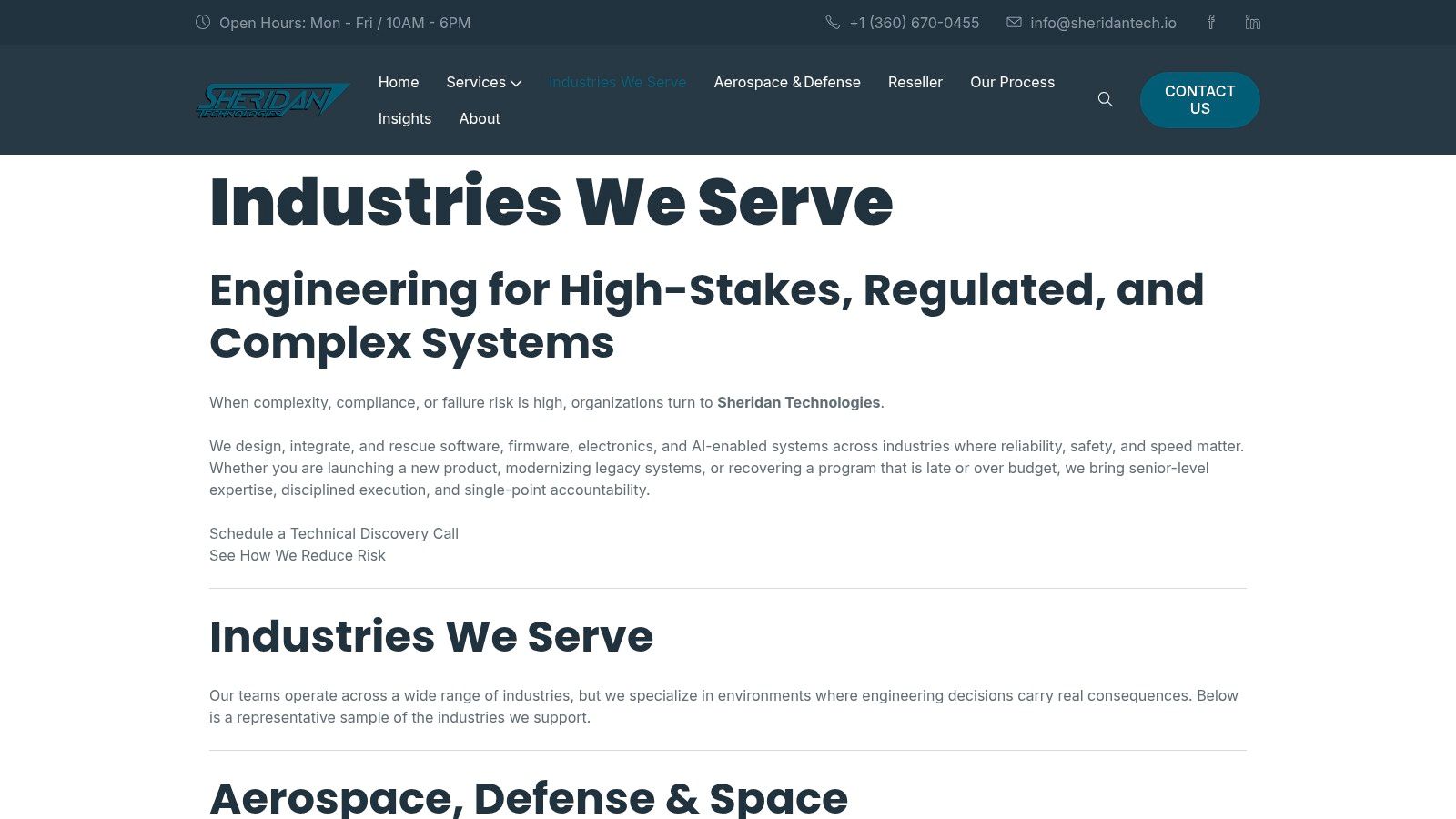
Unlike siloed engineering firms or contract manufacturers, Sheridan Technologies orchestrates the entire development lifecycle. This model is engineered to solve the chronic integration failures that plague complex hardware and software projects, where misaligned teams, poor communication, and a lack of holistic oversight lead to costly rework and schedule delays.
Core Differentiators and Capabilities
Sheridan’s value proposition is built on cohesive project execution. This structure is particularly beneficial for decision-makers in robotics, manufacturing, and med-tech who need to accelerate development without building a massive in-house team.
- Single-Accountable Program Lead: Each project is assigned a dedicated program lead who serves as the central point of contact. This individual coordinates all technical disciplines, including industrial controls, robotics, embedded firmware, and manufacturing test fixtures. This structure simplifies communication, enforces accountability, and mitigates the integration risk that often derails multi-vendor projects.
- Dynamic Expert Network: Instead of relying solely on a fixed bench of generalist engineers, Sheridan leverages a vetted network of specialists. This allows them to rapidly assemble a team with the precise expertise required for each project phase, scaling capacity and skill sets efficiently. This is a critical advantage for projects requiring niche skills, such as advanced sensor integration or compliance with standards like ISO 13485 for medical devices.
- End-to-End System Integration: The company’s methodology is rooted in designing for manufacturability (DFM) and testability (DFT) from day one. By integrating these considerations into the initial architecture, they prevent common late-stage problems. Their capabilities extend from initial design to turnkey prototyping and manufacturing, providing a seamless path from concept to a supply-chain-ready product. This holistic view is crucial for developing robust industrial automation solutions that are both reliable and scalable.
Use Case: Accelerating a Robotics Startup’s Path to Market
- Problem: A robotics startup has developed a novel grasping algorithm but lacks the in-house expertise to build a production-ready mechatronic system. They face significant technical debt in hardware and firmware development, risking missed deadlines with investors and early customers.
- Diagnosis: The team’s core competency is software, but they require a partner to architect, build, and test the physical hardware—including custom PCBs, motor controls, and enclosure design—while ensuring the entire system can be reliably manufactured.
- Solution: Sheridan assembles a dedicated team via its Dynamic Expert Network, led by a single program lead. This team includes a mechatronics engineer, a firmware developer with real-time OS experience, and a DFM specialist. They redesign the prototype for production, source reliable supply chain partners, and develop an automated end-of-line test fixture.
- Outcome: The startup successfully navigates from a lab prototype to a market-ready product in under six months, a significant acceleration. The integrated approach reduces technical risk and allows the startup’s core team to focus on its software IP, securing its next round of funding.
Strengths and Tradeoffs
| Aspect | Strengths | Potential Tradeoffs |
|---|---|---|
| Project Management | Single accountable program lead drastically reduces communication overhead and integration friction for clients. | The model is less cost-effective for simple, single-discipline projects where extensive coordination is unnecessary. |
| Technical Expertise | On-demand access to specialists via the Dynamic Expert Network ensures precise skill-matching for complex challenges. | Physical on-site support for large-scale field deployments may be concentrated near their headquarters in Vancouver, WA. |
| Development Lifecycle | Integrated DFM/DFT and prototyping significantly shortens time-to-market and improves first-pass success rates. | The comprehensive, front-loaded process may seem intensive for teams accustomed to more fragmented, ad-hoc development cycles. |
| Focus | Pragmatic, engineering-driven approach delivers tangible outcomes, reduces rework, and keeps budgets lean. | Best suited for complex custom engineering; not a fit for sourcing simple off-the-shelf automation components. |
Practical Guidance for Engagement
To effectively leverage Sheridan's capabilities, decision-makers should engage them early in the project lifecycle, ideally at the architectural stage. Prepare a clear problem statement and define key business objectives, such as target production cost, time-to-market, or specific performance metrics. This allows their team to align engineering efforts with strategic goals from the outset.
Learn more at: https://sheridantech.io/industries-we-serve/
2. RS Americas (RS Group)
For engineering teams and MRO (Maintenance, Repair, and Operations) professionals who prioritize rapid component sourcing and broad selection, RS Americas serves as a high-velocity e-commerce distributor. Its value proposition is not in providing bespoke engineered solutions but in offering a vast, readily available inventory of industrial automation components from leading brands through a streamlined digital purchasing experience. This makes it a critical partner for teams engaged in prototyping, system builds, and urgent repairs where speed is paramount.
The platform is designed for procurement efficiency, allowing users to move from component identification to checkout with minimal friction. For a system architect designing a new control panel, this means being able to source PLCs, HMIs, power supplies, and terminal blocks from multiple manufacturers in a single order, dramatically reducing sourcing time and administrative overhead.
Core Capabilities and Differentiators
RS Americas distinguishes itself with a deep digital catalog and robust U.S.-based logistics. Its strengths lie in providing immediate access to components, which is crucial for minimizing downtime or accelerating development cycles.
- Extensive Component Catalog: The website provides access to hundreds of thousands of products from brands like Siemens, Schneider Electric, Phoenix Contact, and Omron. This breadth eliminates the need to manage multiple supplier relationships for a single bill of materials (BOM).
- Advanced Filtering and Technical Data: The user interface allows for precise parametric searches. An engineer can filter for a specific sensor based on sensing distance, output type, IP rating, and operating voltage, then immediately access datasheets and 3D models directly from the product page. This accelerates the component validation and design-in process.
- Transparent Inventory and Pricing: Unlike traditional distributors that often require a formal quote process, RS provides live stock levels and tiered pricing directly on its website. This transparency enables immediate purchasing decisions and helps in accurate project budgeting and scheduling.
- U.S. Logistics Network: With a significant U.S. fulfillment footprint, RS offers quick-ship options for in-stock items, ensuring that critical components for a machine-down situation can be delivered rapidly.
Use Case: MRO Emergency
- Problem: A manufacturing facility experiences an unplanned shutdown after a critical proximity sensor on a conveyor line fails. The local electrical supplier does not have the specific NPN inductive sensor from a European brand in stock and quotes a multi-week lead time.
- Diagnosis: The MRO team's primary objective is to restore operation as quickly as possible. They identify the sensor's critical specifications: M12 housing, 4mm sensing range, and a quick-disconnect connector.
- Solution: Using the RS Americas website, the technician filters by these exact parameters and finds several in-stock, cross-compatible alternatives from different manufacturers. They select an option available for next-day delivery from the U.S. warehouse.
- Outcome: The replacement part arrives the next morning, and the line is operational in under 24 hours, averting significant production losses. The single-source, quick-ship capability directly translates to reduced Mean Time to Repair (MTTR).
While RS Americas is a powerful procurement tool, users should note that some specialized OEM components may still have lead times. Additionally, certain products or pricing tiers may require a business account. However, for sourcing standard automation hardware for builds, R&D, and MRO, it remains one of the most efficient industrial automation companies focused on e-commerce distribution.
Website: https://us.rs-online.com
3. AutomationDirect
For engineers and system integrators seeking maximum value and accessibility, AutomationDirect has carved out a distinct niche as a direct e-commerce supplier of low-cost, high-utility industrial control products. Its value proposition is built on providing a comprehensive ecosystem of affordable components, backed by extensive free documentation, software, and U.S.-based support. This makes it an ideal choice for budget-conscious projects, proofs-of-concept, and OEM machine builders where rapid deployment and cost-efficiency are paramount.
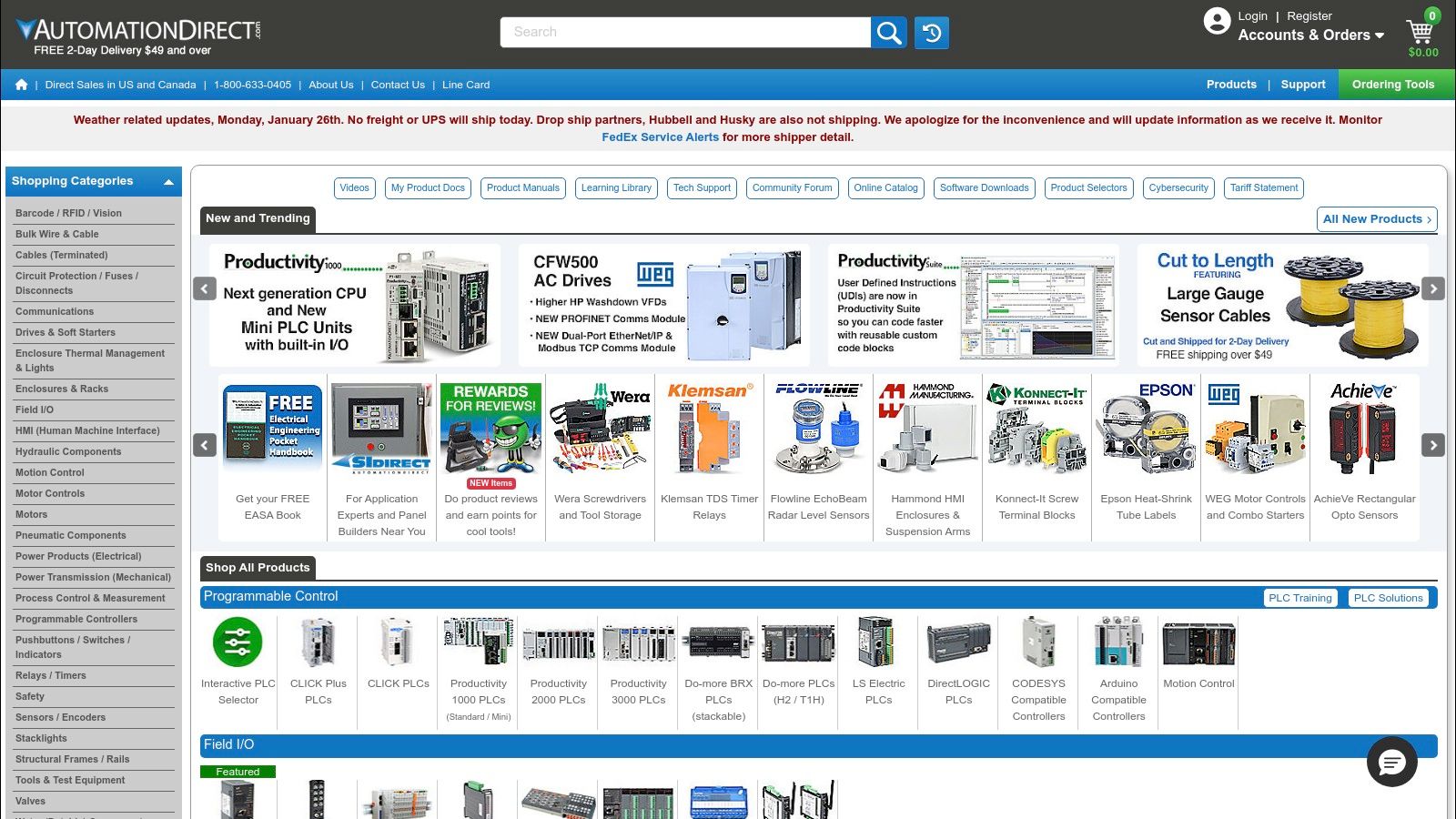
The platform is engineered for a 24/7 self-service experience, empowering users to specify, purchase, and learn without traditional sales friction. A machine designer can build out an entire control system—from PLC and HMI to the VFD and sensors—using the website's robust product selectors and technical resources. This direct model simplifies procurement and removes barriers to entry, particularly for smaller businesses and R&D teams.
Core Capabilities and Differentiators
AutomationDirect’s competitive advantage lies in its vertically integrated product strategy and unwavering focus on customer enablement. By offering a curated selection of its own and partner brands, it maintains tight control over cost, quality, and documentation.
- Low-Cost, High-Value Portfolio: The company offers thousands of industrial components, including its popular Productivity series PLCs, C-more HMIs, and GS series drives, often at a fraction of the cost of legacy brands. This makes advanced automation technology more accessible for a wider range of applications.
- Free Software and Documentation: A key differentiator is the complete lack of licensing fees for its flagship PLC and HMI programming software. This, combined with free access to manuals, CAD drawings, and extensive video training, significantly lowers the total cost of ownership and the learning curve for new users.
- Transparent E-commerce Experience: The website provides clear, upfront pricing and real-time stock levels for all products. Combined with fast shipping from its U.S. warehouse, this transparency allows for predictable project timelines and budgets.
- U.S.-Based Technical Support: Despite its low-cost model, AutomationDirect provides free technical support from its Georgia-based team. For users troubleshooting a new system, this direct access to knowledgeable support is a significant benefit.
Use Case: OEM Machine Prototype
- Problem: An OEM is developing a new, cost-sensitive packaging machine and needs to build a functional prototype to validate the design. Sourcing a complete control system from major incumbent brands would exceed the prototype budget.
- Diagnosis: The core requirements are a PLC for sequential logic, an HMI for operator interaction, and a VFD to manage the main conveyor motor. The engineering team is small and needs detailed documentation to integrate components quickly, including the complete motor control circuit.
- Solution: Using AutomationDirect, the engineer specifies a PLC, HMI, VFD, sensors, and power supply, all within budget. They download the free programming software and all required technical manuals directly from the product pages before the parts even ship.
- Outcome: The components arrive within two days. The team successfully programs and commissions the control system for the prototype in under a week, leveraging free video tutorials and a quick call to technical support. The low hardware cost and zero software expense keep the project on budget, accelerating the path to a market-ready product.
While AutomationDirect offers an excellent ecosystem, its product selection is heavily oriented around its own brands. Engineers requiring specific Rockwell or Siemens components for plant-wide standardization will need to look elsewhere. However, for standalone systems and budget-driven projects, it is one of the most effective industrial automation companies available.
Website: https://www.automationdirect.com
4. Digi-Key Electronics (Industrial Automation and Controls)
For design engineers and R&D teams who require a seamless blend of industrial automation components and board-level electronics, Digi-Key Electronics functions as a high-service, catalog-style distributor. Its primary value is not in creating custom automation systems but in providing rapid, single-source access to a massive inventory spanning both factory automation and electronic component categories. This unique positioning makes it indispensable for teams prototyping new connected hardware, building custom control systems, or requiring both a PLC and the specific microcontrollers to interface with it.
The platform is engineered for speed from design to procurement, enabling users to source a complex bill of materials (BOM) that includes sensors, relays, industrial PCs, and the discrete semiconductors needed to build a custom controller board. This means acquiring the necessary automation hardware and board-level electronics in a single, efficient transaction.
Core Capabilities and Differentiators
Digi-Key excels through its sheer breadth of inventory, best-in-class parametric search engine, and a logistics model built for rapid prototyping and production-level fulfillment. Its key differentiator is the fusion of industrial and electronic component distribution at scale.
- Integrated Automation and Electronics Catalog: With over 300,000 industrial automation SKUs, the platform offers deep inventory from brands like Omron and Phoenix Contact alongside millions of electronic components. This eliminates the need for separate suppliers when a project's BOM crosses these domains.
- Powerful Parametric Search: The website's search and filtering capabilities are a significant advantage. An engineer can search for an HMI, then filter by screen size, communication protocol, IP rating, and specific certifications, while simultaneously viewing real-time stock levels for each option. This accelerates component selection.
- Transparent Inventory and Sourcing Tools: Digi-Key provides live, unambiguous stock counts for its U.S. distribution center and shows factory lead times for out-of-stock items. Crucially, when parts are constrained, the platform often suggests pin-compatible or functionally equivalent alternatives, a vital feature for maintaining project timelines.
- Rapid U.S. and Global Distribution: Centered around its massive U.S. fulfillment hub, Digi-Key is renowned for its quick order processing and shipping. This ensures that components for a first-run prototype or a critical project build can be on an engineer's desk with minimal delay.
Use Case: Prototype Development for a Smart Factory Device
- Problem: An engineering team is building a new-generation end-of-arm tool (EOAT) that includes advanced sensing, local processing, and network connectivity. The BOM includes both standard industrial automation parts (pneumatic gripper, proximity sensors) and specialized electronic components (an ARM Cortex-M MCU, a Wi-Fi module). Sourcing these from separate distributors would create logistical delays.
- Diagnosis: The team needs a single supplier that can fulfill the entire BOM quickly, provides detailed technical datasheets for all parts, and shows available inventory to avoid sourcing dead ends.
- Solution: Using Digi-Key, the lead engineer creates a single project cart. They use the parametric search to find an in-stock Omron sensor that meets their exact mechanical and electrical specs, then add the specific STMicroelectronics MCU and Murata Wi-Fi module required for the custom PCB.
- Outcome: All components arrive in a single shipment within two days, allowing the prototyping phase to begin immediately. The unified sourcing process accelerates the design-to-prototype cycle, saving valuable engineering time and keeping the project on its aggressive schedule.
While Digi-Key is a powerhouse for prototype and small-to-medium volume production, companies requiring very large OEM systems like complex VFDs or large-frame PLCs may find a more specialized selection at dedicated automation houses. However, for a high-mix environment where industrial and electronic components converge, Digi-Key is one of the top industrial automation companies for integrated e-commerce distribution.
Website: https://www.digikey.com/en/resources/industrial-automation
5. Mouser Electronics (Industrial Automation)
For design engineers and procurement specialists focused on new product development (NPD) and prototyping, Mouser Electronics operates as a factory-authorized, high-service distributor. Its primary value is not in system integration but in providing a direct, reliable channel for sourcing the latest industrial automation components with extensive technical resources. Mouser is the go-to platform for engineering teams that require guaranteed genuine parts, deep technical documentation, and rapid fulfillment for R&D and pilot production runs.
The platform is engineered to support the design process from component discovery to delivery. A controls engineer developing a new automated test fixture can use Mouser to research, compare, and order PLCs, sensors, and connectors from authorized brands like Siemens, Omron, Phoenix Contact, and Honeywell. This authorized-source model mitigates the risk of counterfeit parts entering the supply chain, a critical concern in high-reliability applications.
Core Capabilities and Differentiators
Mouser Electronics sets itself apart with its strong emphasis on being an authorized distributor for new component introductions and its investment in educational content for engineers. This positions it as a key resource for design-in activities rather than just MRO fulfillment.
- Authorized Distribution Model: As an authorized source for over 1,200 manufacturer brands, Mouser ensures full traceability and factory warranties. This is crucial for projects in regulated industries or for OEMs who must guarantee the provenance of every component in their bill of materials (BOM).
- Focus on New Product Introductions (NPIs): The platform is often among the first to stock the latest components, from advanced sensors to new controller families. This gives design teams a competitive advantage by allowing them to incorporate next-generation technology into their products early in the design cycle.
- Extensive Technical Content: Mouser provides a rich library of articles, eBooks, and application notes on topics like Industry 4.0 and IIoT. This content helps engineers stay current and make informed decisions when selecting components for new automation challenges.
- Efficient Logistics and Same-Day Shipping: With a state-of-the-art global distribution center, Mouser excels at order accuracy and speed. A significant portion of its massive in-stock inventory is available for same-day shipping, accelerating prototype builds and time-sensitive projects.
Use Case: New Machine Prototype Development
- Problem: A robotics startup is building its first-generation autonomous mobile robot (AMR). The design requires a specific set of safety-rated sensors, industrial connectors, and a compact Siemens PLC. The team must ensure all components are genuine to meet future certification requirements.
- Diagnosis: The BOM includes components from multiple manufacturers. Sourcing from each one individually would be slow and administratively complex. The risk of receiving gray market or counterfeit parts from unauthorized channels is unacceptable.
- Solution: The lead engineer uses Mouser's platform to access the required components in a single order. They use the parametric search to filter for the exact safety sensor specifications and find the NPI they need is in stock. They access the PLC’s datasheet and reference designs directly from the product page to validate its integration.
- Outcome: All components are ordered from a single, authorized source and shipped the same day. The team receives the parts quickly, allowing them to proceed with the prototype build on schedule, confident in the authenticity and reliability of their supply chain. This accelerates their path to a functional proof-of-concept.
While Mouser is an exceptional resource for design engineering, it is less focused on providing the on-site inventory management or heavy MRO services offered by dedicated MRO specialists. However, for engineering teams building the next generation of automated systems, it is one of the top industrial automation companies for sourcing authentic, cutting-edge components.
Website: https://www.mouser.com/empowering-innovation/industrial-automation
6. W.W. Grainger
For facilities maintenance and MRO (Maintenance, Repair, and Operations) teams that need a reliable, single-source supplier for both automation components and broader plant upkeep supplies, W.W. Grainger stands as an industrial distribution giant. Its value proposition is centered on operational continuity, offering an immense catalog of products combined with a powerful U.S. distribution network designed for next-day delivery. Grainger is less a specialized automation house and more an indispensable partner for keeping entire facilities running.
The platform excels at simplifying procurement for large organizations. An MRO manager can order replacement motor starters, safety light curtains, and a new HVAC filter in a single transaction, streamlining purchase orders and vendor management. Grainger’s e-commerce site is built for business-to-business efficiency, integrating procurement tools and inventory management programs to reduce the administrative load of keeping a plant operational.
Core Capabilities and Differentiators
Grainger’s primary differentiator is its combination of a broad MRO catalog with a deep logistics network, making it a one-stop shop for plant maintenance. This positions it uniquely among the top industrial automation companies as a provider of both specialized components and general operational supplies.
- Broad MRO and Automation Catalog: Grainger offers millions of products, including a significant selection of industrial controls, sensors, motor controls, enclosures, and safety components from brands like Eaton, Rockwell Automation (Allen-Bradley), and Siemens.
- National Distribution Network: With a vast network of distribution centers and local branches across the United States, Grainger provides next-day ground shipping to the majority of its customer base. This logistical strength is critical for minimizing plant downtime.
- Inventory Management Solutions: The Grainger KeepStock program offers managed inventory solutions to help customers streamline replenishment, reduce carrying costs, and prevent stockouts of critical spares.
- eProcurement Integration: The platform integrates with major e-procurement systems (like Ariba and Coupa), allowing large enterprises to enforce purchasing controls, manage budgets, and simplify the procure-to-pay cycle directly within their existing ERP or purchasing software.
Use Case: Standardizing MRO Procurement
- Problem: A multi-site manufacturing company aims to consolidate its MRO spending and improve uptime. Currently, each plant independently sources components, leading to inconsistent part selection, rogue spending, and long lead times during equipment failures.
- Diagnosis: The corporate procurement team identifies a lack of a centralized supplier and standardized parts list as the root cause of inefficiency and extended downtime.
- Solution: The company establishes a national account with Grainger, creating a curated catalog of approved automation components (contactors, sensors, power supplies) for common equipment. They leverage Grainger's e-procurement integration to make this catalog available to all plant managers through their corporate ERP with negotiated contract pricing.
- Outcome: All facilities now order from a standardized, pre-approved list of components, ensuring interchangeability and simplifying maintenance. The next-day delivery capability dramatically reduces Mean Time to Repair (MTTR) for common failures. The consolidated purchasing provides better volume pricing and gives corporate a clear view of MRO spending.
While Grainger’s fulfillment is exceptionally reliable, users without a negotiated business contract may find list pricing higher than at specialized electronics distributors. For standardized MRO replenishment and rapid delivery of common industrial controls, however, Grainger is a foundational partner for plant operations.
Website: https://www.grainger.com
7. Thomasnet
For procurement managers and engineers tasked with identifying and vetting specialized automation partners, Thomasnet serves as a comprehensive industrial sourcing and supplier discovery platform. Its core function is not to sell components directly but to provide a structured, searchable directory of North American manufacturers, distributors, and service providers. This makes it an indispensable tool for sourcing turnkey automation systems, custom control panels, and specialized system integration services, where a direct e-commerce transaction is impractical.
The platform is engineered to streamline the Request for Information (RFI) and Request for Quote (RFQ) processes. Instead of relying on general search engines, a project manager can use Thomasnet to build a highly qualified shortlist of potential partners based on specific, verifiable criteria like location, certifications (e.g., ISO 9001, UL 508A), and company size. This accelerates vendor discovery and due diligence for complex automation projects.
Core Capabilities and Differentiators
Thomasnet’s primary differentiator is its deep, curated database of U.S. and Canadian industrial suppliers, combined with powerful filtering capabilities that go far beyond a simple keyword search. It transitions the sourcing process from a discovery problem to a selection problem.
- Granular Supplier Directory: The platform lists thousands of automation system suppliers, allowing users to filter by specific capabilities such as SCADA integration, robotic workcell design, or machine vision implementation. This precision ensures that users connect with companies that have proven expertise in their required domain.
- Objective Vetting Criteria: Users can filter potential suppliers by geographic proximity, diversity ownership status (e.g., woman-owned, veteran-owned), and key quality certifications. Company profiles often include founding year and employee count, providing objective data points for initial qualification.
- Integrated RFQ Workflow: The platform includes built-in tools to issue RFQs to multiple shortlisted vendors simultaneously. This centralizes communication and simplifies the process of comparing proposals for large-scale automation projects or custom-built equipment.
- Focus on Services and Systems: Unlike e-commerce distributors, Thomasnet excels in connecting buyers with providers of complex services. It is a key resource for finding a partner to design, build, and install a complete automated assembly line or retrofit an existing manufacturing facility.
Use Case: Sourcing a Custom Control Panel Builder
- Problem: An OEM is developing a new piece of industrial machinery and needs a UL 508A certified partner in the Midwest to build 50 identical control panels according to their precise schematics and bill of materials (BOM).
- Diagnosis: The OEM's engineering team lacks the internal capacity for panel fabrication and needs to find a reliable, certified third-party builder within their regional supply chain to minimize shipping costs and facilitate collaboration. The critical requirements are UL 508A certification, location within a 300-mile radius, and demonstrated experience with the specified PLC brand.
- Solution: Using Thomasnet, the procurement manager searches for "Control Panel Builders." They apply filters for "UL 508A," specify the relevant states (e.g., Ohio, Michigan, Indiana), and review the profiles of the top results. They identify five promising candidates and use the platform's RFQ feature to send them the design package.
- Outcome: Within a week, the OEM receives four competitive quotes from certified, geographically desirable partners. They are able to vet the suppliers based on their provided capabilities and select a partner, moving from initial search to qualified proposal in a fraction of the time a manual search would have required.
While Thomasnet is a powerful tool for initial supplier discovery, users must still conduct their own in-depth due diligence. It is a starting point for the procurement process, not an end-to-end transaction platform. However, for buyers seeking specialized automation services and systems, it remains one of the most efficient tools among the top industrial automation companies for building a qualified vendor list.
Website: https://www.thomasnet.com
Top 7 Industrial Automation Suppliers Comparison
| Item | 🔄 Implementation Complexity | ⚡ Resource Requirements | 📊 Expected Outcomes (⭐) | 💡 Ideal Use Cases | ⭐ Key Advantages |
|---|---|---|---|---|---|
| Sheridan Technologies — Industrial Automation, Robotics & Manufacturing | High — multi‑discipline program coordination and on‑site integration | High — specialist engineers, prototyping, turnkey manufacturing capacity | High impact — faster time‑to‑market, reduced rework, integrated production (⭐⭐⭐⭐) | Custom robotics/mechatronics, end‑to‑end product development to production | Single accountable program lead; Dynamic Expert Network; design for test/manufacturability |
| RS Americas (RS Group) | Low — straightforward e‑commerce and procurement workflows | Moderate — business accounts for some SKUs, fast U.S. fulfillment | Reliable supply and quick MRO fulfillment (⭐⭐⭐) | MRO replenishment, standard controls, quick replacement parts | Broad brand catalog, live stock/pricing, U.S. logistics and content |
| AutomationDirect | Low — self‑serve online ordering and product selection | Low — budget‑friendly product lines and free software/docs | Cost‑effective deployments and POC readiness (⭐⭐⭐) | Proof‑of‑concept, low‑cost automation builds, rapid deployments | Large low‑cost portfolio, free manuals/software, 24/7 store |
| Digi‑Key Electronics | Low–Medium — easy ordering with parametric search for designs | Moderate — wide electronic + automation SKU coverage for prototyping | Fast design‑to‑prototype sourcing; good alternatives for constrained parts (⭐⭐⭐⭐) | Design/prototyping that mixes automation parts and electronics | Massive SKU depth, parametric filters, transparent stock/alternatives |
| Mouser Electronics | Low — authorized distributor workflows and quick shipping | Moderate — factory‑authorized inventory and technical resources | Reliable authorized sourcing with strong technical support (⭐⭐⭐) | Buyers needing factory‑authorized parts and fast delivery | Wide brand coverage, same-day shipping, educational content |
| W.W. Grainger | Low — established MRO procurement and inventory programs | Moderate–High — procurement integrations, inventory management | High uptime and standardized MRO replenishment (⭐⭐⭐) | Plant maintenance, inventory programs, enterprise procurement | Large DC footprint, KeepStock and procurement tools, next‑day coverage |
| Thomasnet | Medium — supplier discovery and qualification (not e‑commerce) | Low (search) to High (vendor qualification/time) | Effective shortlisting of service providers and integrators (⭐⭐⭐) | Sourcing system integrators, control panel builders, local contractors | Extensive searchable directory, geographic/certification filters |
From Shortlist to Solution: Your Next Steps in Automation Partnering
Navigating the landscape of industrial automation partners can feel like comparing apples, oranges, and entire supply chains. This article has detailed a curated list of providers, each with a distinct operational model—from high-volume component distributors like Digi-Key and Mouser to MRO specialists such as Grainger and comprehensive discovery platforms like Thomasnet. The fundamental takeaway is that there is no single "best" provider; the optimal choice is entirely contingent on your project's specific context, constraints, and strategic goals.
The selection process is not just about comparing part numbers and prices. It is a critical risk-management exercise. For teams focused on standard component procurement or maintenance, repair, and operations (MRO), a distributor-led model offers efficiency and breadth. However, for complex, integrated systems—especially those in regulated environments or with demanding performance requirements—the calculus shifts dramatically.
Synthesizing Your Selection Criteria
To move from this shortlist of top industrial automation companies to a definitive partner, you must first diagnose your primary project drivers and constraints. A structured evaluation prevents teams from defaulting to familiar vendors who may be ill-suited for a novel or complex challenge.
Consider the following critical factors as a framework for your decision:
- Project Complexity and Integration Needs: Is your project a simple upgrade of an existing machine with off-the-shelf components, or a ground-up development of a novel mechatronic system? The former is well-served by distributors. The latter often demands a partner with deep, cross-disciplinary expertise in mechanical design, embedded firmware (e.g., C/C++ for real-time control), and electrical engineering to avoid integration failures.
- Risk Profile and Accountability: When sourcing from multiple component vendors, the integration risk falls entirely on your internal team. If a custom PCB fails to communicate with a specific actuator, who is accountable? An integrated engineering partner provides a single point of accountability, de-risking the project by owning the system-level outcome.
- Speed to Market vs. Unit Cost: For a prototype or first-generation product, time-to-market and first-pass success are paramount. Optimizing for the lowest possible component cost can introduce significant delays through vendor management overhead, shipping logistics, and troubleshooting integration issues. The cost of a schedule slip often dwarfs any savings realized on individual parts.
- Regulatory and Compliance Overhead: Projects in medical device (ISO 13485, IEC 62304) or aerospace (DO-178C) sectors require rigorous documentation and process controls that component distributors are not structured to provide. An engineering services partner with a proven quality management system (QMS) becomes essential for building a compliant design history file (DHF) and ensuring audit readiness.
Making the Final Decision: A Pragmatic Approach
Your next step is to map your specific project requirements against the models presented. If your need is tactical—replacing a specific sensor or stocking up on standard PLCs—the path is clear. But if your challenge is strategic—automating a manual workflow, developing a new robotic system, or rescuing a stalled project—your evaluation must prioritize integrated capabilities over a catalog's depth.
The most common failure mode we observe is underestimating the "soft" costs of managing a fragmented supply chain for a complex build. The time your senior engineers spend coordinating vendors, debugging interfaces, and resolving compatibility conflicts is time they are not spending on core innovation. For mission-critical automation initiatives, the most effective path forward is often to consolidate responsibility with a partner who can manage the entire lifecycle, from architectural design and prototyping to supply chain readiness and production. This integrated approach aligns incentives and ensures that every technical decision is made with the final system's performance and reliability in mind.
If your automation project involves more than just sourcing parts and requires a cohesive team of experts in hardware, firmware, and complex system integration, Sheridan Technologies can help. We act as an extension of your team, providing the end-to-end engineering horsepower to de-risk development and accelerate your timeline from concept to production. Schedule a brief, no-obligation technical assessment at Sheridan Technologies to clarify your project's path forward and identify potential failure modes before they become costly delays.