Table of Contents
Medical device design services provide the specialized engineering and regulatory discipline required to guide a product from concept to a compliant, market-ready device. This encompasses the entire lifecycle: navigating hardware, firmware, and mechanical design through manufacturing and regulatory submission.
From Concept to a Compliant Market-Ready Device
Selecting a partner for medical device design services is a high-stakes decision. Speed, precision, and a robust grasp of regulatory compliance are the baseline. For technical leaders, the core challenge is clear: how do you convert an innovative concept into a manufacturable, compliant product without succumbing to scope creep, budget overruns, or a last-minute regulatory roadblock?
The path from concept to market is rarely linear. It often involves navigating complex R&D and finding support for demanding clinical trial initiatives. Success demands a structured, problem-solving methodology, not a linear development cycle.
This flow illustrates the high-level journey, moving from initial concept through the specifics of design and finally to market launch.
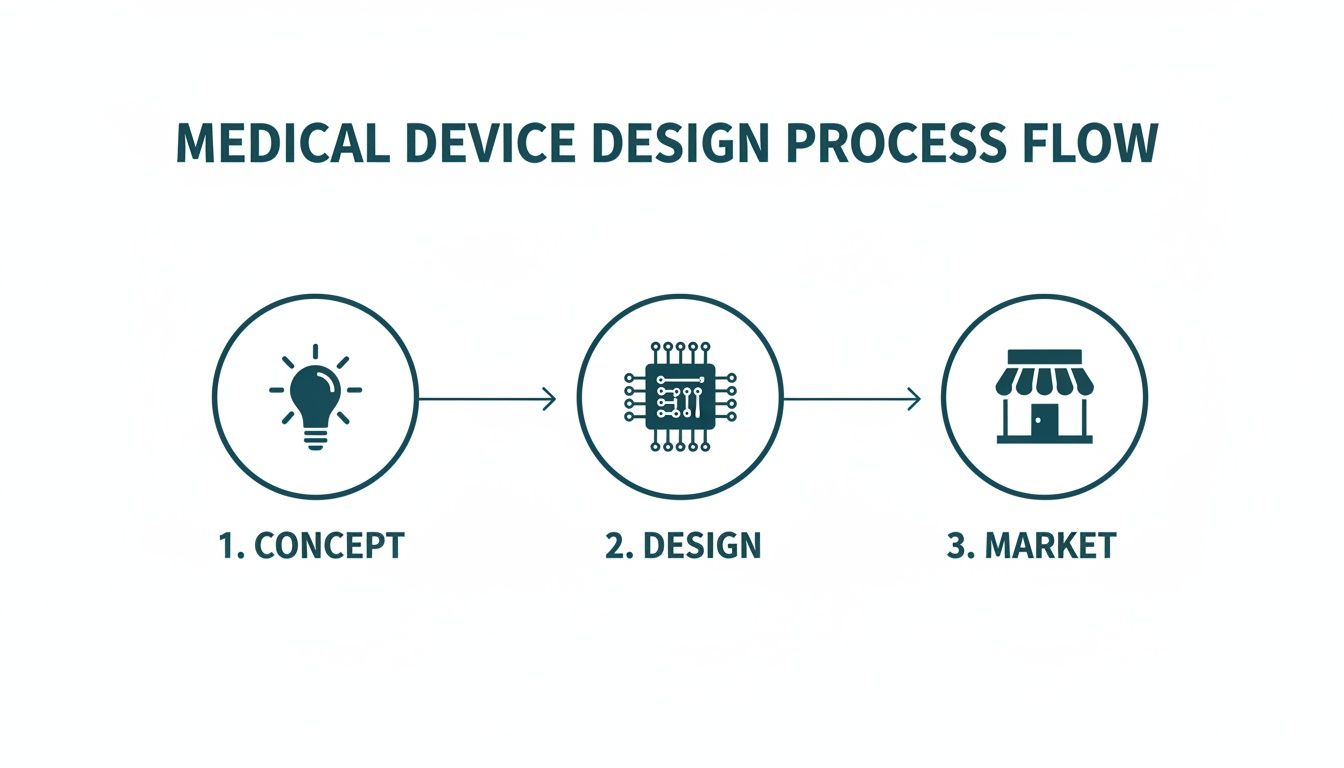
Each stage serves as a critical checkpoint where technical realities, regulatory requirements, and business goals must align to maintain project velocity and control risk.
Diagnosing Common Failure Points
Problem: A project jumps into detailed engineering with vague or incomplete requirements, leading to expensive rework, stalled timelines, and friction between hardware and firmware teams. The prototype is technically impressive but fails to meet user needs or regulatory demands, forcing a costly backtrack.
Diagnosis: The core issue is not a lack of engineering talent; it’s the absence of a disciplined, front-loaded process that treats compliance (e.g., ISO 13485) and manufacturability as primary design inputs, not as afterthoughts.
This is especially critical as the medical device engineering services market expands. Valued at USD 9.63 billion in 2025, it is projected to reach USD 22.54 billion by 2035, growing at a 9.0% CAGR, according to InsightAce Analytic. This growth is driven by demand for expertise in embedded systems, telehealth, AI, and IoT—all of which increase design complexity.
A Phased Solution for Predictable Outcomes
Solution: A phased development approach, governed by a mature Quality Management System (QMS), breaks the lifecycle into distinct stages with formal gates. This methodology mitigates risk and creates predictable timelines.
- Feasibility & Risk Analysis: Confirms technical viability, identifies potential hazards per ISO 14971, and maps the regulatory pathway before significant resources are committed.
- Requirements Definition: Translates user needs and business goals into concrete, verifiable technical specifications. You can learn more about defining project requirements in our detailed guide.
- System Architecture: Defines the high-level interaction between hardware, firmware, mechanical enclosures, and software.
- Detailed Design: Executes on the plan: schematic capture, PCB layout, firmware coding, and mechanical CAD modeling.
- Verification & Validation (V&V): Rigorous testing confirms the device was built correctly (verification) and that the correct device was built (validation).
Outcome: This structured process transforms development from a speculative exercise into a controlled, auditable process. The business impact is clear: reduced project risk, predictable timelines, and a higher probability of first-pass manufacturing success.
The Four Pillars of Medical Device Engineering
Developing a medical device is an exercise in managed complexity. Success hinges on the seamless integration of four core engineering pillars: hardware, firmware, mechanical, and software/UX design. A failure in one discipline can compromise the entire system, leading to costly delays, regulatory hurdles, or complete product failure.
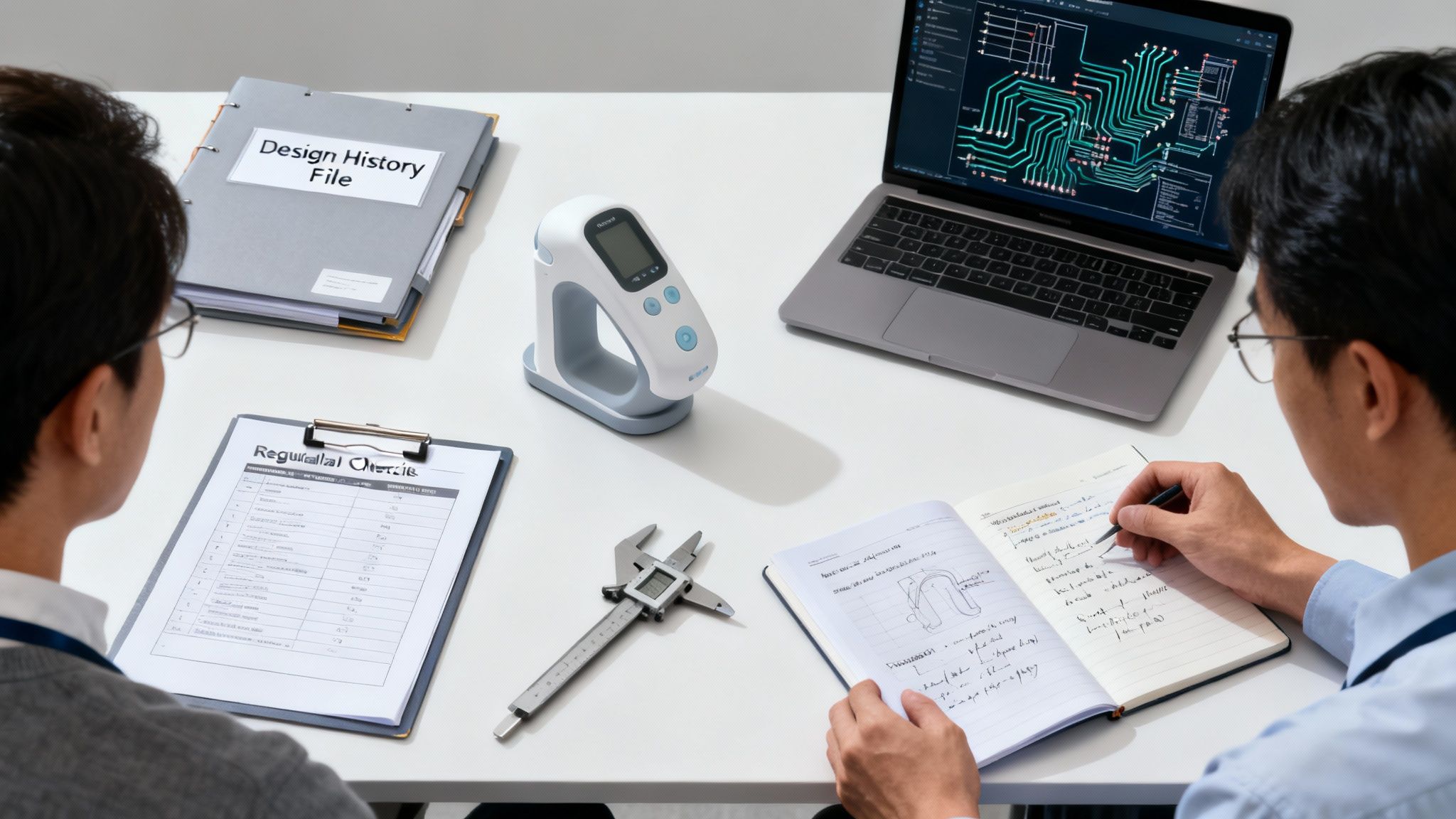
The table below diagnoses common failure modes in each discipline and outlines concrete mitigation strategies, connecting technical decisions to direct business impact.
Core Engineering Disciplines in Medical Device Design
| Discipline | Common Failure Mode (Diagnosis) | Mitigation Strategy (Solution) | Business Impact |
|---|---|---|---|
| Hardware Engineering | Poor signal integrity from a suboptimal Printed Circuit Board (PCB) layout, leading to noisy, unreliable sensor data and failed EMC testing. | Design for Electromagnetic Compatibility (EMC) from day one. Prioritize strategic component placement, controlled impedance routing, and robust grounding schemes per IEC 60601-1-2. | Avoids costly board respins, accelerates the testing timeline by weeks or months, and ensures the device functions reliably in its clinical environment, reducing overall project risk. |
| Firmware Development | A non-deterministic firmware architecture (like a simple super-loop) fails to meet hard real-time constraints, causing missed deadlines for critical tasks like motor control. | Architect the firmware using a Real-Time Operating System (RTOS) or a bare-metal scheduler. This ensures task prioritization and preemption, aligning with IEC 62304 software lifecycle processes. | Guarantees predictable, reliable performance, which is non-negotiable for patient safety. This disciplined approach satisfies regulatory demands and creates a scalable, maintainable codebase for future updates. |
| Mechanical Design | The initial design prioritizes aesthetics over manufacturability, resulting in complex parts that are prohibitively expensive to produce at scale using methods like injection molding. | Integrate Design for Manufacturability (DFM) principles early. Simplify part geometries, design for efficient assembly (e.g., snap-fits), and select materials that balance cost, durability, and biocompatibility. | Drastically reduces unit production cost and project budget overruns. Ensures a stable supply chain and improves profitability, directly impacting the device's market competitiveness and long-term viability. |
| Software & UX/UI | The user interface is confusing or clunky, leading to user errors, frustration, and a failure to meet usability requirements (IEC 62366). The device works, but nobody can use it properly. | Conduct rigorous human factors engineering and usability testing with target users throughout the design process. Develop intuitive workflows and clear information architecture based on real-world feedback. | Increases user adoption and reduces the risk of use-related errors, which is a major patient safety and regulatory concern. A strong UX becomes a key competitive differentiator and builds brand loyalty. |
Each of these pillars is critical, and a weakness in one can easily undermine the strengths of the others.
Real-World Use Case: Infusion Pump Firmware Failure
Problem: A portable infusion pump's firmware occasionally misses its deadlines for motor control, creating a tangible risk of delivering an inaccurate medication dose.
Diagnosis: This is a classic failure to meet hard real-time performance constraints. The firmware was likely built on a simple "super-loop" or a non-preemptive scheduler. Under heavy load, this architecture cannot guarantee that a high-priority task (like motor control) will execute precisely when required. This directly contravenes the safety and reliability principles outlined in standards like IEC 62304.
Solution: The robust solution is to re-architect the firmware around a Real-Time Operating System (RTOS) or a bare-metal scheduler designed for deterministic behavior. This approach, which aligns with the software lifecycle processes of IEC 62304, enables task prioritization and preemption. High-priority functions are guaranteed the necessary CPU resources exactly when needed, regardless of other system activity.
Outcome: The re-architected firmware delivers predictable, reliable performance, eliminating the risk of missed deadlines and ensuring patient safety. This disciplined process satisfies stringent regulatory requirements for medical software and builds a scalable, maintainable codebase for future product iterations, reducing long-term technical debt.
Integrating Quality and Compliance into Your Design
In medical device development, treating compliance as a final gate is a critical error. It is not a checklist to be completed at the end of a project; it is the foundation upon which the entire project must be built. Deferring regulatory considerations is a direct path to catastrophic delays, budget overruns, and failed submissions.
Quality must be designed in from the initial concept, not inspected in during a final audit.
This requires moving beyond mere acknowledgement of standards like ISO 13485 for Quality Management Systems (QMS) and ISO 14971 for Risk Management. It means embedding these frameworks into the daily engineering workflow, making them an active component of the design and development process.
A Real-World Scenario in a Class II Device
Consider a common, preventable failure scenario.
Problem: A team developing a new portable ultrasound scanner (a Class II device) rushes through the initial requirements phase. They capture high-level features but fail to rigorously document detailed design inputs, such as specific performance specifications, granular user needs from varied clinical environments, and a comprehensive list of applicable standards. The engineers proceed, believing they have a clear directive.
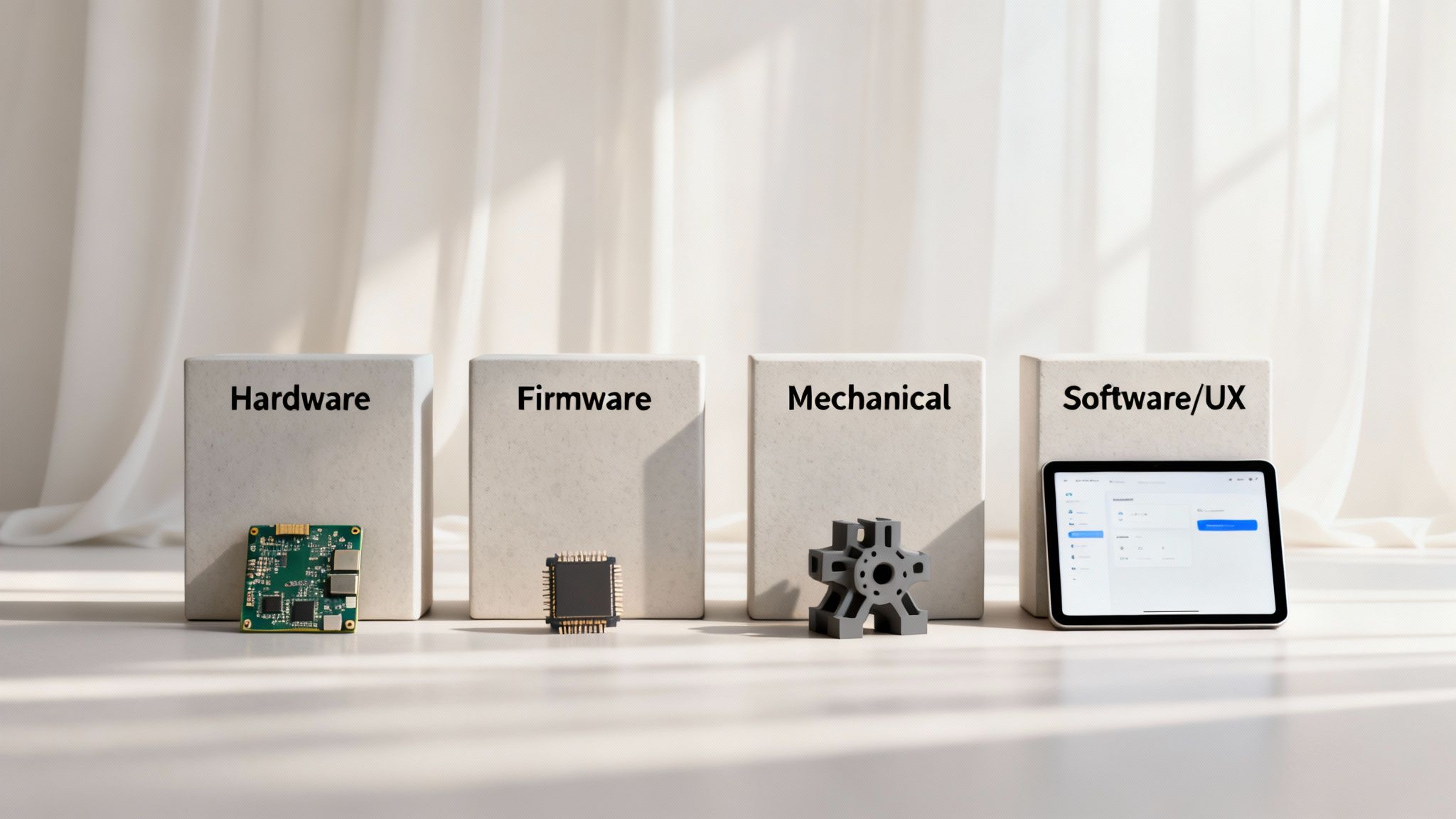
Diagnosis: This is a systemic breakdown of the QMS and a failure of design controls. The Design History File (DHF)—the auditable record proving the device was designed according to a formal plan—is compromised from the start. Without traceable inputs, subsequent verification and validation tests lack a solid foundation. It becomes impossible to objectively demonstrate that the device meets its intended use, a core requirement for regulatory clearance.
Solution: The remedy is a formal, phase-gate development process implemented from day one. This approach mandates documented reviews at each critical milestone before the project can advance.
- Design Input Review: All user needs, technical requirements, and regulatory standards are formally documented and approved by a cross-functional team.
- Design Output Traceability: Every specification, schematic, and code module (the outputs) must trace directly back to a specific, approved input.
- Milestone Audits: The DHF is audited at the end of each phase (e.g., prototype, pre-production) to ensure it is complete, accurate, and ready for regulatory scrutiny.
This structured methodology, which includes understanding hurdles like CE marking requirements for electronic equipment, transforms compliance from an abstract burden into a series of concrete, verifiable engineering tasks.
The Business Impact of a Proactive Approach
The trade-off is simple: invest administrative and engineering effort upfront, or incur an exponentially higher cost later. A critical component of this upfront work is developing a robust risk management plan that serves as a playbook for identifying and mitigating potential hazards.
The upfront effort of meticulous DHF documentation and phase-gate reviews is a fraction of the cost—in both time and capital—of remediating a 510(k) submission rejected by the FDA or, worse, failing a quality system audit post-launch.
A rejected submission can add 6 to 12 months to a launch timeline, necessitating a frantic and expensive effort to reverse-engineer documentation and re-run tests. A failed audit can halt production entirely.
By embedding a culture of quality from the outset, you are not merely satisfying regulators; you are de-risking the entire commercialization process. This discipline transforms your regulatory strategy from a defensive liability into a competitive advantage, accelerating reliable market access.
Bridging the Gap from Prototype to Production
Developing a functional prototype is a milestone, but converting that proof-of-concept into a scalable, manufacturable, and regulator-approved product is a distinct and more demanding challenge. This is where many promising innovations falter.
The journey from the lab bench to the factory floor requires a shift in mindset from "Does it work?" to a more rigorous set of questions governed by formal processes. Success depends on mastering two critical disciplines: Verification and Validation (V&V), and Design for Manufacturability (DFM). These are not final-stage activities but parallel workstreams that must inform the design from its inception.
Verification vs. Validation: A Critical Distinction
In the context of medical devices, these terms have precise, non-interchangeable meanings. Regulators expect clear evidence for both.
-
Verification answers, "Did we build the device right?" This is the objective process of proving that your design outputs (schematics, code, CAD files) meet your specified design inputs and requirements. It involves technical tests, code reviews, and detailed analyses.
-
Validation answers, "Did we build the right device?" This confirms that the final product meets the end-user's needs in its intended clinical environment. This is where human factors engineering and usability testing, guided by standards like IEC 62366-1, are essential.
A device can be perfectly verified—meeting every technical specification—yet fail validation if clinicians find it confusing, cumbersome, or unsafe in a real-world setting. This disconnect is a classic cause of late-stage project failure.
Real-World Failure Mode: The Connected Infusion Pump
Consider a new, connected infusion pump designed for a hospital environment.
Problem: The prototype performs flawlessly on the test bench. Verification is a success. However, during summative usability testing with practicing nurses, a critical flaw emerges: 25% of users consistently make errors programming complex infusion protocols, creating a high risk of a serious dosing error.
Diagnosis: The root cause was a failure to integrate human factors engineering from the beginning. The user interface, while logical to an engineer, was unintuitive to a clinician under pressure. The UI satisfied a list of system requirements but failed to support an actual human workflow.
Solution: A significant redesign of the UI and user workflow, this time guided by formative usability studies. Interactive wireframes were tested with nurses early and often to identify pain points before new firmware was written. The final design incorporated clearer on-screen prompts, logical function grouping, and fail-safes to make incorrect parameter entry more difficult.
Outcome: The redesigned UI passed a second round of summative validation with a near-zero critical error rate. The rework added three months to the timeline but averted a potential post-market recall or an outright rejection during regulatory submission, saving significant long-term cost and brand damage.
For a deeper look into this transition, explore our guide on the journey from a works-like prototype to a production-ready product.
Designing for Manufacturability and Supply Chain Stability
The bridge to production is built on a solid foundation of Design for Manufacturability (DFM). Early-stage CAD and PCB layout decisions directly impact production yield, unit cost, and supply chain resilience. An experienced design partner designs for the factory, not just the lab.
Key DFM considerations include:
- Component Selection: Choosing components based on stable availability, reasonable lead times, and multiple sourcing options to mitigate the risk of a sole-supplier shutdown.
- PCB Layout for Assembly: Arranging components to facilitate automated pick-and-place assembly, minimizing costly and error-prone manual steps.
- Mechanical Enclosure Design: Favoring designs optimized for high-volume processes like injection molding, paying attention to details like draft angles, uniform wall thickness, and avoiding geometries that drive up tooling costs.
Integrating DFM from the start ensures the device is not just a prototype but a commercially viable product.
How to Select the Right Medical Device Design Partner
Choosing a medical device design partner is a critical decision that directly impacts project timeline, budget, and market success. Many design firms appear similar on the surface, but a lack of regulatory and technical depth can lead to stalled projects and costly rescue efforts.
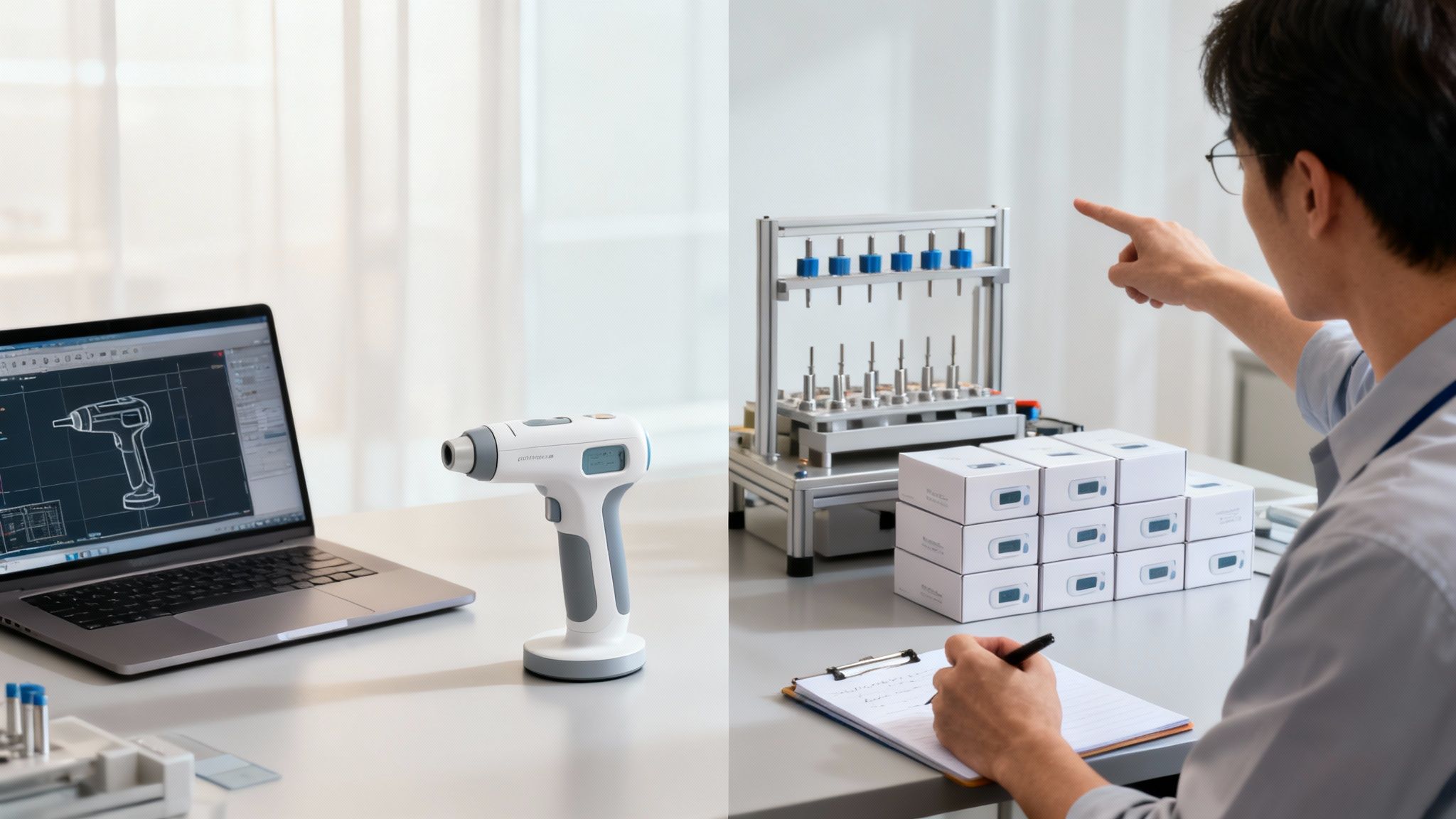
The diagnosis for a failed partnership is almost always a failure to conduct deep, technical due diligence. A slick sales pitch is not a substitute for a rigorous evaluation framework.
Vetting Technical and Regulatory Competence
A partner’s true value lies in their documented processes and demonstrable experience. Focus on verifiable qualifications and a track record that matches your needs.
Key vetting steps:
- Verify ISO 13485 Certification: Ask to see their certificate. A firm that is merely “compliant” or uncertified introduces unacceptable risk into your Quality Management System (QMS).
- Assess FDA Product Code Experience: Inquire about their experience with devices under similar FDA product codes. A team that has successfully navigated 510(k) submissions for comparable devices understands the specific predicates, testing requirements, and regulatory hurdles.
- Examine their Design History File (DHF) Process: Request a redacted example of a DHF table of contents. A mature partner will have a well-defined, template-driven process for managing design controls.
A vague, fixed-bid proposal often signals inexperience. A credible partner provides a detailed, phased proposal that reflects a thorough understanding of the development lifecycle, risk management activities, and key regulatory milestones.
The Design Partner Evaluation Checklist
Use a structured approach to compare potential partners. This checklist is designed to ask pointed questions that reveal a firm’s true capabilities and uncover potential red flags.
Design Partner Evaluation Checklist
| Evaluation Criteria | Key Questions to Ask | Red Flags to Watch For |
|---|---|---|
| Quality Management System | Can you provide your ISO 13485 certificate? How do you manage Design History File (DHF) documentation and traceability? | Claims of being "ISO compliant" without actual certification. Vague answers about their DHF process or an inability to show structured examples. |
| Risk Management Process | Describe your process for risk analysis per ISO 14971. At what stage do you create the initial hazard analysis? | Treating risk management as a late-stage documentation task. It should be an integral part of the design process from day one. |
| Program Management | How will our project be staffed? Who is the single point of accountability? What is your process for managing suppliers and contract manufacturers? | Lack of a dedicated, accountable program lead. Ambiguity around how they qualify and manage third-party suppliers, which can introduce massive supply chain risk. |
| Technical Expertise | Can you share examples of projects with similar technical complexity (e.g., hard real-time firmware, specific sensor integration)? | A portfolio that doesn't align with your technical needs. Glossing over engineering challenges with generic assurances instead of specific mitigation strategies. |
This rigorous evaluation provides a data-driven solution for partner selection. The outcome is a partnership built on proven regulatory discipline and technical excellence, reducing the risk of rework, budget overruns, and failed submissions.
Your Roadmap from Concept to Commercial Reality
Successfully bringing a medical device to market requires more than just skilled engineering; it demands a strategic partnership grounded in regulatory discipline and a deep understanding of manufacturing realities.
Integrating design, regulatory, and manufacturing considerations from day one is the only reliable method to control costs, compress timelines, and mitigate critical regulatory risks.
The most significant preventable cost in medical device development is the systemic failure to design for compliance and manufacturability from the outset. This oversight transforms minor issues into major, expensive rework late in the project lifecycle.
A true design services partner acts as an integrator, ensuring every decision is filtered through three critical lenses: Is it technically viable? Does it satisfy regulatory requirements? Can it be manufactured efficiently? This integrated discipline is what separates a smooth launch from a cycle of delays and redesigns.
If your project is stalled by technical hurdles or regulatory uncertainty, a focused expert assessment can provide clarity. Pinpointing core issues in your hardware, firmware, or development process allows for the creation of an actionable plan to overcome these roadblocks.
If your project requires a clearer path forward, a brief assessment with our engineering leads can help identify technical and regulatory gaps and map out a strategy designed for first-pass success.
Common Questions from the Trenches
Here are direct answers to common questions regarding timelines, regulations, and costs in medical device design.
What’s a Realistic Timeline for a Class II Medical Device?
A typical project for a Class II device, from initial concept to successful 510(k) clearance, ranges from 18 to 36 months.
Factors that extend the timeline include novel technology, the need for extensive clinical data, or an inefficient design and testing process. An experienced partner can often shorten this timeline by anticipating and mitigating common regulatory and technical roadblocks. Factoring in long-lead-time components and planning for multiple prototype iterations from the start is also critical for schedule adherence.
How Does ISO 13485 Actually Affect the Design Work?
ISO 13485 is the blueprint for the entire project, defining the rules for your Quality Management System (QMS) and structuring the engineering work through mandated "design controls."
This requires a rigorous, traceable process: formally documenting design inputs (what the device must do), design outputs (drawings and specifications), and every review, verification test, and validation study. Adhering to this discipline ensures a complete Design History File (DHF) is built throughout the project, which is non-negotiable for regulatory submissions. It also integrates risk management (per ISO 14971) into the core engineering workflow.
What Are the Biggest Hidden Costs We Should Watch Out For?
The most significant unforeseen costs in medical device development typically arise from two areas: inadequate regulatory planning and a failure to Design for Manufacturability (DFM).
Discovering a gap in your regulatory strategy late in development can force extensive redesigns and re-testing, consuming months and significant capital. Similarly, engineering a device that is difficult to manufacture at scale will erode profitability or necessitate a costly post-launch re-engineering effort. Other major hidden costs include rework due to poorly defined requirements and integration challenges between hardware and firmware teams.
The true cost of a design flaw isn't the price of the initial mistake. It’s the compounded expense of finding it late in the process, when every change is exponentially harder and more expensive to fix.
The most effective cost-control strategy is to partner with a firm that designs for both compliance and manufacturability from day one.
When Is the Right Time to Bring in a Design Firm?
The ideal time is during the early concept and feasibility stage.
Engaging a design partner at this point enables them to assist in defining requirements, conducting technical feasibility studies, and building a regulatory strategy from the ground up. This approach de-risks the entire project by identifying potential issues before significant capital has been invested. While firms can be engaged for "project rescue" missions, early engagement provides the greatest leverage to control timeline, budget, and the probability of commercial success.
If your medical device project is facing technical hurdles or regulatory uncertainty, a focused assessment can provide the necessary clarity. The engineering leads at Sheridan Technologies can help diagnose the core issues in your hardware, firmware, or development process and map out a clear path to market.
Schedule a brief, no-obligation consultation to discuss your project at https://sheridantech.io.