Table of Contents
When you hear “medical device engineering services,” don’t think of a generic temp agency for engineers. Think of a specialized, third-party strike team with the exact technical expertise needed to design, develop, and manufacture medical technology under the FDA’s watchful eye.
These services bring together all the critical disciplines—hardware, firmware, mechanical, and software engineering—to navigate the treacherous path from a great idea to a market-ready device that meets standards like ISO 13485 and IEC 62304. For companies trying to get to market faster without breaking the bank, they are often the missing piece of the puzzle.
Why MedTech Leaders Partner for Engineering Excellence
Even the most brilliant in-house R&D teams hit walls. The real challenge for MedTech leaders isn’t just innovating; it’s innovating under the immense pressure of regulatory compliance and fierce competition. Progress stalls and budgets inflate, not because the internal team is incapable, but because of a structural gap. There’s a massive difference between a team’s core strengths and the highly specialized, on-demand expertise needed to build a complex, regulated product from the ground up.
This strategic gap is exactly why more MedTech firms are turning to engineering partners. This isn’t a niche trend; it’s a core strategy. The market for these services was valued at USD 12.79 billion in 2025 and is projected to explode to USD 36.25 billion by 2033, growing at a 14.42% clip. As Grand View Research analysis shows, outsourcing has become a go-to play for manufacturers.
Diagnosing Common Development Hurdles
The decision to bring in outside help usually comes after hitting the same painful roadblocks over and over. These aren’t just minor inconveniences; they’re symptoms of deeper resource constraints that can jeopardize a project’s entire future.
Common hurdles look something like this:
- Specialized Skill Gaps: Your software team might be world-class, but do they have deep, battle-tested experience in real-time firmware engineering that’s fully compliant with IEC 62304? Do they understand the nuances of designing resilient hardware for a sterile, high-stakes clinical environment?
- Bandwidth Limitations: The A-team is often bogged down with sustaining engineering for existing products. Pulling them off to focus on a new R&D project means compromising the products that are paying the bills right now.
- Regulatory Blind Spots: Let’s be honest, navigating the maze of FDA submissions and maintaining an ISO 13485 compliant quality management system is a full-time job. One wrong turn in documentation or validation can trigger crippling delays and force expensive rework.
The Strategic Solution: An Engineering Partnership
This is where a true engineering partner changes the game. It’s a flexible, efficient solution that provides instant access to a full spectrum of engineering firepower—hardware, firmware, and mechanical design—all orchestrated by a single, accountable program lead. This model allows a company to augment its internal team with the exact experts it needs, for exactly as long as it needs them, without the cost and commitment of full-time hires.
The goal is never to replace an in-house team but to amplify its capabilities. A great partner integrates seamlessly, filling critical knowledge gaps in areas like Design for Manufacturability (DFM) or high-speed signal integrity—the kinds of details that determine first-pass success.
This approach tackles the root cause of the problem. Instead of hunting for that unicorn engineer who somehow masters five different disciplines, a MedTech leader can tap into a network of proven specialists. For instance, a project might need a top-tier RF engineer for three months to nail the wireless components, followed by a firmware security expert for just six weeks to lock it down. A partnership makes this kind of dynamic resourcing not just possible, but simple.
The result? A development process with far less risk. Costs are contained, and the timeline from concept to a market-ready, compliant device gets dramatically shorter. By bringing in specialized medical device engineering services, leaders can keep their internal teams focused on core innovation, confident that the foundational engineering is being executed to the highest possible standard.
Navigating The Medical Device Development Lifecycle
The journey of bringing a medical device to market is a rigorous, phase-gated process, governed by strict frameworks like ISO 13485. It’s not a straight line from A to B. Think of it as a series of iterative loops where every engineering step must be perfectly synchronized with quality management and meticulous documentation.
For any technical leader, understanding how a specialized engineering partner fits into this process is absolutely critical. It’s how you accurately forecast timelines, keep budgets in check, and head off risks before they become full-blown crises. Each phase calls for a different mix of engineering skills, from the first napkin sketch to the final handoff for manufacturing.
Getting one stage wrong creates a domino effect of expensive problems downstream. These issues often don’t surface until verification and validation—the point where fixing them is most painful and costly. This is the constant tightrope walk MedTech leaders are on.
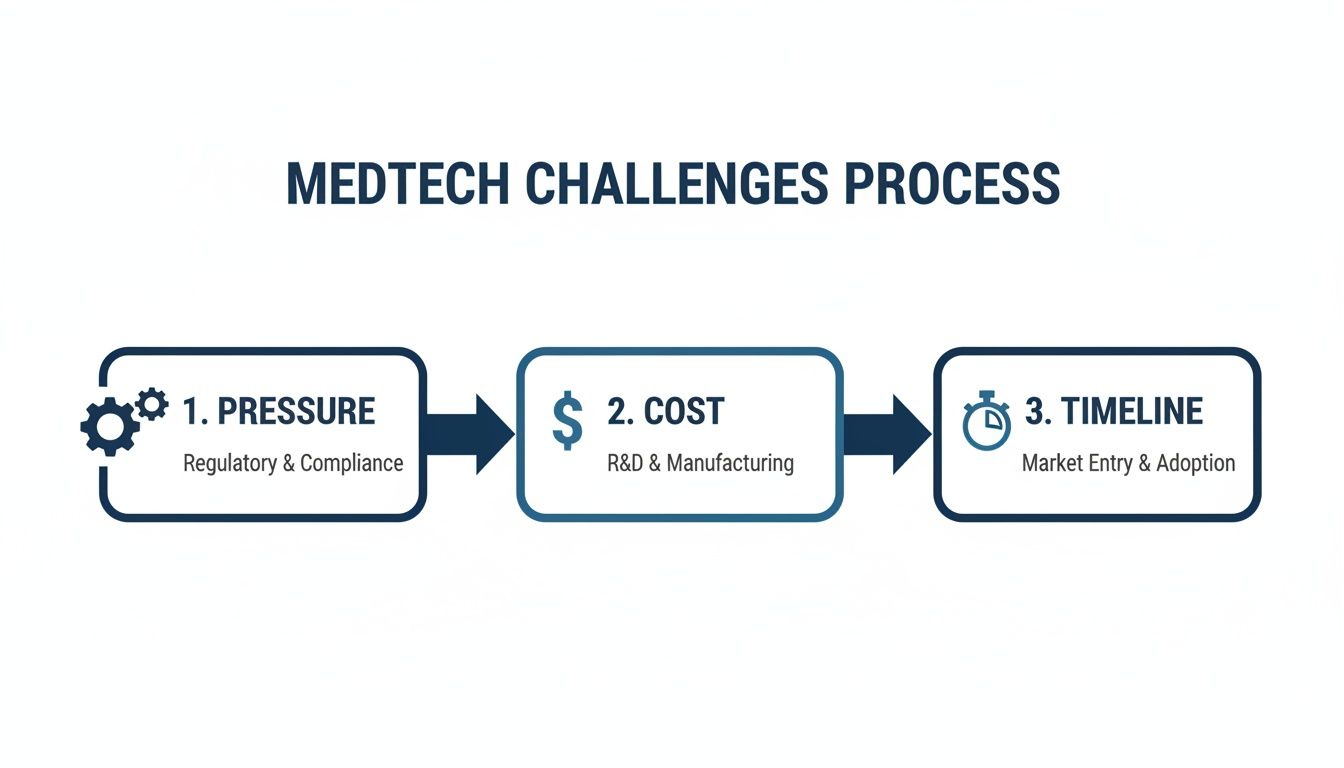
As the graphic shows, intense pressure, tight cost constraints, and aggressive timelines aren’t hurdles you clear one by one. They are constant, overlapping forces you have to manage all at once.
Concept and Feasibility
This is where an idea gets its first reality check. It’s not just about having a great concept; it’s about proving the device can be built reliably, affordably, and in a way that regulators will approve. An engineering partner is invaluable here, running technical feasibility studies, flagging technology risks, and building early proof-of-concept prototypes.
Key activities during this stage include:
- Requirements Gathering: This is where we translate what users and the market need into a preliminary set of technical specifications.
- Technology Assessment: We evaluate different hardware components, software architectures, and materials to map out the most robust and cost-effective path forward.
- Initial Risk Analysis: As required by ISO 14971, we start identifying potential hazards and failure modes right away to inform the entire design direction.
The main output is a high-level System Requirements Specification (SRS). This document becomes the bible for the project, preventing scope creep and making sure everyone is on the same page from day one.
Design and Development
Once the concept is deemed feasible, the project moves into the core design and development phase. This is where the heavy lifting happens, turning specifications into real designs, schematics, and code. Every single activity and output must be meticulously documented in the Design History File (DHF).
An expert engineering partner can seriously accelerate this stage by running multiple disciplines in parallel. While hardware engineers are laying out the PCB, firmware engineers are developing the low-level drivers, and mechanical engineers are modeling the enclosure for usability and ingress protection.
Integrating Design for Manufacturability (DFM) and Design for Test (DFT) principles from the very beginning is non-negotiable. Waiting until the design is “complete” to think about manufacturing is a classic, costly mistake that leads to expensive re-spins and massive delays.
A Real-World Scenario
Problem: A team was developing a Class II handheld diagnostic device. They were laser-focused on sensor accuracy, which led them to create a compact but incredibly complex PCB layout. Manufacturing considerations were pushed to “later.”
Diagnosis: When they finally sent the design to their contract manufacturer (CM), it was flat-out rejected. The component density made automated assembly impossible, and the lack of test points made functional verification painfully slow and expensive. The project was suddenly facing a six-month delay and a complete redesign.
Solution: For their next project, they brought in an engineering partner with deep DFM expertise from the start. This time, the team incorporated the CM’s feedback during the schematic capture and layout phase. The partner adjusted component placement for automated soldering and designed a bed-of-nails test fixture interface right onto the PCB.
Outcome: The new design passed the CM review on the first try. This single change cut manufacturing setup time by 75% and slashed per-unit testing costs by 30%. The device moved to V&V right on schedule, avoiding a market launch delay that would have cost millions.
The medical device development lifecycle is a structured journey with distinct phases, each carrying specific engineering, deliverable, and regulatory requirements. The table below breaks down these stages to provide a clearer picture of the process from concept to production.
Medical Device Development Phases and Key Engineering Deliverables
| Development Phase | Primary Engineering Focus | Key Deliverables | Regulatory Milestone (e.g., ISO 13485) |
|---|---|---|---|
| Concept & Feasibility | Technical viability, risk assessment, proof-of-concept. | System Requirements Specification (SRS), Feasibility Report, Initial Risk Analysis. | Early hazard identification (ISO 14971). |
| Design & Development | Detailed hardware, firmware, software, and mechanical design. | Detailed Schematics, Bill of Materials (BOM), Source Code, CAD Files, Design History File (DHF). | Design Controls and DHF documentation (21 CFR 820.30). |
| Prototyping & Iteration | Building functional units, testing subsystems, refining the design. | Functional Prototypes, Test Protocols & Reports, Design Reviews. | Design verification planning and execution. |
| Verification & Validation | Formal testing to confirm design outputs meet inputs (V&V). | V&V Protocols and Reports, Traceability Matrix, Usability Study Report. | Formal V&V activities, IEC 60601/62304 compliance testing. |
| Manufacturing Transfer | Preparing design for mass production, process validation. | Manufacturing Process Instructions (MPI), Test Fixture Designs, Finalized BOM. | Transfer to production, process validation (IQ/OQ/PQ). |
Understanding these phases and their deliverables is key to navigating the regulatory landscape and successfully launching a device.
Verification, Validation, and Transfer
The final stages are all about proof. Verification confirms you built the device right (it meets the design specifications). Validation confirms you built the right device (it meets the user's needs). This involves a battery of rigorous tests, including electrical safety (IEC 60601), software validation (IEC 62304), and usability studies.
Once validated, the engineering team bundles everything into a comprehensive package for manufacturing transfer. This ensures the CM can build the device consistently and at scale. A truly comprehensive approach also considers the entire product journey, including what happens at the end of its life. For instance, planning for specific Medical Equipment Disposal Best Practices for Healthcare Facilities ensures responsible product stewardship from cradle to grave.
The Core Engineering Disciplines and Their Business Impact
Bringing in a medical device engineering partner isn't about offloading tasks; it's about acquiring highly specific, outcome-driven expertise. Think of it less as outsourcing and more as insourcing a critical capability. Each engineering discipline plays a distinct role, directly shaping your device's reliability, user safety, and ultimately, your bottom line.
A simple list of services doesn't tell the whole story. The real question is: how does each piece of the puzzle mitigate risk and clear your path to a successful market launch?
The industry's growing reliance on these specialized skills is fueling some serious market expansion. The global medical device engineering services market, valued at USD 6.30 billion in 2025, is on track to hit USD 13.68 billion by 2032, growing at a healthy 11.7% CAGR. You can dig into the numbers in the full analysis from Coherent Market Insights. This isn't just growth for growth's sake; it shows a clear industry shift toward strategic partnerships to wrangle the ever-increasing complexity of device development.
Hardware and PCB Design
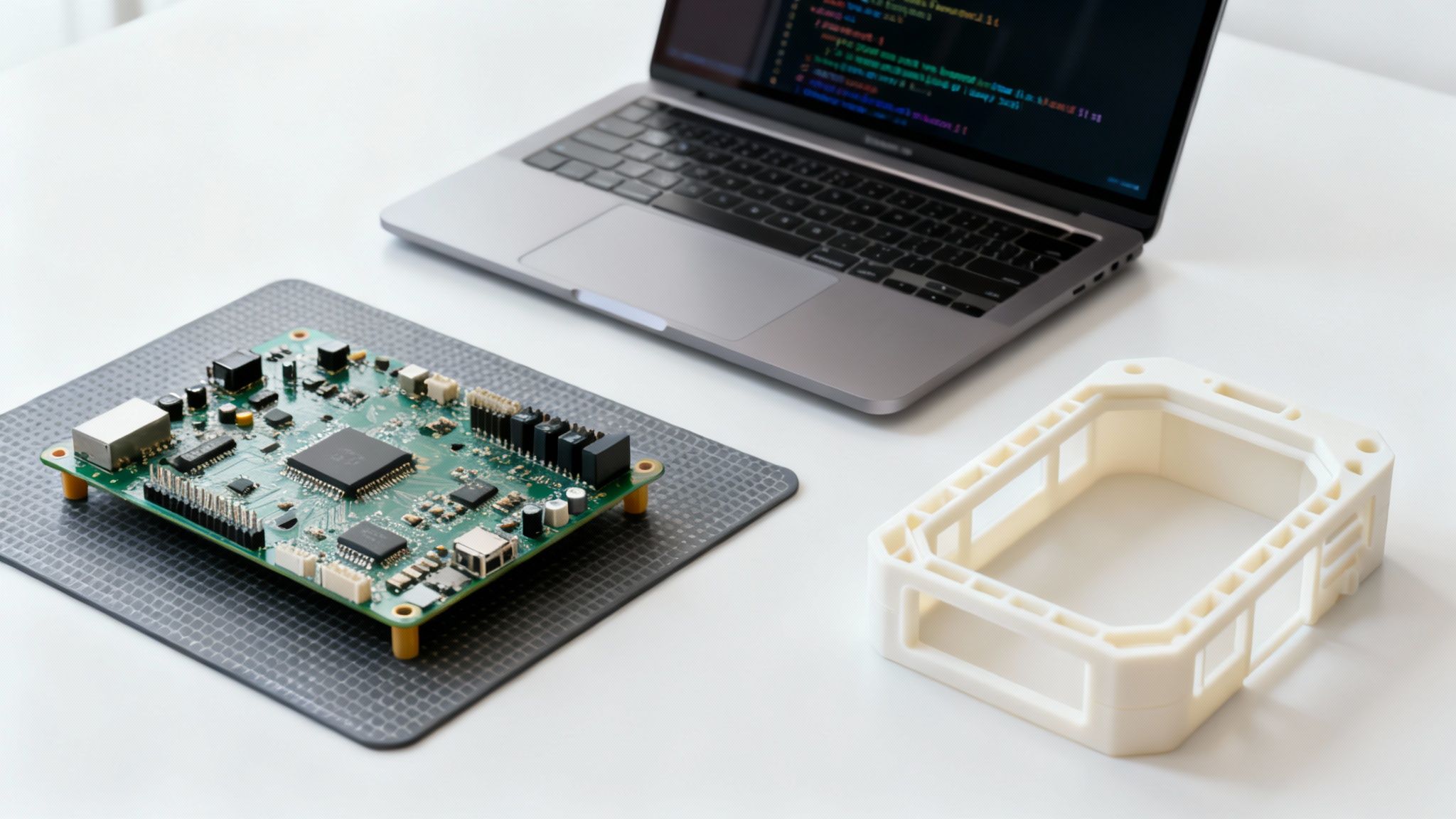
The printed circuit board (PCB) is the central nervous system of any modern medical device. A flaw here isn't a minor bug; it's a fundamental failure that can turn your device into a paperweight or, far worse, a danger to patients. Expert hardware engineering really boils down to two critical business impacts: data integrity and supply chain resilience.
Let's walk through a real-world scenario.
- Problem: A new patient monitoring device is spitting out intermittent, unreliable data. This is causing a flood of false alarms in the ICU and completely eroding clinical trust.
- Diagnosis: After investigation, the root cause is signal integrity issues on the PCB. Improper trace routing and poor shielding are corrupting the sensitive analog sensor data.
- Solution: An experienced hardware engineer steps in. They implement differential pair routing for the critical signals, add dedicated ground planes to isolate noisy digital components, and specify components with higher electromagnetic compatibility (EMC) ratings.
- Outcome: The device now delivers stable, accurate readings. It meets the performance specs for its FDA submission and, most importantly, keeps patients safe. This proactive design work just avoided a costly and time-consuming board re-spin late in the verification and validation phase.
Firmware Engineering
Firmware is the code that lives on the hardware, the critical link where the digital world meets the physical. Its reliability isn't just important; it's non-negotiable. In the regulated world of MedTech, firmware engineering isn't just about writing functional code. It’s about building a secure, stable, and deterministic system that is fully compliant with standards like IEC 62304.
The business impact is crystal clear: risk reduction. Well-architected firmware prevents device lockups, guarantees real-time performance for life-sustaining tasks, and hardens the device against unauthorized access. Every single line of that code has to be traceable back to a specific requirement in your Design History File (DHF).
A common—and dangerous—mistake is treating firmware like any other software project. Medical device firmware often operates in a hard real-time environment. In this world, a missed deadline in processing data isn’t a performance lag; it can be a catastrophic failure.
Mechanical Engineering and Prototyping
The mechanical design dictates how a user physically interacts with the device and how it holds up in its intended environment. This discipline is so much more than just designing a plastic box. It's an intricate blend of material science, human factors engineering (ergonomics), and designing for real-world clinical demands like sterilization or waterproofing. The objective is a device that is functional, intuitive, safe, and built to last.
Here are just a few of the strategic considerations at play:
- Biocompatibility: This involves selecting materials that strictly comply with ISO 10993 to ensure they won't cause adverse reactions when in contact with a patient.
- Usability: This means designing enclosures with intuitive button layouts, crystal-clear displays, and comfortable grips to minimize the chance of user error, especially in high-stress clinical settings.
- Sterilization Compatibility: It's about choosing materials and assembly techniques that can withstand repeated exposure to autoclaves, ethylene oxide (EtO), or other harsh sterilization processes without degrading over time.
Smart mechanical engineering, a core piece of our comprehensive medical device design services, directly leads to higher user adoption and fewer use-related adverse events—a major red flag for regulators. When you integrate these disciplines seamlessly, you transform a collection of disparate parts into a cohesive, compliant, and market-ready medical device.
How to Select the Right Engineering Partner
Choosing a medical device engineering partner is one of the most consequential decisions you'll make as a leader. Get it right, and you accelerate your timeline while de-risking the entire project. Get it wrong, and you can burn through capital, cripple your regulatory strategy, and end up with a product that’s dead on arrival.
This decision goes far beyond a simple capabilities checklist or picking the lowest bidder.
A truly effective evaluation comes down to verifying three core pillars: proven regulatory know-how, deep technical expertise in your specific device class, and a transparent, disciplined project management framework. Anything less is an invitation for unacceptable risk.
Differentiating True Partners from Mere Vendors
You need to know the difference between a true partner and a simple vendor. A vendor just builds what you ask them to. A partner, on the other hand, operates as a genuine extension of your team—they challenge your assumptions, pressure-test your strategy, and spot risks you haven’t even considered yet.
This distinction is everything. Here are the key differentiators to dig into:
- An ISO 13458-Aligned QMS: Don’t just ask if they have a Quality Management System; ask them to show you evidence of it. A real partner can walk you through how their internal processes for design controls, risk management, and documentation align with ISO 13485. If they’re vague or can’t articulate this clearly, they aren't prepared for medical device work.
- Direct Device Class Experience: Have they actually brought a Class II or Class III device to market? Successfully launching a simple Class I device doesn't even come close to preparing a firm for the rigors of a PMA submission. Demand specific, verifiable case studies that are directly relevant to your product’s risk profile.
- A Transparent DHF Process: How do they manage the Design History File (DHF)? This isn't a "nice-to-have"; it's a fundamental regulatory requirement. A mature partner will have a well-defined, auditable system for maintaining complete traceability from user needs all the way through to final verification and validation.
A Real-World Failure Mode: Choosing on Cost Alone
Here’s a story we’ve seen play out more than once.
Problem: A startup developing a novel Class II infusion pump picked an engineering firm based on a very attractive, low-cost proposal. The firm had a great portfolio in consumer electronics but was a newcomer to the MedTech space.
Diagnosis: The vendor’s lack of regulatory discipline became painfully obvious during the very first design review. Their documentation was a mess, their risk analysis was superficial, and they had no formal process for design controls. The startup's own quality team ended up spending more time managing the vendor's documentation gaps than actually focusing on the product.
Solution: The project was put on hold. The startup cut their losses and engaged a new partner—Sheridan Technologies—with a proven track record in medical devices. Our team immediately implemented a structured DHF and conducted a full FMEA (Failure Modes and Effects Analysis) according to ISO 14971 standards.
Outcome: The switch caused an initial three-month delay, but the project was ultimately saved. The disciplined approach of the new partner ensured the device met every single regulatory requirement for its 510(k) submission, which was cleared on the first pass. The initial "savings" from the low-cost vendor would have been completely wiped out by the cost of a failed submission and the inevitable redesign.
The most expensive engineering partner is often the one that fails to get your device cleared by regulators. Technical skill without regulatory discipline is a recipe for project failure.
A Practical Evaluation Checklist
When you're qualifying potential medical device engineering firms, a structured approach is your best defense against making a costly mistake. The checklist below provides a framework for asking the right questions—the ones that move beyond surface-level claims and uncover a firm’s true capabilities and maturity.
Engineering Partner Evaluation Checklist
| Evaluation Criteria | Key Questions to Ask | Red Flags to Watch For |
|---|---|---|
| Regulatory Acumen | How does your QMS align with ISO 13485? Can you walk us through a sanitized example of a DHF you've managed? | Vague answers on quality processes; inability to produce clear documentation examples. |
| Technical Expertise | Describe your team's experience with devices of a similar class and complexity. How do you handle challenges like signal integrity for sensitive analog sensors? | Citing only non-medical projects; a lack of technical depth on challenges specific to MedTech. |
| Project Management | Who will be our single point of contact? How do you manage scope changes and communicate progress on a weekly basis? | Multiple, shifting contacts; an unclear or informal process for change control. |
| Integration Capability | How do you ensure seamless integration between hardware, firmware, and mechanical engineering teams? | Siloed teams with poor cross-functional communication; no single, designated program lead. |
Ultimately, choosing the right partner comes down to trusting their process as much as their people. A single, accountable point of contact, backed by a dynamic network of vetted experts, provides the specialized skill and leadership needed to navigate the complexities of medical device development. This model avoids the integration risks that cripple so many promising projects.
Proven Strategies for Mitigating Development Risk
In medical device engineering, risk isn't just a line item on a project plan. It's a direct threat to patient safety, a potential roadblock to regulatory approval, and a massive commercial liability. Proactive, systematic risk management is not a bureaucratic chore; it is a strategic advantage.
Simply reacting to problems as they emerge is a surefire way to blow your budget, face catastrophic delays, and receive a rejection from the FDA. True risk mitigation is an active, ongoing process baked into every phase of development. It’s about anticipating failures before they occur and engineering resilience directly into your device and its documentation to build a safer product and clear a faster path to market.

Addressing Technical Risk with FMEA
Technical risk is the danger that the device itself will fail. It could be anything from a faulty capacitor to a subtle software bug. Your most powerful tool against this is a meticulous Failure Modes and Effects Analysis (FMEA), a structured process for mapping out what could go wrong and what happens when it does.
Think about this scenario:
- Problem: A design team overlooks a single point of failure in a power supply component. It’s a small oversight with huge consequences.
- Diagnosis: The risk analysis was treated like a checkbox activity. The team didn't dig deep into the cascading effects of one tiny component failing.
- Solution: A cross-functional team—hardware, firmware, and quality experts—gets together to conduct a proper FMEA. They quickly spot the weak link and design in a redundant power circuit. Now, the device stays on even if the primary component gives out. This entire process is documented to meet ISO 14971 standards.
- Outcome: A critical failure that could have easily triggered a Class I recall is completely designed out of the system. This single activity saves millions in potential costs and, more importantly, protects patients.
Mitigating Regulatory Risk Through Documentation
Regulatory risk is the chance that your device—no matter how innovative—gets rejected by the FDA because your paperwork isn't in order. The best defense against this is to build a comprehensive Design History File (DHF) right from the very beginning.
The DHF isn't a folder you frantically assemble at the end. It's a living record, an auditable trail of evidence proving your device was designed under control and meets every single requirement.
One of the most common and costly mistakes is waiting until the verification and validation phase to get organized. By then, the reasoning behind critical design choices is often forgotten, forcing teams to reverse-engineer justifications. Auditors see right through that. Integrating DHF management into daily work ensures total traceability and a far smoother submission. We lay the groundwork for this in the project discovery phase.
Overcoming Market Risk with Human Factors Engineering
Market risk is a painful one: you build a perfect, fully compliant device that clinicians and patients either can't figure out or just plain dislike. This is where Human Factors Engineering (HFE) and usability testing, guided by standards like IEC 62366, are absolutely essential.
Consider this all-too-common story:
- Problem: A major usability flaw is found just before launch. Users are consistently making a dangerous mistake during setup.
- Diagnosis: Human factors was an afterthought. The team waited until the design was finalized to let real users touch it.
- Solution: On the next project, they integrate formative usability studies from the earliest prototyping stages. They use direct feedback from clinicians to refine the user interface and physical design over and over again.
- Outcome: The final product is intuitive and error-proof. This leads to much higher user adoption and a dramatic reduction in use-related safety incidents.
Accelerating Your Path to Market Launch
Getting a medical device from a concept scribbled on a napkin to a market-cleared product is a gauntlet. Technical execution is just one piece of the puzzle. Real success comes from weaving together engineering disciplines, a proactive regulatory strategy, and an obsessive focus on manufacturability from the very first day.
For today’s MedTech leaders, bringing in specialized medical device engineering services isn’t a luxury anymore—it’s a core part of the game plan for anyone serious about innovating under pressure.
The benefits hit the bottom line directly and decisively. Partnering with the right experts allows companies to slash technical and regulatory risk, shave critical time off development schedules, and be smarter with their capital. It transforms what is often a series of disconnected, high-stakes stages into a single, cohesive, and professionally managed program.
Your Strategic Advantage with an Integrated Partner
This is exactly where Sheridan Technologies creates a clear advantage. We don’t just provide piecemeal engineering support; we deliver end-to-end program leadership.
Our Dynamic Expert Network gives you on-demand access to elite specialists perfectly matched to what your project needs right now—whether that’s complex firmware, ruggedized hardware, or deep human factors engineering. A single, accountable program lead directs every moving part, ensuring we get it right the first time. For a closer look at our methodology, check out our guide on moving from a working prototype to a scalable product.
Success isn't just about building a device that works; it's about building a compliant, manufacturable, and commercially viable product. That requires a partner who understands the entire ecosystem—from initial architecture to the manufacturing floor.
This integrated approach is the definitive answer to the challenges of modern device development. It provides the technical depth, regulatory foresight, and project discipline required to turn ambitious concepts into market-ready realities, faster and with far more certainty.
If your organization is staring down a complex technical or regulatory roadmap, let’s talk. Schedule a brief, confidential consultation with our engineering leadership to assess your project and find opportunities to get you to market faster.
Frequently Asked Questions
When you're evaluating a potential engineering partner for a medical device, you'll find a lot of the same questions pop up. It's not just about the tech; it's about the practicalities of the relationship, who owns what, and how you'll get through the FDA. Let's tackle the most common ones head-on.
What's The Best Way To Structure The Engagement?
There's no single "right" way to structure a partnership; it really comes down to your internal team's bandwidth, the project's complexity, and how much day-to-day control you want to maintain. The goal is always to get the right expertise where you need it, without paying for overhead you don't.
Most engagements fall into one of three buckets:
- Fully Managed Program: This is the "turnkey" option. The engineering partner takes the wheel for the entire project, from the first napkin sketch all the way to handoff for manufacturing. It's the perfect fit if you need a complete, outsourced R&D team with one person to call.
- Project-Based Engagement: Think of this as hiring a specialist for a very specific job. You have a well-defined scope, a clear set of deliverables, and a timeline. Maybe you just need the firmware developed for a new handheld, or a specific mechanical part redesigned for better manufacturability.
- Staff Augmentation: Sometimes you just have a very specific, temporary skill gap. You might need a firmware security expert for six months or an RF antenna designer for a critical phase. This model embeds their engineer directly into your team, giving you maximum control.
It’s a classic trade-off between control and responsibility. A fully managed program frees up your internal team but requires a high degree of trust in your partner. Staff augmentation gives you total control but means your team is still managing the project.
How Does Intellectual Property Work?
This is non-negotiable. Before any work starts, the handling of intellectual property (IP) needs to be crystal clear. In the world of professional medical device engineering, the gold standard—and the only acceptable answer—is that the client retains 100% ownership of all IP developed for the project.
This should be spelled out in your Master Services Agreement (MSA). The contract must explicitly state that every invention, line of source code, schematic, and design file created during the engagement is your exclusive property. Any reputable partner will have this as their default and will have a clean process for handing over all IP assets when the project wraps up.
Red Flag: If a potential partner even hints at a joint ownership model or wants to retain rights to the core IP they develop for your product, walk away. It creates massive complications down the road for funding, acquisitions, or even just expanding your product line.
What Kind Of Documentation Should I Expect?
You should expect—and demand—a documentation package that's comprehensive enough to build your Design History File (DHF) and sail through a regulatory audit. A great engineering partner doesn't just hand you a working prototype. They deliver the auditable proof that regulators like the FDA (21 CFR 820.30) and international bodies (ISO 13485) require.
At a minimum, this package should always include:
- Design Inputs: Detailed system and subsystem requirements.
- Design Outputs: The final schematics, Bill of Materials (BOM), fully commented source code, CAD files, and assembly instructions.
- Verification and Validation: The complete V&V test protocols and the final reports that prove every single design input was met.
- Risk Management File: A thorough risk analysis, typically an FMEA, that is fully compliant with ISO 14971.
This documentation isn't a scramble at the end. It’s generated in lockstep with the development process, ensuring everything is accurate and traceable from the very beginning.
How Is Regulatory Compliance Guaranteed?
Compliance isn't an accident; it's the result of a disciplined, process-driven engineering culture. It has to be baked into the workflow from day one, all managed under a robust Quality Management System (QMS).
A partner demonstrates this by strictly following established standards like ISO 13485 for their quality system and IEC 62304 for the software development lifecycle. This means mandatory design reviews at every key milestone, rigorous version control for every file, and a traceability matrix that connects every single requirement to its design output and the test that verified it. It's a meticulous process, but it's the only reliable way to develop a medical device that is safe, effective, and ready for regulatory submission.
Bringing a medical device to market requires a partner who combines deep technical skill with unwavering regulatory discipline. Sheridan Technologies provides that end-to-end program leadership, powered by our Dynamic Expert Network, to shorten your path from a great idea to a market-ready, compliant product.
If you're facing a complex development challenge, schedule a confidential assessment with our engineering leaders to see how we can de-risk your project and accelerate your time to market.