
Table of Contents
Choosing a product development firm is a high-stakes decision that dictates your project’s trajectory and business outcomes. The right partner acts as a force multiplier, navigating technical complexity to deliver a market-ready product on schedule and within budget. The wrong one becomes an anchor, pulling your project into a morass of technical debt, budget overruns, and missed market windows.
The Strategic Cost of a Misaligned Partnership
As an engineering leader, you are accountable for delivering functional, reliable products to market. A stalled project is not merely a technical setback; it’s a business failure that consumes capital, erodes stakeholder confidence, and cedes ground to competitors. While it’s tempting to attribute failures to discrete events—a component shortage, a missed deadline—the root cause is often a systemic misalignment with a development partner lacking end-to-end expertise.
The core problem is often a failure to integrate manufacturability into the earliest stages of design. Engaging a firm without a deep, process-driven understanding of the entire product lifecycle—from architecture to scaled production—introduces unacceptable risk.
From Tactical Sourcing to Strategic De-risking
Viewing partner selection as a strategic alliance rather than a procurement task fundamentally changes the evaluation criteria. You aren’t just sourcing hours; you are integrating a critical capability that directly impacts business outcomes. The performance gap is stark: best-in-class companies achieve a 76% success rate for new products, while average firms barely clear 51%. This delta underscores how an elite engineering partner can improve outcomes, particularly when industry data shows that rework affects 49% of projects. You can review more of these product development statistics here.
Problem → Diagnosis → Solution: A Common Failure Mode
- Problem: An industrial IoT device project is six months behind schedule and 40% over budget after the “final” prototype was delivered.
- Diagnosis: The initial firm, skilled in rapid prototyping, delivered a functional model with no consideration for Design for Manufacturability (DFM) or Design for Assembly (DFA). The enclosure required complex tooling, the PCB layout created thermal management issues, and the bill of materials (BOM) relied on sole-sourced components with long lead times. It was impossible to build reliably or cost-effectively at scale.
- Solution: A complete redesign was required, focused on DFM from day one. This involved re-architecting the board layout for thermal dissipation, redesigning the enclosure for high-yield injection molding, and specifying a BOM with multi-sourced, available components.
- Outcome: While the redesign added an initial delay, it resulted in a product that was 20% cheaper per unit and could be manufactured with a 99% first-pass yield, ultimately enabling a profitable launch. The initial “fast” prototype was a costly illusion.
The solution is a structured evaluation that prioritizes firms with integrated, end-to-end expertise. You need a partner whose engineers are considering supply chain constraints and assembly processes during the first architecture review. Key indicators of a strategic product development firm include:
- Integrated Expertise: Hardware, firmware, and mechanical engineering teams that operate as a single, cohesive unit, not as siloed functions.
- Manufacturing Foresight: A documented, mandatory process for DFM and Design for Test (DFT) that begins at project inception.
- Accountable Leadership: A single, dedicated program lead who owns the entire project lifecycle and serves as the primary technical and commercial point of contact.
Insisting on a partnership architected for manufacturability de-risks the entire development lifecycle, transforming a high-risk endeavor into a predictable, controllable process.
Differentiating a Partner from a Vendor: Assessing Integrated Capabilities
A premier product development firm operates as an integrated system, not a collection of discrete services. As an engineering leader, you must verify cross-functional mastery across the entire technology stack. The presence of hardware, firmware, and mechanical engineers is table stakes; the critical differentiator is how these disciplines are systematically integrated to prevent costly downstream failures.
A frequent failure mode is siloed execution. Consider a medical device where the electrical engineering team designs a functionally brilliant PCB, but the mechanical team’s enclosure design makes assembly unfeasible at scale or fails to account for proper thermal dissipation. The issue isn’t a lack of talent in either discipline; it’s a breakdown in the integrated process. The result is a design that performs on a lab bench but is non-viable for production, leading to expensive rework, schedule slips, and a compromised ROI.
The antidote is a partner with a non-negotiable, integrated process from project inception. This means electrical, firmware, and mechanical engineers are co-located in design reviews from the initial architecture phase, all focused on achieving Design for Manufacturability (DFM).
From Silos to Systems
An effective partner thinks in systems, not silos. When vetting a firm, you must probe their ability to merge these engineering domains into a coherent strategy. Use this checklist to assess their systemic approach:
Firmware and Embedded Systems: Go beyond checking for C/C++ proficiency. Ask for specific experience with real-time operating systems (RTOS) versus bare-metal development. Inquire about their process for implementing secure bootloaders or optimizing for ultra-low-power operation. Request a walkthrough of a project where they managed a complex hardware abstraction layer (HAL) to de-risk a transition to a new microcontroller.
Hardware and Electrical Engineering: The portfolio must demonstrate more than simple two-layer PCBs. Look for evidence of complex, high-speed digital, mixed-signal, or RF designs. Ask specific, targeted questions: “How did you mitigate crosstalk on a high-density board with parallel buses?” or “Describe your methodology for power integrity analysis on a recent low-power IoT device.” This probes for genuine expertise in signal integrity, power distribution network (PDN) design, and EMI/EMC mitigation for regulated environments.
Mechanical Engineering and 3D CAD: Move past aesthetic renderings. Probe their expertise in material selection, finite element analysis (FEA) for thermal and structural validation, and tolerance stack-up analysis. A mature partner will provide CAD models designed for specific manufacturing processes (e.g., injection molding with appropriate draft angles, CNC machining with realistic toolpaths) from the start, not as a post-prototype afterthought. This early focus is a critical part of a successful project discovery phase.
Assessing Software and Security Proficiency
In today’s connected landscape, a physical product’s software and security posture are integral to its viability. A partner’s ability to identify and mitigate application security vulnerabilities is a critical, non-negotiable capability.
The firm’s capacity to build secure, scalable, and maintainable software—from companion mobile applications to cloud data platforms—is paramount. They must demonstrate a documented process for threat modeling, adherence to secure coding practices (e.g., MISRA C for safety-critical systems), and a clear strategy for post-launch security maintenance and patching. A failure in this domain exposes your business to significant risk, from reputational damage due to data breaches to operational failure of devices in the field.
This concept map illustrates the interconnected nature of project risks. Budget overruns and missed deadlines are lagging indicators of deeper, systemic problems—often rooted in a disconnected, siloed development process.
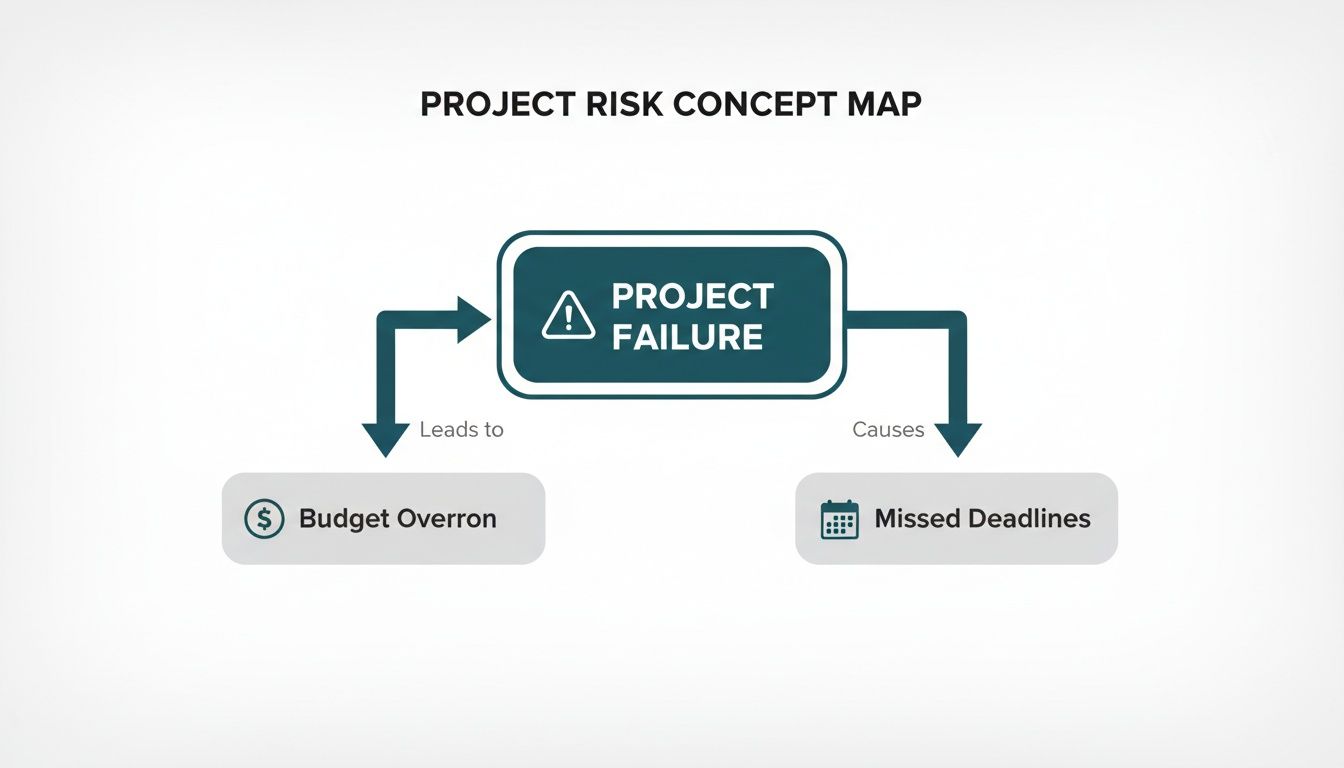
The visual clarifies that by the time you see schedule and budget deviations, the foundational error has already occurred. This typically stems from a lack of integrated expertise early in the design cycle.
By shifting your evaluation from a checklist of services to a deep analysis of a firm’s integrated development process, you can identify a true strategic partner—one that proactively eliminates risk rather than reactively managing crises.
Engagement Models: Static Bench vs. Dynamic Expert Network
A firm’s operational structure directly impacts project velocity, cost-efficiency, and access to specialized talent. A misalignment between your project’s needs and the firm’s engagement model creates friction, introduces hidden costs, and leads to delays.
The traditional model, used by in-house teams and many consultancies, relies on a large, static bench of full-time specialists. This structure is inherently inefficient. Product development is phased; you don’t require every expert’s full-time engagement throughout the entire project. An intense, six-week need for RF engineering expertise may be followed by five months where that skill is idle.
With a static bench model, you bear the overhead of that expert’s unutilized time. This forces a trade-off: either maintain a costly bench of specialists for “just-in-case” scenarios or lack the niche expertise required to solve emergent, complex problems.
The Advantage of a Dynamic Expert Network
A more effective model mirrors the dynamic reality of product development: the Dynamic Expert Network. This agile structure rejects the high-overhead, static team. Instead, it relies on assembling a precisely matched team of elite, vetted specialists on demand.
Rather than a fixed roster of generalists, this model pulls from a curated network of proven experts, constructing a bespoke team for each specific phase of your project.
The core principle of a Dynamic Expert Network is to align expertise precisely with need. It solves the talent allocation problem by deploying the right specialist for the right problem at the exact moment required, enabling the rapid scaling of critical capabilities.
This model fundamentally alters the project’s financial and operational dynamics. By engaging specialists only when their skills are critical, the cost of idle bench time is eliminated. This lean approach focuses budget directly on value-creating activities.
Business Impact of an Agile Engagement Model
The benefits extend beyond cost savings; the primary advantages are speed and access to a higher caliber of talent.
- Drastically Reduced Timelines: When a project encounters a roadblock requiring a specialist in, for instance, medical device firmware compliant with IEC 62304, a months-long recruiting cycle is not viable. A dynamic network allows a firm to deploy world-class talent in days, compressing timelines and maintaining momentum.
- Access to Elite, Niche Talent: The most sought-after experts in many domains often operate as independent consultants. This model provides access to a talent pool unavailable through traditional hiring, which is mission-critical when tackling challenges in regulated environments like those governed by DO-178C for avionics or ISO 13485 for medical devices.
- A Single Point of Accountability: This agile structure is not a freelance management burden. It is orchestrated by a single, accountable program lead. This experienced manager serves as your sole point of contact, seamlessly integrating the various disciplines—hardware, firmware, software, manufacturing—into a cohesive program.
This combination of on-demand expertise and unified leadership offers the flexibility and cost-efficiency of a variable model with the execution and accountability of a dedicated in-house team. It ensures the right experts are on the job precisely when needed, without carrying unnecessary financial overhead.
A Practical Framework for Vetting a Development Partner
Selecting a product development partner requires moving beyond presentations and sales pitches. The definitive test lies in their process, transparency, and ability to engage in a substantive, technical discussion with your team.
Generic questions yield rehearsed, generic answers. To understand a firm’s operational DNA, you need a vetting framework that compels them to demonstrate, not just claim, their expertise.

Partnership failures often trace back to inadequate due diligence—accepting claims without interrogating the how. The conversation must shift from a firm’s stated capabilities to their documented, repeatable processes.
Questions That Expose Process and Capability
Avoid yes/no questions. Frame inquiries to demand evidence, specific examples, and process walkthroughs. This forces a potential partner to substantiate their competence.
Here are high-signal questions designed to reveal operational maturity:
- On Design for Manufacturability (DFM):
- Don’t Ask: “Do you perform DFM?”
- Ask Instead: “Walk me through a specific DFM review you conducted for a recent high-volume electronics product. Show me a design change you recommended that directly reduced unit cost or improved assembly yield, and explain the trade-offs you analyzed.”
- On Managing Technical Risk:
- Don’t Ask: “How do you handle scope creep?”
- Ask Instead: “Describe your formal process for managing scope changes and technical debt. How do you quantify the long-term cost of a proposed workaround, and what is the mechanism for communicating that impact to stakeholders?”
- On Resilience and Problem-Solving:
- Don’t Ask: “Have you ever fixed a failing project?”
- Ask Instead: “Describe a program rescue you led. What was the state of the project upon engagement? What was your root-cause analysis methodology, and what were the specific technical and process interventions you implemented to recover the program?”
These questions shift the dynamic from a sales presentation to a peer-level engineering review. This is where a firm’s true depth and operational discipline are revealed. For more guidance on structuring these critical discussions, see our guide to selecting software development consulting services.
Identifying Red Flags and Hidden Risks
A competent product development firm will welcome this level of scrutiny as an opportunity to demonstrate their process. Evasive or vague responses are significant data points.
A vague project plan, for instance, is not a minor oversight; it indicates a weak process that reliably leads to budget overruns.
A partner’s reluctance to discuss past failures is a critical red flag. Every complex engineering project encounters obstacles; a firm that claims otherwise is either inexperienced or disingenuous. True expertise is defined by the methodology used to diagnose, communicate, and resolve these problems.
Use the table below as a diagnostic tool during your evaluation. It maps common red flags to their likely root causes and the business risks they represent.
Evaluation Checklist: Red Flags and Associated Risks
| Red Flag | Potential Diagnosis | Business Risk |
|---|---|---|
| Vague Project Plans | Lack of a structured discovery and architecture process. Inability to decompose complex problems. | High probability of uncontrolled scope creep, significant budget overruns, and missed launch dates. |
| No Experience with Relevant Standards | The firm lacks the process discipline and domain knowledge for regulated environments (e.g., ISO 13485, DO-178C). | Product will likely fail certification, forcing costly redesigns, delaying market access, or causing complete project failure. |
| Siloed Team Structure | Communication between hardware, firmware, and mechanical disciplines is ad-hoc or mediated solely by a project manager. | Critical integration issues (e.g., thermal management, EMC/EMI) are discovered late in the cycle, forcing expensive rework and schedule delays. |
| Overemphasis on Prototyping | The firm excels at one-off “looks-like, works-like” models but lacks deep manufacturing and supply chain expertise. | The design is not manufacturable at scale or within budget, trapping the project in “prototype purgatory.” |
| Inability to Detail a Program Rescue | The team lacks experience with complex, high-stakes projects and has no mature methodology for problem-solving and recovery. | When inevitable challenges arise, the firm will be unable to effectively triage and resolve the situation, leading to project stalls or failure. |
By employing this framework—combining deep, process-oriented questions with a systematic check for red flags—you can penetrate the marketing veneer and identify a partner committed to methodical execution.
Real-World Scenarios: From Concept to Production
Theory is insufficient; a partner's value is demonstrated through execution under real-world constraints. The following scenarios illustrate how a strategic engineering partner navigates two common project archetypes: first-pass success and program rescue.

Scenario 1: First-Pass Success Through Proactive DFM
A venture-backed startup developing a connected agricultural sensor had a hard market deadline: the spring planting season. Missing this window meant a one-year delay.
Problem: The founding team, experts in software and data science, had created a "benchtop" prototype using off-the-shelf modules. The prototype was functional but not manufacturable. They had no defined path for scaled production, supply chain management, or achieving the necessary IP67 rating for environmental ruggedness.
Diagnosis: The prototype design was a dead end for mass production. Its unit cost was prohibitive, the enclosure was unsuitable for injection molding, and the RF design would fail FCC/CE certification. Proceeding with this design would have exhausted their seed funding and guaranteed a missed launch.
Solution: We executed a complete redesign grounded in Design for Manufacturability (DFM) from day one. Our integrated team—mechanical, hardware, and firmware engineers—collaborated to consolidate electronics onto a single, custom PCB, specified a cost-effective and available BOM, and designed a ruggedized enclosure optimized for high-yield assembly.
Outcome: The redesigned product passed all validation and certification testing on the first attempt. By partnering with a firm that integrates manufacturing considerations from the outset, the startup secured a contract manufacturer, met its production schedule, and launched on time. They ultimately came in 15% under their original budget due to the elimination of rework and redesign cycles. Our guide on moving from prototype to product details this critical transition.
Scenario 2: The Program Rescue
A mid-sized industrial equipment company had invested over a year and significant capital into a new automated control system. The project was stalled, failing performance validation and losing internal support.
Problem: The flagship system was plagued by intermittent hardware failures and firmware instability. The in-house engineering team was experiencing burnout, management's confidence was shaken, and the project was on a trajectory toward cancellation.
Diagnosis: A comprehensive technical audit revealed a systemic failure, not a single root cause. The main controller board's power distribution network (PDN) was inadequately designed, leading to voltage droop under load. Concurrently, the firmware lacked robust error handling, causing any transient hardware fault to crash the system. This was a classic symptom of siloed development, where hardware and firmware teams failed to communicate and test systemically.
A program rescue is an exercise in technical triage and trust restoration. The first step is not fixing code but accurately diagnosing the systemic process failure that allowed the defects to propagate.
Solution: We implemented a three-pronged recovery plan. First, we rapidly prototyped and validated a new PCB with a robustly engineered PDN. Second, our firmware specialists refactored the codebase to implement fault tolerance and improve stability. Third, and most critically, we instituted a rigorous, integrated test plan that stressed the hardware and firmware together under simulated real-world conditions.
Outcome: Within eight weeks, the system achieved stability and met all performance targets. The company was able to relaunch the product, salvaging the initial investment and restoring credibility to the program. Beyond fixing the product, we helped them implement a more resilient, cross-functional development process for future projects.
Navigating Project Timelines and Budget Realities
Two questions dominate every new product initiative: how long will it take, and what will it cost? Clear, realistic answers are the bedrock of a well-run program.
For any operator, a vague project timeline is a significant red flag, signaling a high probability of scope creep, budget overruns, and missed market opportunities.
Predictability is not accidental; it is the direct result of a structured, phased methodology where each stage is designed to systematically reduce uncertainty and technical risk. A credible product development firm will provide a clear roadmap through this process.
The Four Phases of a Predictable Product Lifecycle
While project specifics vary, the development of a complex hardware product typically follows a four-phase structure. Understanding these phases is critical for building a defensible business case and securing stakeholder alignment.
The typical breakdown is as follows:
Phase 1: Discovery and Architecture (4–8 weeks)
This is the primary de-risking phase. It includes a deep dive into requirements, technical feasibility studies, definition of the core system architecture, and identification of long-lead-time components to mitigate supply chain risk. The output is a validated project roadmap.Phase 2: Design and Prototyping (12–20 weeks)
This is the core engineering phase. Electrical engineers develop schematics and PCB layouts, mechanical engineers create detailed 3D CAD models optimized for manufacturing, and firmware engineers write foundational code. This phase culminates in the delivery of the first functional prototypes.Phase 3: Validation and Testing (8–16 weeks)
Prototypes undergo rigorous testing to validate all design decisions against requirements. This includes functional testing, environmental stress testing (e.g., temperature, humidity), and pre-compliance testing for regulatory standards like FCC/CE to identify and resolve issues early.Phase 4: Manufacturing Handoff (4–8 weeks)
With a validated design, the focus shifts to production readiness. This involves finalizing the bill of materials (BOM), creating detailed assembly documentation, and collaborating closely with the chosen contract manufacturer to bring up the production line.
Budgeting for Complex Embedded Systems
Developing a complex embedded system—involving custom hardware, firmware, and mechanicals—requires significant engineering investment. While project costs are unique, establishing a realistic budget range is essential for financial planning.
For the full, turnkey development of a moderately complex connected device—from initial concept to a manufacturing-ready design package—a budget between $250,000 and $750,000 is a realistic baseline. This range typically covers multi-disciplinary engineering, multiple prototype iterations, and the exhaustive validation required to ensure first-pass manufacturing success.
This should be viewed as a strategic investment to mitigate the far greater costs of a product failure, recall, or extensive post-launch engineering. A structured process with an experienced partner converts that investment into a predictable path to market.
The Art of Predictable Outcomes: Choosing the Right Development Partner
Selecting a product development firm is the single most critical decision influencing your project's success. It is the primary lever for achieving predictable business outcomes. A strategic partner is not a vendor; they are an asset that actively reduces technical risk, accelerates time-to-market, and enforces budget discipline.
This outcome is not achieved by hiring individual specialists but by integrating multiple disciplines—hardware, firmware, software, mechanical—into a single, cohesive unit. It requires a partnership model built for agility and accountability, with an unwavering focus on manufacturability from the first conversation.
The Foundation of Predictable Success
A partnership engineered for predictability is built on three pillars:
- Integrated Expertise: Hardware, firmware, and mechanical teams must work in lockstep, eliminating the siloed handoffs that create late-stage integration failures.
- Accountable Partnership: A single program lead owns the outcome, providing a unified point of contact and ensuring all disciplines remain synchronized.
- Manufacturing Foresight: The product must be designed for scalable, cost-effective production from day one. This Design for Manufacturability (DFM) principle must be integral to the entire process, not an afterthought.
The objective is to transform product development from a high-risk venture into a controlled, repeatable process. By focusing on manufacturability and systematically de-risking the project at each phase, a capable firm makes a successful market launch a foreseeable outcome, not a fortunate accident.
This lifecycle-centric approach is what distinguishes a partner from a vendor. When a firm also ensures operational readiness through clear documentation, they can dramatically boost product adoption with step-by-step guides and directly support your business objectives. This is the difference between delivering a clever prototype and delivering a profitable product.
At Sheridan Technologies, we specialize in converting complex engineering challenges into market-ready products. If you are managing a stalled project or planning a new initiative, a complimentary assessment can provide immediate, actionable insights from our senior engineering team.
Schedule your complimentary project assessment with Sheridan Technologies