Table of Contents
Integrating firmware and hardware on a complex product is a high-stakes endeavor. A single misstep can trigger cascading failures, leading to costly manufacturing rework, blown deadlines, and a product that fails in the field. For engineering leaders, these are not just technical problems; they are significant business risks that can jeopardize funding, market share, and customer trust. This is where strategic embedded systems consulting becomes critical—not as a stopgap, but as a mechanism for de-risking the entire product lifecycle.
This guide is for VPs of Engineering, CTOs, and Program Managers responsible for shipping mission-critical embedded products, particularly in regulated industries like medical devices or aerospace. It is not for hobbyists or teams where system reliability is a low-stakes concern. We’ll frame the decision-making process to help you choose the right partner and engagement model to ensure your technical execution delivers on business goals.
By the end of this article, you will be able to:
- Diagnose the core problem your program faces to select the right engagement model.
- Identify the key deliverables and processes that signal a high-performing partner.
- Define clear next steps for evaluating and engaging an embedded systems consulting firm.
Why Embedded Systems Consulting Is Crucial for Complex Products
When you engage an embedded systems consultant, you are not just hiring a temporary developer. You are bringing in a partner to take end-to-end ownership of technical challenges, de-risking the product journey from architecture to manufacturing. This single-threaded ownership—integrating hardware engineering, firmware development, and PCB layout—is essential for navigating the rising complexity of modern devices.
The global embedded systems market is projected to hit $169.1 billion by 2030, a testament to its increasing sophistication. In this environment, siloed teams struggle to manage dependencies. Read the full research on embedded market growth.
High-performing teams mitigate risk proactively. They insist on designing for testability (DFT) and manufacturability (DFM) from day one. This discipline is what separates a predictable project from one bogged down in costly, late-stage rework. A mature partner implements rapid prototyping for early validation and builds bulletproof verification strategies, especially when navigating the strict requirements of regulated industries. For a closer look at the firmware and software side of this process, explore these expert embedded software development services.
Choosing the Right Engagement Model for Your Program
The decision of how to engage an embedded systems consulting partner is strategic and directly impacts your budget, timeline, and risk profile. Misalignment here can lead to scope creep, knowledge silos, and missed deadlines. The right model aligns with your team’s capabilities, project maturity, and risk tolerance. The core decision hinges on ownership: do you need to augment your team with a specific skill, or do you need a partner to own the outcome and deliver a complete solution?
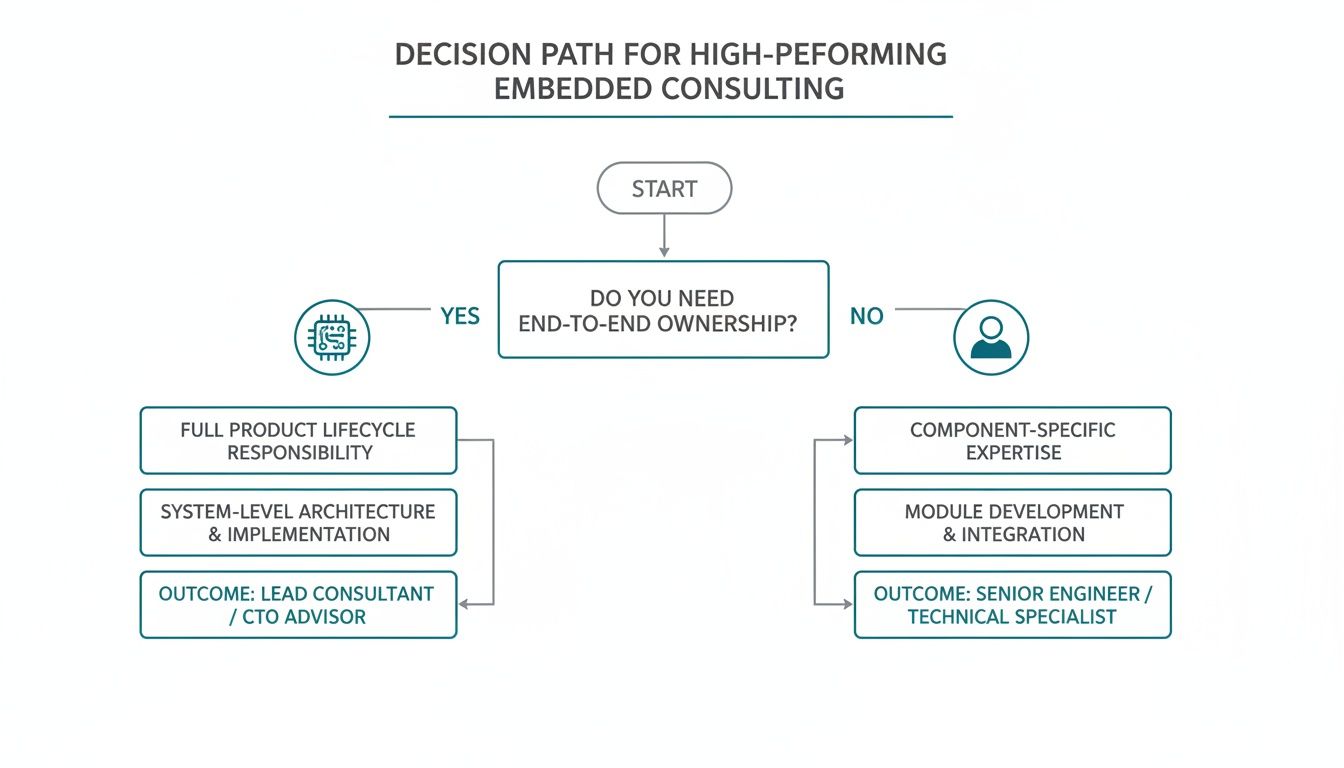
There are three common engagement models, each with distinct trade-offs:
| Engagement Model | Best For | Key Tradeoff |
|---|---|---|
| Staff Augmentation | Filling a specific, well-defined skill gap (e.g., needing an RF engineer for 3 months). | You retain full project risk and management overhead. Limited knowledge transfer. |
| Turnkey Solution | Outsourcing a complete, well-defined subsystem or product when your team lacks bandwidth or expertise. | Higher upfront cost, but transfers execution risk to the partner. Requires clear requirements. |
| Program Rescue | A project is off-track, facing critical technical debt or timeline failure. | An intensive, often costly intervention focused on diagnosis and recovery. Highest value in crisis. |
Choosing incorrectly is a common failure mode. Using staff augmentation when you need turnkey ownership means you’re still on the hook for integration failures and schedule slips. Conversely, paying for a turnkey solution for a simple task is an inefficient use of capital. The key is an honest assessment of your internal capacity and the true nature of the problem you’re solving.
Real-World Scenario: Medical Device Prototype Rescue
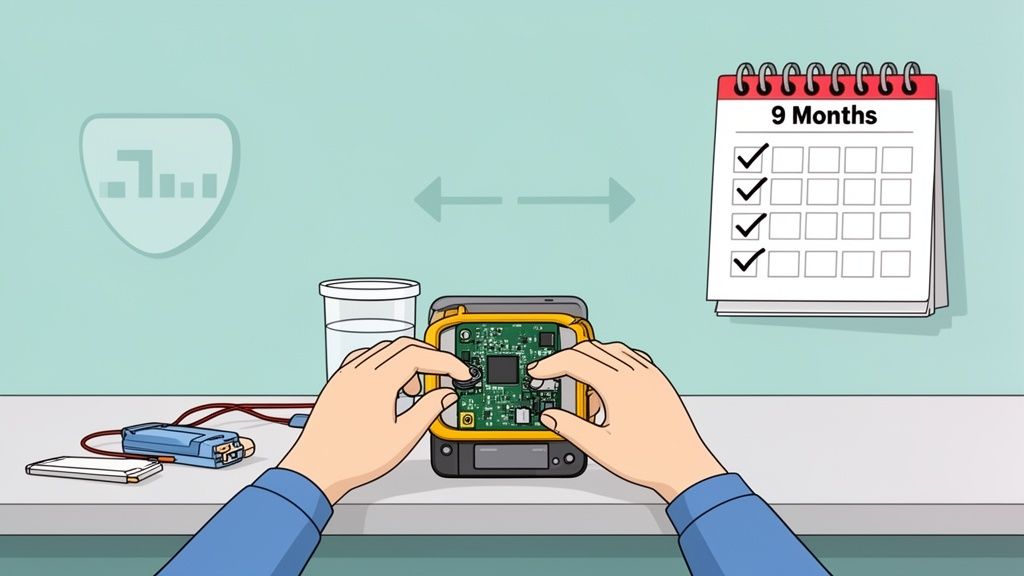
Problem: A medical device startup developing a portable diagnostic tool is six months into a nine-month timeline to deliver a prototype for clinical trials. Their hardware and firmware teams, working in silos, have produced components that fail integration testing. Power management is unstable, and the firmware architecture is not documented to the standard required for future IEC 62304 compliance. Their next funding round depends on a successful trial.
Diagnosis: This is a classic Program Rescue scenario. The core issues are a lack of integrated technical leadership, poor architectural decisions, and an absence of design-for-test discipline. The root cause is not a single skill gap but a process failure. The team made critical early decisions, like the trade-offs between flexible firmware vs. software, without a unified system view.
Solution: A credible consulting partner would first perform a rapid diagnostic audit (1-2 weeks) to identify the critical path to a stable prototype. The immediate steps would be:
- Freeze new feature development. Focus exclusively on stabilization.
- Establish a single-threaded owner for the integrated system.
- Implement a rigorous verification plan targeting the specific failure modes (e.g., power cycling under load, data integrity checks).
- Refactor critical firmware modules with testability and documentation in mind, laying the groundwork for compliance.
- Triage hardware issues, prioritizing board spins only for show-stopping bugs.
Outcome: By bringing in an external team to own the recovery, the startup de-risks the timeline. The partner’s objective, disciplined approach cuts through internal politics and focuses the team on the singular goal of a trial-ready prototype. This is how complex medical device development services get back on track.
How to Evaluate a Potential Consulting Partner
Choosing the right embedded systems consulting partner requires looking beyond marketing claims and assessing their process maturity and technical depth. You are not hiring a vendor; you are selecting a partner to whom you will entrust a critical business outcome.
Ask for evidence of their process, not just promises. Request sanitized artifacts like:
- A sample verification and validation (V&V) plan.
- An example of a manufacturing readiness checklist.
- A redacted design history file (DHF) table of contents for a regulated product.
These documents reveal their discipline and methodology. Look for signals of a high-performing team. Do they speak in terms of single-threaded ownership? Do they have a clear process for managing the transition from prototype to production? This handoff is a common failure point and a core competency for any serious product development firm.
Finally, evaluate their strategic focus. Understanding a firm’s core competencies, like SYRATE’s expertise in AI and embedded technologies, helps determine if their skills align with your long-term roadmap.
Measuring the Business Impact of Your Engagement
The success of an embedded systems consulting engagement is measured by its business impact, not just by tasks completed. The objective is to achieve tangible outcomes: accelerated time-to-market, reduced program risk, higher product quality, and a lower total cost of ownership.
These are not abstract goals. They are the direct result of disciplined engineering. For example, a robust DFT/DFM process directly reduces manufacturing fallout rates, saving real money. A well-architected system simplifies future updates, lowering long-term maintenance costs. The embedded software market alone was valued at $20.7 billion in 2024, reflecting the immense value and complexity locked within these systems. Getting it right has a clear ROI. Discover more insights about the embedded software market on gminsights.com.
Your Next Steps: From Diagnosis to Action
The framework is clear. Your immediate task is to apply it.
- Conduct an Internal Diagnosis: Convene your key stakeholders for an honest assessment. Use the criteria in this guide to map your program’s strengths, weaknesses, and, most importantly, the primary risks to your timeline and budget. The output should be a clear problem statement. Are you facing a skill gap, a capacity shortfall, or a systemic process failure?
- Define Your Required Outcome: Based on the diagnosis, define what a successful engagement looks like in business terms. Is it a stable prototype by Q3? Is it a 50% reduction in field failures? Be specific.
- Engage Potential Partners: With this clarity, you can approach consulting firms from a position of strength. Present your problem statement and required outcome. Their response will tell you everything you need to know about their ability to be a strategic partner versus just a pair of hands.
This structured approach transforms the conversation from a vague request for help into a targeted search for a solution.
Common Mistakes to Avoid When Hiring a Consultant
- Writing a vague SOW: A poorly defined Statement of Work leads to scope creep and budget overruns. Be explicit about deliverables, acceptance criteria, and ownership.
- Optimizing for the lowest hourly rate: The cheapest consultant is rarely the one who delivers the most value. Focus on the total cost of the outcome, including the cost of delays and rework.
- Ignoring knowledge transfer: Ensure the engagement includes structured documentation and handoffs. Otherwise, you create a long-term dependency.
- Failing to integrate the consultant: A consultant left on an island cannot succeed. Integrate them into your team’s communication channels, stand-ups, and review processes.
To help you begin your internal diagnosis, Sheridan Technologies offers a no-obligation architecture and program risk assessment.
Contact Sheridan Technologies for a confidential architecture review.