Table of Contents
Building a complex hardware product is a high-stakes endeavor for any startup. It’s a journey demanding military-grade operational discipline, where early missteps in architecture or ignoring manufacturability can prove fatal long before a product reaches the market. For founders, CTOs, and program managers, a brilliant idea is merely the entry fee; winning requires a relentless focus on execution and risk reduction. Poor product development isn’t just a setback—it’s a silent killer, responsible for a staggering 17% of startup failures.
This guide is a phase-by-phase playbook for technical leaders at hardware startups navigating the transition from a funded concept to a scalable, manufacturable product. It is specifically for teams building complex electronics or electromechanical systems and is not intended for pure software ventures or early-stage ideation. The core recommendation is to adopt a phase-gated process that systematically de-risks development by embedding verification, manufacturability, and supplier readiness into every stage.
By following this blueprint, you will learn how to:
- Build a resilient foundation with discovery deliverables that lock down scope and align stakeholders.
- Execute a phase-gated validation process (EVT, DVT, PVT) to methodically eliminate program risk.
- Integrate Design for Manufacturability (DFM) and Testability (DFT) from day one to prevent costly late-stage failures.
Laying the Groundwork: Discovery and Architecture
Before writing a single line of firmware or ordering a single component, the most critical work begins. The discovery and architecture phase is where you translate a market vision into a technically viable product blueprint. Rushing this stage is a direct path to scope creep, blown budgets, and missed market windows. The goal is not to create bureaucracy but to forge a set of living artifacts that serve as the program’s single source of truth, aligning engineering, product, and business stakeholders.
The Three Pillars of a Solid Foundation
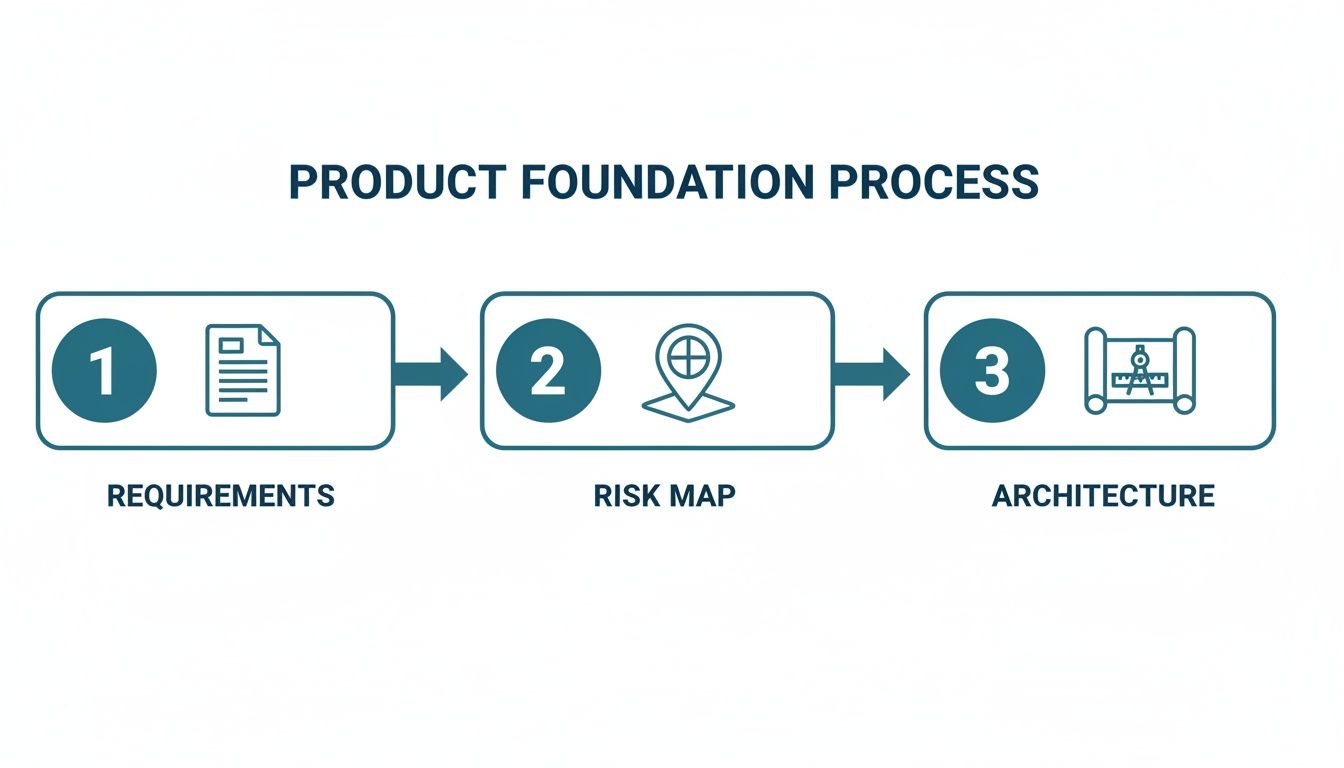
At the heart of this phase are three core deliverables: the System Requirements Document (SRD), an initial risk map, and an Architecture Decision Log (ADL). These documents form the resilient framework that guides every technical decision, ensuring it supports a concrete business outcome like reliability, cost, or time-to-market.
- System Requirements Document (SRD): Defines what the product must do in clear, quantitative, and testable terms. It forces difficult conversations early to eliminate ambiguity that leads to rework.
- Initial Risk Map: An honest assessment of the top technical and programmatic threats to your schedule, budget, and performance. This surfaces unknowns before they become crises.
- Architecture Decision Log (ADL): Chronicles the why behind major technical choices, documenting the trade-offs considered and the rationale for the final direction.
A Cautionary Tale: The Warehouse Drone
Imagine a robotics startup building an autonomous drone for warehouse inventory management. They know the market demands long flight times and operation in a wide temperature range. Eager to see a prototype fly, their initial SRD simply states: “The drone must have a long flight time.” This vague requirement is untestable and dangerous.
Fast forward to their first EVT builds. The engineering team makes a gut-wrenching discovery: the drone only achieves 18 minutes of flight time, far short of the implicit 30-minute target. The motors and compute module selected draw far more power than anticipated, especially at the lower end of the required temperature range. The root cause wasn’t a bad engineering choice—it was a poorly defined requirement.
A proper SRD would have specified: “The drone shall achieve a minimum flight time of 30 minutes at -5°C under a maximum payload condition.” This single, testable requirement would have forced a detailed power budget analysis upfront, preventing a costly and demoralizing redesign that could delay market entry by six months.
From Vague Ideas to Testable Requirements
The SRD converts business needs into engineering specifications that can be definitively verified. Vague statements like “user-friendly” or “durable” must be quantified to be actionable.
| Vague Requirement | Testable Requirement | Business Impact |
|---|---|---|
| "Good battery life" | "The device shall operate for a minimum of 72 hours on a single charge under typical use case X." | Sets a clear performance target for component selection and power management firmware, enabling credible marketing claims. |
| "Durable design" | "The device shall withstand a 1.5-meter drop onto concrete on all six faces without functional failure." | Defines the reliability standard, informs material selection and mechanical design, and ultimately reduces warranty returns. |
| "Fast boot time" | "The system shall boot from a cold start to a fully operational state in under 500 milliseconds." | Critical for user experience in time-sensitive applications and a key non-functional requirement for safety-critical systems. |
This discipline eliminates the ambiguity where scope creep is born. To dive deeper into structuring this critical early-stage work, see our guide to the product discovery phase of a project. It ensures your development starts on solid ground, ready for the complexities ahead.
Navigating the EVT, DVT, and PVT Gates
This is where your architecture collides with physics. The journey through Engineering Validation Testing (EVT), Design Validation Testing (DVT), and Production Validation Testing (PVT) is not a series of checkpoints but a disciplined, phase-gated process designed to systematically hunt down and kill risk before you commit to expensive tooling and mass production. Each stage has a distinct mission with clear entry and exit criteria that prove your product is maturing as intended.
This methodical progression separates a smooth production ramp from a frantic, cash-burning scramble. Successful validation is the direct result of disciplined, front-end planning.
Engineering Validation Testing (EVT): Does the Core Design Work?
The mission of EVT is simple: prove the core design functions as architected. This is your first look at real hardware, focused on verifying the highest-risk assumptions. EVT builds are lab instruments, not marketing samples; finding flaws here is a gift.
Key activities include:
- PCB Bring-up: Verifying that power rails are stable, clocks are clean, and the processor boots reliably. This is the foundation.
- Basic Functional Verification: Confirming you can communicate with key peripherals—sensors, memory, radios—and that they perform their most basic functions.
- Core Feature Testing: Validating the fundamental “magic” of your product, even in a raw capacity.
An EVT failure is not a disaster; it’s a critical learning opportunity. Finding a flaw in a small 5-10 unit build is exponentially cheaper and faster to fix than discovering it in a DVT build of 50-100 units after tooling has been kicked off.
Design Validation Testing (DVT): Does it Work Reliably?
DVT asks a harder question: does the design work reliably across its entire specified operational envelope? This is where you harden the product and prepare to freeze the design for manufacturing. DVT builds use production-intent parts and tooling to verify the product against every single requirement in your SRD.
The DVT test plan should be unforgiving:
- Environmental & Stress Testing: Does it survive and operate at temperature extremes, humidity, vibration, and shock?
- Signal and Power Integrity: Characterizing system performance under heavy electrical load to ensure stability.
- Regulatory Pre-scans: Running early EMI/EMC tests to de-risk formal certification, a common source of major schedule delays and budget overruns.
Passing DVT is the gate to locking your design. From this point on, changes must go through a formal Engineering Change Order (ECO) process to prevent ripple effects on manufacturing and quality.
Production Validation Testing (PVT): Can the Factory Build It?
PVT’s focus pivots from validating the design to validating the manufacturing process. The question is: can your Contract Manufacturer (CM) build the product consistently, at volume, and to your quality specification? This phase occurs on the actual production line using final fixtures, processes, and operators.
Key outputs you are validating during PVT:
- First Pass Yield: Proving the line can hit your target yield without excessive rework.
- Process Capability (Cpk): Statistical validation that key manufacturing processes are stable and in control.
- Work Instruction Validation: Confirming assembly and test instructions are clear and repeatable for line operators.
The global landscape adds complexity here. With uneven growth in startup ecosystems—booming in Asia-Pacific, plateauing in the US—a partner who can execute predictably across borders is critical. Explore the full analysis of startup ecosystem growth to understand these dynamics. Successfully navigating PVT demands deep operational expertise.
Designing for Manufacturing and Supplier Readiness
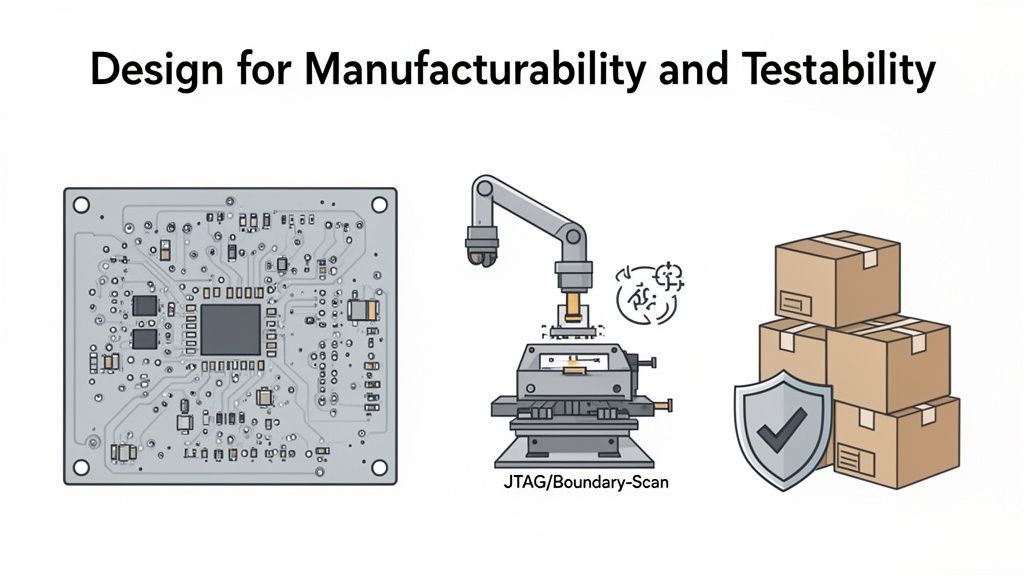
There’s a graveyard full of brilliant prototypes that died on the factory floor because they couldn’t be built at scale, cost, or quality. The disciplines that separate a scalable product from a science project are Design for Manufacturability (DFM) and Design for Testability (DFT). These are not late-stage checks; they must be baked into your architecture from day one. Ignoring them guarantees painful redesigns, blown budgets, and launch delays.
Embedding Manufacturability Into Your Design
DFM is a mindset that forces you to think like your Contract Manufacturer (CM). It’s about making design choices that reduce assembly complexity, improve yield, and lower your unit cost. Simple DFM decisions, like selecting components with resilient supply chains (multiple qualified vendors) or optimizing PCB layout for efficient panelization, have a massive business impact.
Key DFM and DFMA (Design for Manufacturing and Assembly) checkpoints:
- Component Selection: Are parts readily available from multiple distributors? Have you vetted their lifecycle status to avoid near-term End-of-Life (EOL) components?
- Placement & Orientation: Are components oriented consistently to minimize pick-and-place machine rotation? Is there sufficient clearance for automated soldering and inspection?
- Panelization Strategy: How many boards fit on a standard manufacturing panel? Do fiducials and breakaway tabs align with your CM’s standard processes?
Designing a Product That Can Be Tested
If you can’t test it, you can’t ship it with confidence. DFT is the practice of building in the hooks and access points needed to verify that every unit coming off the line is perfect. Catching a bad solder joint in the factory costs pennies; catching it after a customer return costs hundreds of dollars and damages your brand.
A multi-stage manufacturing test plan is your primary defense against field failures.
The core principle of DFT is to find defects as early in the manufacturing process as possible. A defect caught on the production line is a problem your customer will never see and a failure you don’t have to troubleshoot in the field.
A strong test strategy requires deliberate design choices. Including a standard JTAG (boundary scan) interface allows for programming and testing connections between complex ICs without custom fixtures. Adding test points for critical voltage rails and signals makes automated testing and debug exponentially easier. This is a crucial part of taking a device from a working prototype to a scalable product.
Orchestrating Your Supply Chain
Choosing the right CM is one of the most critical decisions a hardware startup will make. This isn’t a vendor; it’s a partner whose capabilities directly impact product quality, cost, and your ability to scale. Vet them rigorously: do they have experience with your product’s complexity? Can they demonstrate a robust Quality Management System (QMS)?
Once a partner is selected, the real work begins. This includes establishing clear incoming quality inspection criteria and a feedback loop for failure analysis. A FRACAS (Failure Reporting, Analysis, and Corrective Action System) is essential. When a unit fails on the line, FRACAS ensures the failure is documented, root-caused, and a corrective action is implemented to prevent recurrence. This data-driven loop methodically drives up yield, directly impacting gross margin and profitability.
Scaling Production and Post-Launch Operations
Shipping your first production units is a major milestone, but it’s the starting line of a much longer race. Your focus must now pivot from design validation to the realities of volume production and supporting a product in the field. Issues that were manageable in a 50-unit run can become catastrophic yield-killers at 5,000 units. Suddenly, you’re wrestling with a sprawling system of suppliers, logistics, and a firehose of field data.
Building for In-Field Reliability
For any connected device, success hinges on robust firmware built for the chaos of the real world. You can’t replicate every user’s environment, so building in resilience is non-negotiable.
Key firmware reliability patterns include:
- Bulletproof OTA Updates: Your Over-the-Air (OTA) update system must be rock-solid, with atomic updates (all-or-nothing) and a rollback capability. A bricked device from a failed update is a catastrophic failure of customer trust.
- Fault Containment: Defensive firmware is essential. Hardware watchdog timers that reboot the system if it freezes and brownout detection to ensure predictable behavior during power dips are simple but powerful tools to prevent lockups and data corruption.
Turning Field Failures into Actionable Intelligence
You can’t fix what you can’t see. Your most valuable asset for post-launch improvement is data from devices in the field. A thoughtful logging and telemetry system isn’t a feature tacked on at the end; it’s a core product capability designed to capture just enough data to root-cause failures without compromising user privacy.
A well-designed telemetry system is your eyes and ears in the field. It transforms a vague customer complaint like “it stopped working” into an actionable bug report with a specific fault code, memory state, and sensor readings. This elevates support from guesswork to a data-driven engineering exercise.
Good telemetry allows you to spot trends, identify systemic problems, and push targeted fixes before a small issue becomes a massive recall.
Closing the Loop for the Next Revision
The product you launch is V1. Every lesson learned from manufacturing and field support is fuel for V2. The post-launch phase is about creating a continuous improvement cycle that feeds directly into your next product revision.
Pulling this off requires operational discipline:
| Discipline | Key Action | Business Impact |
|---|---|---|
| Supplier Quality Management | Conduct regular audits and monitor key performance indicators (KPIs) like defect rates and on-time delivery. | Prevents defective components from reaching customers, reducing warranty costs and ensuring supply chain stability. |
| EOL Management | Actively track component lifecycles and maintain a process for qualifying second-source or replacement parts. | Avoids costly redesigns or line-down situations when a critical component is suddenly discontinued. |
| Institutional Knowledge Capture | Formally document lessons learned from manufacturing runs, field returns, and support tickets in a central repository. | Ensures you don't repeat the same mistakes, leading to faster development cycles and higher-quality future products. |
This continuous feedback loop—from field data to supplier management to the next design—is what separates startups that thrive from those crushed by operational debt.
Leveraging Modern Tools to Accelerate Development
In the race to market, startups must use every available advantage. Modern software tools, particularly AI, are fundamentally changing the speed at which complex products can be developed. These are practical instruments that can supercharge small engineering teams and compress development timelines.
Generative AI is already showing tangible impact, helping to slash time-to-market by 5% and boost product manager productivity by 40%. In reliability-critical sectors, this translates into faster architecture design, virtual testing with digital twins, and de-risking system behavior before committing to expensive hardware. The global AI market is exploding at a 37.3% CAGR through 2030, which means more of the routine engineering work is being automated, freeing up your team for genuine innovation. You can dive deeper into these product development trends here.
Practical Applications for Lean Teams
AI-powered tools can jumpstart key areas of development, acting as assistants for brainstorming system architectures, generating boilerplate firmware code, or creating initial test cases. However, one of the most powerful applications is the use of AI-driven digital twins for virtual testing and simulation.
By creating a sophisticated virtual model of your product, you can simulate complex environmental stresses, power conditions, and system interactions. This allows you to identify potential design flaws before a single physical prototype is built, dramatically shortening iteration cycles and de-risking the entire process.
The Role of No-Code and Low-Code
No-code and low-code platforms have a place in the toolbox for creating quick proof-of-concept models or internal tools. They empower non-technical team members to build functional mockups and validate ideas without consuming engineering resources.
However, a word of caution is necessary. While excellent for initial validation, these platforms often hit performance and scalability walls. For production-grade systems, especially in demanding hardware applications, they are typically not the right long-term solution. The goal is to use modern tools to augment your team’s expertise, not replace rigorous engineering discipline.
Burning Questions from the Hardware Trenches
Let’s address the questions I hear most often from founders navigating the hardware development maze. These are the on-the-ground realities that can make or break a new product.
How Much Does It Cost To Develop a Hardware Product?
This is the ultimate “it depends” question, but we can map out the territory. A simple PCB assembly might require only tens of thousands in NRE, whereas a regulated medical or aerospace device can easily run into the millions.
Your major costs fall into these buckets:
- Non-Recurring Engineering (NRE): The upfront cost for design, architecture, firmware development, and verification.
- Tooling and Fixtures: Molds for enclosures and custom fixtures for manufacturing and testing are significant capital expenses.
- Bill of Materials (BOM): The per-unit cost of every component in your product.
- Certification: Fees for regulatory bodies like FCC, CE, and UL involve significant lab time and cost.
A common mistake is budgeting for design but getting blindsided by verification and compliance testing. These testing costs can easily match or exceed the initial design budget. Plan for them explicitly.
When Should We Bring In a Manufacturing Partner?
Engage potential Contract Manufacturers (CMs) far earlier than you think. My rule of thumb: start the conversation during the architecture phase or, at the absolute latest, during early EVT builds. Waiting until your design is “locked” is a classic, costly error.
Bringing a CM into the loop early is a strategic advantage. Their Design for Manufacturability (DFM) feedback can influence your design before it becomes expensive to change. They provide invaluable advice on component selection for supply chain health, PCB layout for their specific line, and test strategies that prevent agonizing redesigns.
What Is the Biggest Mistake Startups Make?
Without a doubt, the single most destructive mistake is underinvesting in the initial discovery and architecture phase. Driven by an eagerness to get a prototype working, many teams rush forward. They skip the painstaking work of creating a detailed System Requirements Document (SRD) and a robust verification plan. This shortcut almost always leads to scope creep, endless rework, and a product that is a nightmare to test and manufacture at scale. It burns cash and obliterates your time-to-market advantage.
At Sheridan Technologies, we specialize in helping teams navigate these exact complexities. If you’re struggling to get from a working prototype to a scalable, manufacturable product, an expert design review can pinpoint these risks before they become five- or six-figure problems. Request a design review and let’s build something great, the right way.