If you're a technical leader steering a complex electronics project, you've likely faced the challenge of budgeting for UL certification. The process is notorious for its cost variability, where an initial quote rarely reflects the final invoice. A "simple" device might cost $15,000, while a complex industrial or medical system can easily exceed $200,000. This unpredictability isn't just a line-item problem; it's a significant program risk. An inaccurate forecast can derail budgets, delay a critical product launch, and erode trust with stakeholders who rely on your team's predictability.
This guide is for the VP of Engineering, Program Manager, or Lead Engineer responsible for delivering compliant hardware on time and within budget. It's most relevant when you're in the planning stages for a product targeting North American markets, especially in high-reliability sectors like industrial automation, medical devices, or critical infrastructure. We will move beyond the lab's initial quote to dissect the direct and indirect costs that define a realistic certification budget, enabling you to build a defensible financial model and manage a high-stakes, non-negotiable project milestone.
This article will help you:
- Frame the problem: Understand the direct and indirect cost drivers that make budgeting for UL certification so difficult.
- Build a realistic model: Use operating scenarios to estimate costs based on product complexity, target standards, and program risks.
- Implement cost controls: Apply engineering-led strategies to reduce your total certification cost by minimizing rework and test failures.
The Complete Breakdown of UL Cost Components
Building an accurate budget for UL certification requires looking beyond the initial testing fee. The total cost is a composite of direct and indirect expenses that arise throughout the product development lifecycle and into full-scale production. Miscalculating these costs is a classic—and expensive—mistake, leading to blown budgets and surprise delays that put engineering and leadership teams in a difficult position. This breakdown serves as a financial roadmap, helping you anticipate each expense and build a budget that withstands scrutiny. These costs have a direct ripple effect on your ability to hit launch dates, maintain financial stability, and retain investor confidence.
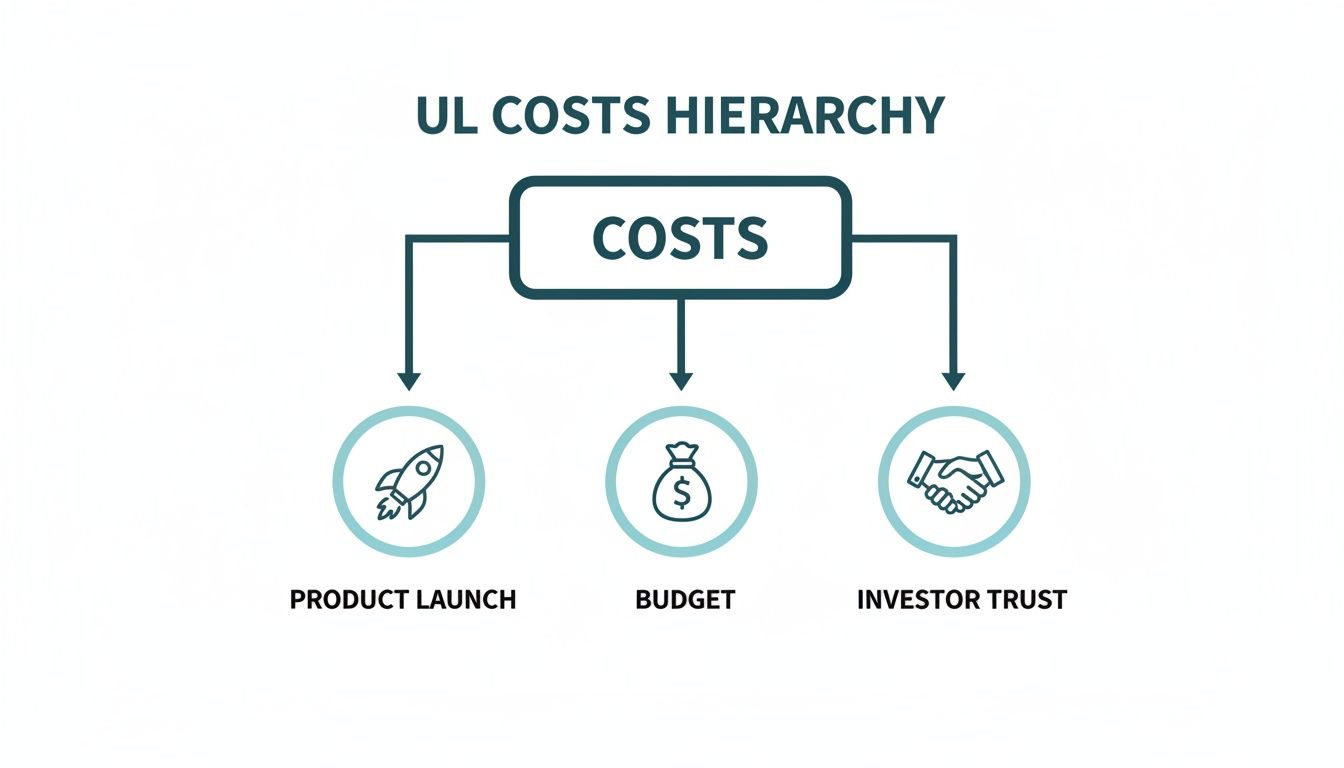
Managing these expenses is foundational to program execution. It directly influences your ability to launch on time, control finances, and maintain the trust of your team and stakeholders.
UL Certification Cost Components at a Glance
This table outlines the typical direct and indirect costs associated with a UL certification project, providing clarity on where budget is allocated throughout the process.
| Cost Category | Description | Typical Timing |
|---|---|---|
| Initial Upfront Fees | Administrative and project setup charges required to open your file and assign a project engineer. | Before testing begins |
| Core Testing & Evaluation | The largest cost component, covering hands-on lab testing and engineering analysis of your product against the relevant UL standard. | During the main project phase |
| Corrective Actions & Retesting | Unplanned costs for engineering consulting and re-testing if your product fails the initial evaluation. A major source of budget overruns. | Following a test failure |
| Post-Certification Fees | Ongoing, recurring fees to maintain the UL Mark, including factory inspections and annual listing fees. | Annually and quarterly, post-certification |
Understanding the timing of these costs is as crucial as knowing their a`mount, enabling more precise financial forecasting.
Initial Upfront Fees
Before any testing begins, you'll encounter non-refundable administrative costs to get your project into the UL system.
- Quote and Application Fee: This charge covers the upfront work by UL to review your technical documentation, determine the applicable UL Standard, and prepare a detailed scope of work and price quote.
- Project Handling Fee: You're paying for a dedicated UL project engineer who serves as your primary point of contact, responsible for scheduling lab time, tracking progress, and facilitating communication between your team and UL's test engineers.
These fees are typically fixed amounts required to initiate the project.
Core Testing and Evaluation Costs
This is where the bulk of your budget is allocated and where the most significant cost variability lies. This phase involves hands-on engineering work where UL's lab subjects your product to a battery of tests to verify compliance with every requirement in the relevant UL Standard. The final cost is directly proportional to the engineering and lab hours consumed, which are dictated by your product's complexity.
The global Testing, Inspection, and Certification (TIC) market is projected to expand from USD 4.4 billion in 2026 to USD 21.9 billion by 2033. For a single complex product targeting the US market, certification can range from USD 10,000 to over USD 100,000, reflecting the depth of engineering work involved. To gain insight into how service-based projects are priced, it can be useful to understand various pricing models.
Post-Certification and Ongoing Fees
Achieving UL certification is not a one-time event. To maintain the validity of your UL Mark, you must budget for recurring costs.
- Factory Inspection Fees: After your product is certified, a UL field representative will conduct unannounced inspections at your factory, typically four times a year. They verify that the product is still being manufactured with the exact components and processes specified in the approved design.
- Follow-Up Services (FUS) Fee: This is the annual fee to keep your certification active in UL's system, covering the administrative overhead of the inspection program.
These ongoing fees are a tangible part of your product's long-term Cost of Goods Sold (COGS) and must be factored into financial planning to avoid future surprises.
Key Factors That Drive Your UL Certification Costs
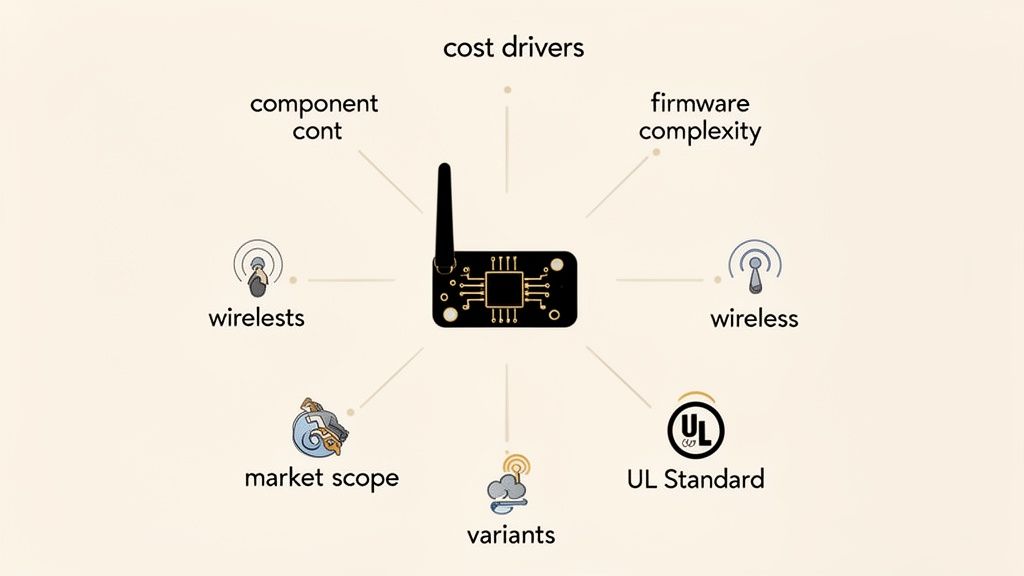
Why does one team secure a UL Mark for $20,000 while another faces a bill approaching $200,000? The discrepancy isn't random; it's determined by your product's design complexity and go-to-market strategy. Understanding these variables early is crucial for accurate budgeting. Every design choice, from component selection to target markets, adds layers of testing requirements. Each layer translates directly into more lab time—the primary driver of your final bill. Mapping these factors allows you to make informed trade-offs during development and build a budget that reflects your product's specific risks.
Product Complexity and Construction
The most significant factor influencing your UL certification cost is your product's complexity. A simple AC-to-DC power adapter undergoes a vastly different testing regimen than a multi-board industrial robot controller.
- Component Count and Density: A densely packed PCB with high-power components requires extensive thermal and electrical stress testing to mitigate risks of overheating or arcing.
- Firmware and Software: If safety-critical functions are managed by firmware, it demands rigorous validation to ensure predictable behavior under fault conditions.
- Wireless and RF Capabilities: Integrating Wi-Fi, Bluetooth, or cellular technologies triggers a separate battery of tests for electromagnetic compatibility (EMC) and radio performance, often governed by different standards.
- Voltage and Power Levels: Higher voltages and currents impose stricter requirements for insulation, creepage, and clearance, adding significant evaluation time and complexity.
As products become more interconnected, the global Testing, Inspection, and Certification (TIC) market has seen certification services become its fastest-growing segment. For developers of complex medical devices, for instance, UL certification costs can range from $50,000 to over $500,000 per product line. Partnering with an engineering firm that designs for compliance from day one can cut these costs by up to 30% by minimizing rework and streamlining testing. To see more on this market trend, you can read the full research on global TIC demand.
Product Variants and Families
Most products exist within a family of variants with different features or power ratings. Your certification strategy for these variants significantly impacts the total cost. Certifying each model separately is the most expensive approach. A more cost-effective strategy is to group them into a product "family." This allows you to identify a single worst-case model (typically the most complex or highest-power version) for full, rigorous testing. Other variants can then be certified through a less intensive process of analysis and limited confirmatory testing, reducing overall cost and effort.
Applicable UL Standard and Market Access
The specific UL Standard your product falls under is a critical cost driver. Standards vary dramatically in complexity and testing rigor. For example, UL 62368-1 for A/V and IT equipment has a different and often more extensive set of requirements than a standard for a basic household appliance.
Your target markets dictate which marks you need. While the UL Mark is key for the US, selling in Canada requires meeting CSA standards. You can often bundle these into a single project to obtain a "c-UL-us" mark, which is more cost-effective than separate certification campaigns. If Europe is on your roadmap, you must also account for CE marking, which involves its own directives, standards, and costs. For more on that, see our guide on CE marking requirements for electronic equipment. Planning for all target markets from the outset allows you to consolidate testing and avoid redundant, expensive evaluations later.
Operating Scenarios and Realistic Budget Models
Abstract cost categories are useful, but to build a budget that holds up, you must see how these factors play out in real-world scenarios. The final UL invoice for a simple IoT device versus a complex piece of industrial machinery can differ by an order of magnitude. Let's model two distinct products to make these concepts tangible and highlight the financial impact of discovering compliance issues late in development.
Scenario A: Industrial Automation Controller
This device is destined for a high-stakes manufacturing environment where failure has severe consequences. The hardware is sophisticated, and the operating conditions are demanding.
Product & Program Constraints:
- Features: A multi-board design with a main processor, multiple I/O boards, an integrated high-voltage power supply, and a proprietary backplane. Includes both wired Ethernet and BLE for diagnostics.
- Target Standard: UL 61010-1 (Safety Requirements for Electrical Equipment for Measurement, Control, and Laboratory Use).
- Team: A 12-person engineering team under pressure to meet a Q4 launch deadline.
- Market: North America (US and Canada), requiring the c-UL-us Mark.
The combination of high voltage, multiple interconnected PCBs, and a mixed-signal environment makes this a high-risk certification candidate with numerous potential failure points.
High operational costs in the Testing, Inspection, and Certification (TIC) sector directly inflate UL certification expenses. The market is projected to reach USD 255 billion by 2025, growing at a 7% CAGR, driven by demand for specialized equipment and skilled labor. For complex aerospace and medical products, it's not uncommon for UL certification programs to cost between $200,000 and $1 million, a figure that accounts for inevitable cycles of failure analysis and redesign. To get a sense of this market's scale, you can explore more findings on testing and certification market growth on maximizemarketresearch.com.
Scenario B: Connected Agricultural Sensor
This device seems simpler: a connected sensor for harsh agricultural environments that monitors soil moisture and transmits data wirelessly. While less electronically complex, its operating environment introduces unique challenges.
Product & Program Constraints:
- Features: A single-board design with an MCU, a low-power LoRaWAN radio, an analog front-end for the sensor, and a battery power system with solar charging, all in a weather-resistant enclosure.
- Target Standard: UL 62368-1 (Audio/video, information and communication technology equipment).
- Team: A lean 4-person startup team with a tight budget.
- Market: US-only for the initial launch, requiring a standard UL Mark.
The primary risks are environmental. The enclosure must prove its IP rating against dust and water, and the battery system requires thorough evaluation for thermal safety, especially with the solar charger. These areas will be a major focus during testing.
Example UL Certification Cost Scenarios For 2026
This table breaks down the potential costs for our two example products, illustrating how the budget escalates based on complexity and risk.
| Cost Item | Scenario A: Industrial Controller | Scenario B: Connected Ag-Tech Sensor |
|---|---|---|
| Project Application & Management | $5,000 – $8,000 | $3,000 – $5,000 |
| Initial Testing & Evaluation | $45,000 – $70,000 | $20,000 – $30,000 |
| Construction & Standards Review | $10,000 – $15,000 | $5,000 – $8,000 |
| Initial Factory Inspection (FUS) | $3,000 – $5,000 | $3,000 – $5,000 |
| Corrective Actions (1-2 Rounds) | $15,000 – $30,000 | $5,000 – $15,000 |
| Annual Maintenance & FUS Fees | $4,000 – $6,000 | $3,000 – $4,000 |
| Total Estimated First-Year Cost | $82,000 – $134,000 | $39,000 – $67,000 |
The industrial controller's first-year certification costs could easily be double that of the ag-tech sensor. The higher testing fees reflect the greater number of standards and potential failure points, and the budget for corrective actions is larger because fixing issues on a complex, multi-board system is more expensive and time-consuming.
For a deeper dive into how these scenarios fit into the bigger picture, our guide on the product development lifecycle stages provides valuable context. It can also be helpful to look at how other standards are budgeted; for instance, checking out an ISO 27001 certification cost calculator can offer a different perspective on how compliance expenses are estimated.
These scenarios highlight a critical point: cost is about risk. The controller's risk is its electrical complexity. The sensor's risk is its environmental resilience and power system. Accurate budgeting requires identifying and quantifying these distinct risk profiles from the start.
How to Strategically Reduce Your UL Certification Costs
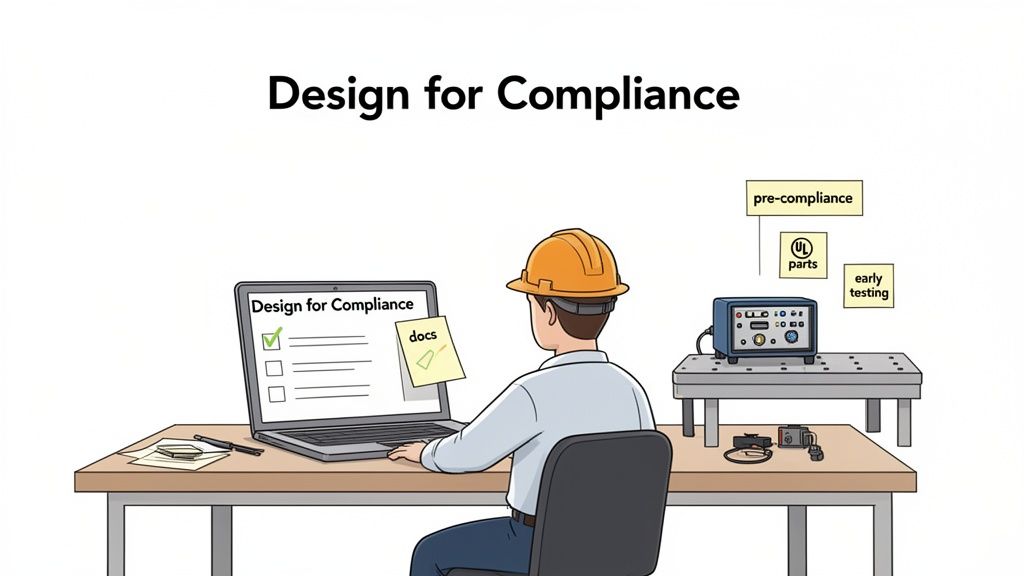
While the UL invoice is an unavoidable cost of doing business, it's a number you can actively manage. The key is to shift from treating compliance as a final gate to integrating it into your design process from day one. Waiting until your EVT or DVT builds are complete to consider UL requirements is a recipe for costly rework and schedule delays. The most effective cost-reduction tactics are rooted in engineering discipline, focusing on designing out potential failures long before a UL engineer sees your product.
Design for Compliance from the Start
The single most impactful lever for managing UL certification costs is Design for Compliance (DFC). This is a proactive engineering mindset where the UL standard's requirements inform decisions from the earliest architectural sketches. DFC means making deliberate choices about component selection, PCB layout, and enclosure design with specific UL rules in mind. When compliance is an afterthought, you risk discovering that component spacing is too tight, your power supply isn't certified, or your enclosure lacks the required flame rating. These late-stage surprises force expensive PCB respins and tooling changes, adding tens of thousands of dollars and months of delays.
At Sheridan Technologies, we view DFC as a core engineering discipline, not an optional feature. A design that isn't compliant is an incomplete design. Getting this right from the start prevents the costliest outcome: a failed test followed by a major redesign.
The High ROI of Pre-Compliance Testing
Formal UL testing is expensive, and you pay the full price whether you pass or fail. Pre-compliance testing is your dress rehearsal to de-risk this process. It involves running key UL tests in-house or at a local third-party lab before submitting the product for formal evaluation. This allows you to identify and fix problems when they are still simple engineering tasks. Finding an emissions issue on a prototype is a minor headache; finding it during your paid slot at UL is a program-level crisis.
Key areas for pre-compliance checks include:
- Electromagnetic Compatibility (EMC/EMI): Run basic scans for radiated and conducted emissions to ensure your device isn't creating interference that will cause an instant failure.
- Electrical Safety: Perform your own hipot, ground bond, and leakage current tests to catch obvious electrical hazards.
- Thermal Analysis: Stress your product under maximum load to identify any hot spots on components or enclosure surfaces that could violate temperature limits.
Spending a few thousand dollars at a local test lab is a fraction of the cost of even one failed round of formal testing.
Control Your Bill of Materials (BOM)
Your BOM is a major cost driver. The components you select directly impact the scope and expense of testing.
First, prioritize using UL Recognized components, especially for critical parts like power supplies, connectors, fuses, and switches. A UL Recognized component has already passed its own safety evaluation, often allowing UL to accept it in your product with minimal additional testing. Using a non-certified power supply, by contrast, forces UL to conduct a full, expensive evaluation on it as part of your project.
Second, maintain strict control over your component sourcing. If your design is qualified with a specific UL-rated plastic, ensure your contract manufacturer doesn't substitute it for a cheaper, non-rated alternative. Such a change can invalidate your UL certification and trigger a costly re-evaluation. A robust supplier quality process is essential, as detailed in our guide on how to reduce manufacturing costs without compromising compliance.
Common Questions About UL Certification Costs
Even with a detailed budget, questions often arise around the UL certification process. The variables can seem endless, and the financial stakes are high. Let's tackle some of the most common points of confusion to help you navigate the final hurdles of compliance.
How Long Does UL Certification Take and How Does That Impact Cost?
The timeline for UL certification is a massive, and often hidden, cost driver. It can be as quick as a few weeks for a simple product or drag on for over six months for a complex system. A longer timeline means delayed revenue and keeps your engineering team tied up—costs that won't show up on a UL invoice but will absolutely hit your bottom line. Nearly every delay comes down to test failures or incomplete documentation. Each re-test adds weeks or months to the schedule, along with more fees and missed market opportunities.
The most effective way to control both timeline and cost is obsessive preparation. A bulletproof submission package with flawless documentation and a product designed for compliance is the fastest path to the UL Mark.
Are There Recurring Fees After We Get the UL Mark?
Yes, and this is a critical long-term expense. To maintain your certification, you must enroll in UL's Follow-Up Services (FUS) program. This involves:
- Quarterly Factory Inspections: A UL representative will make unannounced visits to your manufacturing facility, typically four times a year.
- Compliance Verification: The inspector checks that the product is still being built with the exact components and processes specified in the original UL report.
- Annual Fees: You'll also pay an annual service fee to keep your certification listed.
Any deviation can trigger expensive corrective actions or even loss of certification. These ongoing FUS fees must be baked into your product’s long-term Cost of Goods Sold (COGS).
What Is The Cost Difference Between UL Listed and UL Recognized?
The costs differ significantly because they apply to different things.
- UL Listed: This mark is for a complete, standalone product. The evaluation is exhaustive, covering the entire system to ensure it's safe for end-users, making it the more expensive of the two.
- UL Recognized: This mark applies to components intended for use inside a larger UL Listed system (e.g., a power supply, switch, or plastic material). The testing is more focused and therefore less expensive.
Using UL Recognized components is a cornerstone of a smart cost-reduction strategy, as it dramatically reduces the testing scope for your final product.
Can an Engineering Partner Really Lower My UL Certification Costs?
Absolutely. A partner with deep compliance experience provides a massive ROI by systematically eliminating risk and preventing expensive rework. They don't just design a product; they design a product to pass.
Here’s how they reduce your total cost:
- Design for Compliance (DFC): They integrate UL requirements from the start, selecting compliant components and layout strategies.
- Pre-Compliance Testing: They de-risk the formal submission by finding and fixing potential EMI, thermal, and electrical safety issues early.
- Documentation Management: They prepare the meticulous, submission-ready documentation package UL requires, preventing administrative delays.
This "prototype-to-production" mindset avoids the catastrophic redesigns that follow test failures. By preventing just one major board re-spin, a skilled partner can often cut total certification costs by 25-40% while ensuring a faster, more predictable path to market.
At Sheridan Technologies, we build compliance readiness into every stage of development. Our integrated approach to hardware and firmware engineering minimizes the risk of late-stage failures and costly rework. If you're planning a complex electronics project and need to get the compliance strategy right from the start, let's talk.