
Table of Contents
For leaders in complex electronics and connected product development, a supply chain disruption is not an inconvenience; it is an existential threat. A single component shortage, geopolitical shock, or supplier failure can derail a multi-year program, trigger catastrophic budget overruns, and erode customer trust. This article is for the VP of Engineering, program manager, or technical lead responsible for guiding a product from prototype to production and navigating the operational risks of hardware. It applies when you have moved past initial prototypes and are planning for scale (EVT, DVT, PVT), where supply chain decisions have significant financial and timeline consequences.
This is not a theoretical overview. We provide a framework of field-tested supply chain risk mitigation strategies specifically for high-stakes hardware programs, focusing on the intersection of design engineering, manufacturing, and procurement. The core principle is that resilience must be designed in, not bolted on.
This guide provides a strategic roadmap for de-risking your hardware supply chain before a crisis forces your hand. You can skim the key takeaways here:
- Proactive design choices are your most powerful mitigation tool. Decisions made during architecture and component selection have the greatest impact on long-term supply chain resilience.
- Deep supplier partnership is a risk control. Moving beyond a purely transactional relationship to a strategic partnership creates shared visibility and problem-solving capability.
- Systematic risk analysis is non-negotiable. You cannot mitigate risks you cannot see; a structured process for identifying and planning for failure is fundamental.
1. Supplier Diversification and Dual-Sourcing
Problem: Over-reliance on a single supplier for any critical component creates a single point of failure that can halt production. A disruption with one supplier—whether from a factory fire, quality failure, or geopolitical event—becomes your disruption.
Diagnosis: A Bill of Materials (BOM) analysis reveals multiple “golden screws”: single-source, long-lead-time, or custom-fabricated parts like microcontrollers (MCUs), power management ICs (PMICs), or specialized connectors. These components represent concentrated, unmitigated risk.
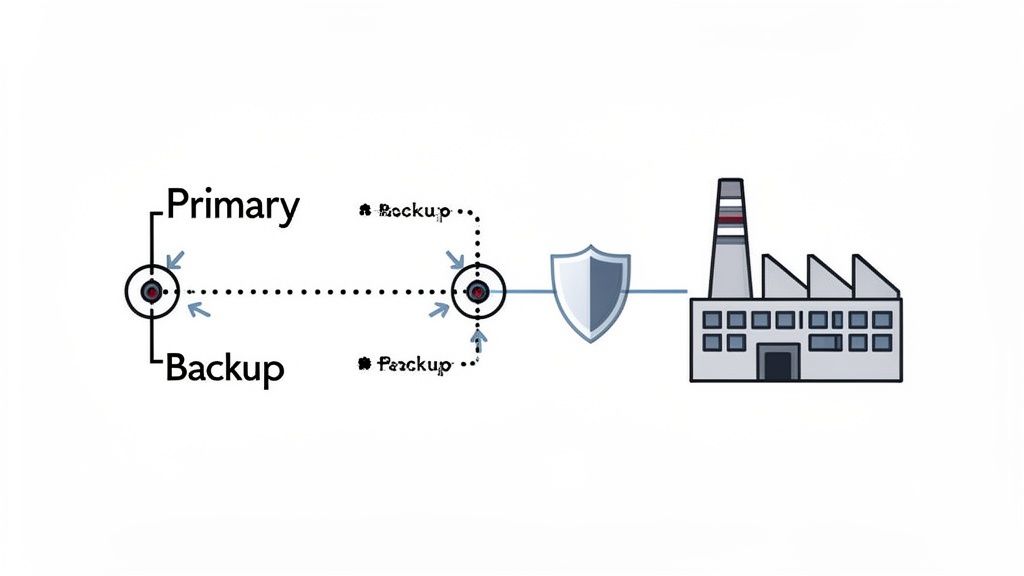
Solution: Supplier diversification is a fundamental supply chain risk mitigation strategy involving the qualification and use of multiple, independent suppliers for critical parts.
Operating Scenario: A medical device program is in the DVT phase, with a projected production ramp in 9 months. The primary MCU is a specific STM32 model with a 52-week lead time and allocation constraints. A single-supplier strategy exposes the entire product launch to one component’s availability. The engineering team is tasked with qualifying a pin-compatible alternative from another manufacturer as a backup, even if it requires minor firmware adjustments. This involves a full validation cycle on the second-source MCU to ensure performance and reliability parity before the production freeze.
Outcome: By having a pre-qualified alternate supplier, the program can absorb a disruption. If the primary supplier de-commits or faces a shortage, production can shift to the backup source, avoiding a catastrophic line-down situation and protecting the launch schedule. While this requires upfront engineering and qualification investment, it acts as a critical insurance policy against high-probability risks.
Implementation Tips
To effectively implement this strategy, focus on a prioritized and data-driven approach. It is not feasible to dual-source every screw and resistor.
- Prioritize Ruthlessly: Start by identifying your highest-risk components. These are typically single-source, custom-fabricated, or long-lead-time items like specific MCUs, power management ICs (PMICs), or specialized sensors.
- Establish Clear SLAs: Define and enforce service-level agreements with all suppliers. These must cover on-time delivery percentages, acceptable quality levels (AQL), and required response times for engineering change orders (ECOs).
- Track Performance with Scorecards: Create a supplier scorecard to objectively measure performance. Key metrics should include on-time delivery, parts-per-million (PPM) defect rates, and communication responsiveness. Review these scorecards quarterly.
- Negotiate Flexible Contracts: Build volume flexibility into your supplier agreements. This allows you to rapidly scale orders up or down with a specific supplier in an emergency without incurring severe penalties.
Building a resilient supply base requires more than just having a list of names. A deep understanding of sourcing strategy best practices is foundational to qualifying partners who can meet your technical, quality, and logistical requirements under pressure.
2. Design for Supply Chain Resilience (DfSCR)
Problem: Treating supply chain as a downstream problem is a common and costly mistake. Design decisions made without considering component availability, lead times, and supplier risk lock in vulnerabilities early in the development cycle.
Diagnosis: The product architecture is rigid, relying on niche, single-source components selected purely for performance or cost. Late-stage EOL (End-of-Life) notices or shortages force expensive redesigns, re-qualification cycles, and significant schedule delays after tooling is already committed.
Solution: Design for Supply Chain Resilience (DfSCR) is a proactive methodology that embeds supply chain risk considerations directly into the product architecture and component selection process. Instead of reacting to shortages, DfSCR makes stability, component availability, and manufacturing feasibility core technical requirements from the initial design stages. This is a critical supply chain risk mitigation strategy because it prevents costly redesigns and qualification cycles after manufacturing commitments are already made.
Operating Scenario: An industrial IoT company is developing a new sensor gateway. During the architecture phase, the lead engineer is deciding between a new, high-performance but single-source cellular modem and a slightly older, widely available modem with multiple qualified vendors. The DfSCR framework requires them to choose the multi-source option unless the performance gain from the single-source part is a “must-have” product requirement. They document this decision in an Architecture Decision Record (ADR), explicitly trading a small performance margin for a massive reduction in supply chain risk.
Outcome: Six months before launch, the single-source modem is placed on allocation with a 40-week lead time. Competing products are stalled, but the company’s product proceeds to manufacturing on schedule using its readily available, multi-source modem. The upfront design decision prevented a multi-quarter delay and significant lost revenue.
Implementation Tips
Effective DfSCR requires shifting procurement and manufacturing input to the very beginning of the design process, where changes are cheapest.
- Create Component Risk Scorecards: During component selection, evaluate options not just on performance and cost, but on supply chain risk. Score each component on its availability, lead time, single vs. multi-source status, and geopolitical exposure.
- Establish Sourcing Design Rules: Implement clear rules, such as requiring a minimum of two qualified sources for any component with a lead time greater than 12 weeks or any part designated as critical.
- Document Design Sensitivities: Maintain clear documentation detailing which component substitutions are feasible without a major redesign. This “alternate BOM” becomes an actionable playbook during a shortage.
- Involve Partners Early: Bring procurement and manufacturing experts into design reviews from the start. Their input on component availability and process constraints is invaluable before a design is locked down.
Integrating these practices is closely related to a robust design for manufacturing (DFM) approach, as both disciplines aim to de-risk the transition from prototype to full-scale production by addressing downstream realities upfront.
3. Strategic Inventory Buffering and Safety Stock Optimization
Problem: A pure just-in-time (JIT) inventory model, while efficient in a stable world, is brittle. It exposes complex electronics programs to severe disruption from even minor supplier or logistics delays.
Diagnosis: The company experiences frequent production stoppages (“line-down” events) due to shortages of critical parts. Expedite fees for air-freighting components are a common and significant line item in the COGS budget, eroding margins.
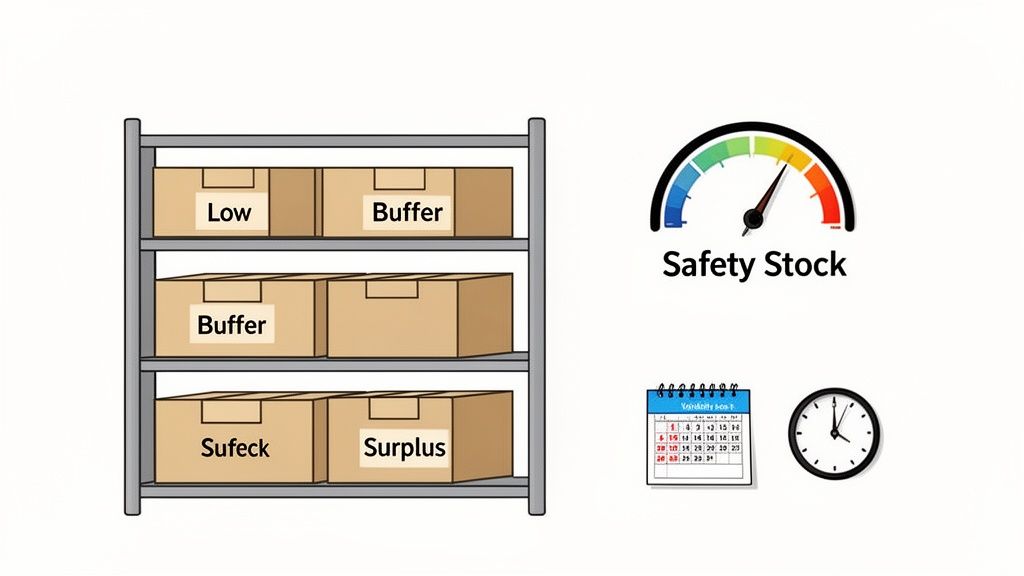
Solution: Strategic inventory buffering is a quantitative approach to maintaining optimal stock levels of critical components. This supply chain risk mitigation strategy uses data-driven models that consider supplier lead times, demand volatility, and component criticality to absorb disruptions. The goal is to balance inventory carrying costs against the very high cost of a line-down event.
Operating Scenario: A robotics startup is preparing for its first production run of 1,000 units. Their BOM includes a custom lidar sensor with a 20-week lead time and a history of delivery variability. A JIT approach is too risky. The operations lead calculates safety stock based on lead time deviation, targeting a 95% service level for this specific component. They place a bulk order to create a 4-week buffer stock of the lidar sensor, held at their contract manufacturer’s facility.
Outcome: Two weeks before the planned production start, the lidar supplier announces a 3-week shipment delay due to a raw material shortage. Without the safety stock, this would have delayed the entire production run. Instead, the team consumes the buffer inventory, and production proceeds on schedule. The cost of carrying the extra inventory for a few weeks was a fraction of the revenue and reputational cost of a delayed launch.
Implementation Tips
Effective inventory optimization requires a granular, risk-based approach rather than a one-size-fits-all rule. It’s about being smart with your capital, not just holding more of everything.
- Segment by Criticality: Not all parts are equal. Segregate inventory and define service level targets based on risk. For high-criticality components with lead times over 16 weeks (e.g., custom ASICs, specific FPGAs), target a 95-99% service level. For common, multi-source commodity items, an 85-90% level is often sufficient.
- Use Data-Driven Models: Move beyond static assumptions. Use a safety stock formula like SS = Z × σLT, where Z is the desired service level factor and σLT is the standard deviation of lead time. This mathematically connects your buffer to real-world supplier performance variability.
- Automate Reorder Points: Implement automated reorder point (ROP) triggers in your MRP or ERP system based on actual consumption velocity and current lead times. This ensures replenishment actions are timely and reflect real demand, not outdated forecasts.
- Explore Supplier-Held Inventory: Negotiate Vendor-Managed Inventory (VMI) or consignment agreements. In a VMI model, your supplier holds and manages the inventory, often at their facility or a nearby third-party logistics (3PL) warehouse, reducing your direct carrying costs while ensuring availability.
Optimizing safety stock is a continuous process of review and adjustment. A deep understanding of manufacturing readiness and DFM is essential, as design choices directly influence which components require the largest and most expensive buffers.
4. Supplier Relationship Management (SRM) and Collaboration
Problem: A purely transactional, arm’s-length approach to supplier management creates an adversarial dynamic and limits visibility. When a crisis hits, you are just another customer in line.
Diagnosis: Communication with key suppliers is infrequent and reactive, usually centered on purchase orders and quality complaints. Your team has no visibility into a supplier’s capacity, raw material pipeline, or potential risks. You learn about problems only after they have already impacted your delivery schedule.
Solution: Supplier Relationship Management (SRM) is a strategic commitment to building deep, transparent partnerships with key suppliers. This strategy emphasizes regular communication, shared visibility into forecasts, joint problem-solving, and mutual investment. Strong SRM serves as an early warning system and is one of the most effective supply chain risk mitigation strategies. A partner who understands your product’s criticality is more likely to provide advance notice of a shortage or allocate scarce capacity to you during a crisis.
Operating Scenario: An aerospace systems integrator relies on a single, highly specialized vendor for a flight-critical connector. Instead of a simple buyer-seller relationship, they establish a strategic partnership. This includes executive-to-executive alignment, quarterly business reviews (QBRs) where 18-month rolling forecasts are shared, and joint engineering sessions to improve connector manufacturability.
Outcome: During a global materials shortage, the connector vendor’s capacity is constrained. Because of the deep relationship and long-range forecast visibility provided by the integrator, the vendor prioritizes their orders over those of transactional, “spot-buy” customers. The partnership directly translates into supply continuity for a mission-critical program.
Implementation Tips
Effective SRM requires segmenting suppliers and tailoring your engagement level. You cannot maintain a deep strategic partnership with every vendor.
- Segment Your Supplier Base: Classify suppliers into tiers. Strategic partners (e.g., sole-source MCU vendor, primary CM) require deep, executive-level engagement. Preferred suppliers get moderate engagement, and transactional suppliers require minimal, efficient interaction.
- Establish Joint Performance Scorecards: Create and share supplier scorecards that track more than just cost. Key metrics should include on-time delivery, quality (PPM defect rates), lead time stability, and innovation contributions. Review these scorecards quarterly in a formal business review.
- Hold Quarterly Business Reviews (QBRs): For strategic partners, conduct structured QBRs. The agenda must include roadmap alignment, long-range forecast updates (even if uncertain), performance reviews, and a formal process for joint problem resolution.
- Involve Suppliers in Early Design Reviews: Invite key suppliers to participate in design reviews for the components they will manufacture. Capturing their DFM (Design for Manufacturability) feedback early prevents costly late-stage ECOs and production delays. This is especially critical for custom enclosures, PCBs, and specialized electromechanical assemblies.
5. Supply Chain Visibility and Real-Time Monitoring
Problem: You cannot manage what you cannot see. A lack of visibility into supplier operations, logistics, and inventory levels creates blind spots where disruptions can fester undetected until it’s too late.
Diagnosis: Your team relies on outdated spreadsheets and email chains to track critical shipments. You only learn of a delay when a shipment fails to arrive at the contract manufacturer, forcing you into reactive crisis management. There is no single source of truth for component status or inventory levels across the supply chain.
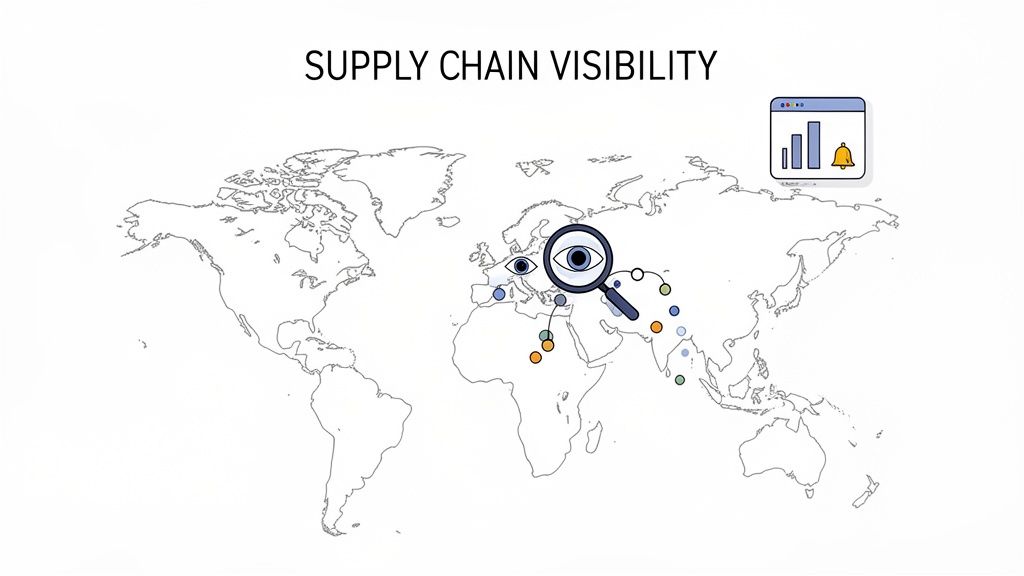
Solution: Technology-enabled supply chain visibility is a critical risk mitigation strategy that uses software, sensors, and data analytics to create a real-time, shared view of operations. For companies building complex electronics, this means tracking component shipments, monitoring a contract manufacturer’s work-in-progress (WIP), and understanding a key supplier’s true production capacity.
Operating Scenario: A consumer electronics company sources components from Asia for assembly in Mexico. They implement a visibility platform that integrates with their freight forwarders and contract manufacturer’s ERP system. The platform provides real-time tracking of component shipments and daily updates on WIP and finished goods inventory at the factory.
Outcome: The platform flags a two-day customs delay for a shipment of critical display panels. The automated alert allows the operations team to proactively adjust the production schedule at the Mexican facility, re-prioritizing assembly of another product while they await the displays. This avoids a costly line-down situation and idle labor costs. The visibility turns a potential crisis into a manageable operational adjustment.
Implementation Tips
Achieving end-to-end visibility can feel overwhelming. The key is to start with a targeted approach focused on your highest-risk areas and expand incrementally.
- Apply the 80/20 Rule: Don’t try to monitor everything at once. Begin by establishing visibility into the top 20% of your suppliers by spend or component criticality.
- Track High-Risk Components: Prioritize real-time tracking for single-source parts, components with long lead times, and international shipments that are vulnerable to customs or port delays.
- Establish Automated Alerts: Set up system alerts for key risk indicators like inventory falling below safety stock, supplier capacity constraints, or delivery dates slipping by more than a week.
- Integrate Data Streams: Connect supplier delivery data directly with your manufacturing execution system (MES) or ERP to optimize JIT schedules and immediately flag discrepancies between planned and actual arrival times.
Advanced visibility efforts can evolve into creating a complete digital twin of your supply chain, offering powerful simulation and predictive capabilities. Exploring the concepts behind digital twinning in manufacturing can provide a roadmap for future investments in this area.
6. Near-Shoring and Geographic Supply Chain Diversification
Problem: Concentrating manufacturing and sourcing within a single country or region introduces significant vulnerability to single-country disruptions like natural disasters, geopolitical tensions, or sudden regulatory shifts.
Diagnosis: Over 90% of your BOM cost and final assembly is located in a single geographic region. A port strike, lockdown, or new tariff in that region would completely halt your ability to build and ship product. Lead times are long and logistics are complex.
Solution: Near-shoring and geographic diversification are powerful supply chain risk mitigation strategies that involve deliberately distributing production and supplier locations across different regions. By bringing manufacturing closer to end customers, near-shoring also shortens lead times and reduces logistics complexity.
Operating Scenario: A US-based company manufactures its industrial control product entirely in China for the global market. Faced with rising tariffs and logistics uncertainty, they decide to pursue a “China+1” strategy. They keep their high-volume production in China for the Asian market but qualify a second contract manufacturer in Mexico to serve the North American market. This requires an investment in tooling and qualification at the new facility.
Outcome: A new round of tariffs on Chinese imports is announced. While competitors are forced to absorb the cost or raise prices, the company shifts its North American production to the Mexican facility, mitigating the tariff impact. Additionally, they can now offer shorter lead times and more responsive service to their largest market, turning a risk mitigation effort into a competitive advantage.
Implementation Tips
Implementing a geographic diversification strategy requires a careful analysis of costs, risks, and capabilities. It is not about abandoning low-cost regions but about building a balanced, resilient network.
- Assess by Category: Analyze your bill of materials (BOM) to identify which components can be near-shored without major cost penalties. For many electronics, a 5-15% cost increase for near-shored parts is offset by reduced logistics, inventory, and risk costs.
- Evaluate Total Cost of Ownership (TCO): Look beyond the per-unit price. TCO includes logistics, duties, inventory carrying costs, and the financial impact of quality escapes or production halts. When all factors are considered, near-shoring is often more cost-effective than it initially appears.
- Establish Regional CM Partnerships: Qualify and build relationships with two to three regional contract manufacturers. Each should be capable of scaling to at least 50-100% of your total production needs to provide true redundancy in a crisis.
- Build Redundancy into the Design: A key practice for manufacturing readiness is designing a product that can be built in multiple regions without tooling or component changes. This requires standardizing on components available globally and designing test fixtures that are easily replicated.
7. Supply Chain Risk Mapping and Scenario Planning
Problem: Effective risk mitigation requires moving from reactive crisis management to proactive contingency planning. Without a structured process to identify and plan for disruptions, teams are left scrambling when a problem occurs.
Diagnosis: Your team has no formal plan for what to do in the event of a key supplier bankruptcy, a major logistics failure, or a geopolitical disruption. Response is ad-hoc, slow, and often ineffective, driven by whichever problem is “on fire” that day.
Solution: Supply chain risk mapping is a systematic process for identifying and visualizing potential vulnerabilities across your entire network. This map serves as the foundation for scenario planning, where you develop ‘what-if’ response playbooks for specific, plausible disruptions. This proactive analysis allows companies to build resilience before a crisis hits, rather than scrambling for a response after production has already stopped.
Operating Scenario: The program manager for a new connected device leads a workshop with engineering, operations, and finance. They map their top 10 critical components, identifying a single-source power management IC (PMIC) from a fab in a geopolitically sensitive region as their top risk. The team then develops a response playbook for a scenario where that supplier is unavailable for 6 months. The playbook includes triggers for action, an immediate plan to engage a design partner to begin qualifying an alternative, and a communication plan for stakeholders.
Outcome: When geopolitical tensions escalate and export controls are placed on that region, the team is not caught flat-footed. They immediately execute their pre-approved playbook, kicking off the redesign effort weeks or months before their competitors, who are just beginning to assess the impact. The plan turns a potential existential threat into a manageable (though still difficult) engineering problem.
Implementation Tips
To translate risk mapping into actionable plans, focus on creating a living system, not a static document. Your goal is a practical framework for making decisions under pressure.
- Create a Vulnerability Matrix: Map your critical components against risk factors like supplier financial health, geographic concentration, lead time, and single-source dependency. This creates a visual heat map highlighting your most exposed parts.
- Identify the “Critical Few”: Focus your deep analysis on the 15-20% of suppliers and components that represent over 80% of your supply risk. It’s not practical to map every single resistor; prioritize high-impact nodes.
- Develop Response Playbooks: Draft clear, actionable playbooks for 3-5 realistic scenarios. These should include a major supplier capacity loss, a geopolitical trade disruption (e.g., tariffs or export controls), and a logistics failure like a port strike. For each, document the decision triggers, expected impact, and pre-approved mitigation steps.
- Stress-Test Your Scenarios: Conduct tabletop exercises to test your response plans. A valuable prompt is: “Assume our top three suppliers become unavailable for six months. What happens to our production timeline, and what are our immediate actions?” This forces a realistic assessment of your backup strategies.
8. Contract Manufacturing Partnerships and Capacity Agreements
Problem: Relying on a single contract manufacturer (CM) for production creates a significant operational risk, similar to depending on a single-source component supplier. A quality escape, fire, or financial failure at that one CM can halt your entire business.
Diagnosis: All of your production is with one CM in one factory. You have no pre-qualified alternative. If that CM de-prioritizes your business for a larger customer or has a major operational failure, you have no immediate path to continue production.
Solution: Strategic partnerships with multiple CMs, backed by formal capacity agreements, are a critical supply chain risk mitigation strategy. This approach involves qualifying several manufacturing partners and securing contractual commitments for production capacity, ensuring you have priority allocation during constrained periods. This diversification at the manufacturing level prevents a single factory issue from derailing an entire product program.
Operating Scenario: A fast-growing smart home company is scaling production. They currently use a single CM in Asia. To de-risk, they qualify a second, smaller CM in North America. They place a formal capacity reservation agreement with their primary CM, guaranteeing them line time for up to 10,000 units per month. Simultaneously, they place smaller, initial orders with the North American CM to keep the relationship active and the production line warm.
Outcome: The primary CM’s region is hit with unexpected port lockdowns, delaying shipments by 6 weeks. Instead of a complete revenue halt, the company is able to ramp up production at their North American partner to serve key customers, bridging the gap until the primary facility is back online. The cost of qualifying the second CM is easily justified by the avoidance of a single quarter of lost sales.
Implementation Tips
Effective CM diversification goes beyond simply having a second name on a list. It requires deep integration and clear contractual frameworks to be a reliable risk control.
- Qualify for Redundancy: Identify and qualify at least two CMs capable of building your product to specification. Each should have the capacity to handle 60-80% of your anticipated peak volume, providing a substantial buffer.
- Secure Capacity with Agreements: Establish formal capacity reservation agreements that guarantee a certain number of production line hours or units per month. In return, you can often negotiate volume discounts for the committed business.
- Define Explicit Quality & Test Requirements: Your CM contract must detail all quality expectations, including first-pass yield targets, acceptable defect rates (PPM), required test coverage, and full component traceability.
- Negotiate Volume Flexibility: Build clauses into your agreements that allow for reasonable adjustments (e.g., ±25-50%) to committed volumes without incurring major financial penalties. This gives you agility as market demand shifts.
- Conduct Regular Audits: Perform annual on-site audits to assess each CM’s financial stability, capacity utilization, quality management system, and their own supply chain risks.
Integrating CMs early in the design process is also vital. Involving them in DFM reviews provides crucial feedback that improves manufacturability and reduces costly rework. A robust NPI process in manufacturing ensures these partnerships are established and tested well before volume production begins.
9. Supply Chain Financial Hedging and Procurement Strategies
Problem: Volatility in commodity prices, currency exchange rates, and logistics costs can erode profit margins and make financial planning impossible.
Diagnosis: Your COGS (Cost of Goods Sold) fluctuates unpredictably from quarter to quarter. Unexpected price hikes for raw materials like copper or aluminum, or a spike in freight rates, directly impact your bottom line, forcing reactive price increases or lower profitability.
Solution: Financial hedging and strategic procurement are essential supply chain risk mitigation strategies that act as a buffer against market turbulence. By locking in costs and supply through forward contracts, currency hedging, and long-term agreements, companies can stabilize their COGS and protect profit margins.
Operating Scenario: A manufacturer of high-power electronics uses a significant amount of copper and aluminum in its products. The procurement team, anticipating market volatility, enters into a 12-month forward contract for 75% of their projected copper needs at a fixed price. They also hedge their Euro exposure for components sourced from a key German supplier.
Outcome: Over the next six months, the spot price for copper increases by 30% and the Euro strengthens against the dollar. While competitors face significant margin pressure, the company’s material costs remain stable due to their hedging strategy. This cost predictability allows for more accurate financial forecasting and competitive pricing.
Implementation Tips
Effective financial and procurement strategies require proactive market analysis and disciplined contract management. It’s about shifting from reactive purchasing to strategic cost control.
- Implement Forward Contracting: For major commodity exposures like metals, plastics, and resins, lock in 50-75% of your anticipated annual needs 6-12 months in advance through forward contracts.
- Hedge Currency Exposure: If your supplier contracts are denominated in foreign currencies, hedge 50-75% of your exposure to protect against unfavorable exchange rate shifts. Leaving a portion unhedged allows you to benefit if rates move in your favor.
- Establish Price Escalation Clauses: Negotiate supplier agreements with clearly defined price adjustment clauses tied to published, independent indices (e.g., London Metal Exchange) rather than allowing unilateral supplier-driven price hikes.
- Secure Long-Term Agreements: For critical, long-lead-time components like specialized ICs, negotiate multi-year agreements. In exchange for volume commitments, secure price locks and guaranteed allocation, which is invaluable during shortages.
10. Supply Chain Agility and Flexibility Architecture
Problem: Traditional supply chain management optimizes for static efficiency, creating a rigid system that is brittle and breaks under stress. This approach is ill-suited for the volatile and unpredictable nature of modern electronics.
Diagnosis: Your manufacturing processes and product design are tightly coupled. A minor component change requires a full firmware respin and a lengthy validation cycle. Swapping suppliers or moving production to a new facility is a monumental effort that takes months.
Solution: An agile and flexible architecture prioritizes adaptability over static efficiency. It involves intentionally designing products, manufacturing processes, and supplier relationships for rapid pivots. The core idea is to build a system that can absorb and adapt to shocks, rather than one that breaks when the ideal scenario changes. This is one of the most advanced supply chain risk mitigation strategies, treating flexibility as a designed-in feature.
Operating Scenario: A company building a smart-home camera designs its firmware to be hardware-agnostic. The software is architected to work with three different qualified image sensors and two different Wi-Fi modules. The “Flex BOM” allows the procurement team to source whichever components are most available or cost-effective at the time of the production run, with the factory loading the correct firmware variant based on the components used.
Outcome: The primary image sensor supplier has a yield issue and cannot meet demand. Instead of halting production, the company seamlessly switches to its pre-qualified backup sensor for the next production run. There is no fire drill, no firmware panic, and no delayed shipments. The built-in flexibility allows the supply chain to adapt in real time.
Implementation Tips
Building an agile architecture requires a shift in mindset from pure cost optimization to paying a premium for flexibility.
- Design for Component Optionality: For every critical sub-assembly, aim to qualify more than one component option. Create a “Flex BOM” that allows for quick bill-of-materials (BOM) switching without requiring a hardware redesign.
- Standardize Interfaces: Use standardized connectors, power interfaces, and software protocols. This allows you to substitute components like memory chips, sensors, or power modules from different vendors with minimal firmware or hardware changes.
- Reserve Manufacturing Capacity: Instead of maxing out capacity with a single contract manufacturer (CM), maintain relationships with several. Keep some capacity in reserve, which allows you to surge production with an alternative partner during a disruption at your primary facility.
- Establish Rapid Decision-Making: Supply chain decisions cannot be bogged down in months-long approval cycles. Create a process and empower a small, cross-functional team to make critical changes, like a supplier swap, within 48-72 hours.
- Decouple Firmware from Hardware Versions: For IoT and robotics, design firmware and software to support multiple hardware versions simultaneously. This prevents a single component change from bricking fielded units or halting production to wait for a new firmware build.
10-Strategy Supply Chain Risk Mitigation Comparison
| Strategy | Implementation Complexity (🔄) | Resource Requirements (⚡) | Expected Outcomes (⭐ 📊) | Ideal Use Cases | Key Advantages (💡) |
|---|---|---|---|---|---|
| Supplier Diversification and Dual-Sourcing | 🔄🔄 — moderate coordination overhead for multiple suppliers | ⚡⚡ — procurement effort, qualification costs, higher inventory | ⭐⭐⭐ — high resilience; 📊 reduces single‑point risk and lead‑time impact | Critical components, electronics, aerospace, medical | Reduces SPOF; bargaining leverage; faster pivots. Tip: prioritize long‑lead/specialized parts. |
| Design for Supply Chain Resilience (DfSCR) | 🔄🔄🔄 — requires cross‑functional design changes early | ⚡⚡ — design time, supply‑intel, governance | ⭐⭐⭐ — fewer redesigns; 📊 faster time‑to‑production and lower rework | Regulated industries, long‑qualification programs (aerospace, medical) | Prevents late redesigns; modularity; supplier‑aware choices. Tip: use component risk scorecards. |
| Strategic Inventory Buffering & Safety Stock Optimization | 🔄🔄 — modeling and periodic tuning effort | ⚡⚡⚡ — capital tied in inventory, storage and handling | ⭐⭐ — high availability; 📊 trades off cost vs. disruption protection | Long‑lead semiconductors, perishable/critical materials | Protects production; reduces expediting. Tip: use EOQ+safety‑stock calculations and review quarterly. |
| Supplier Relationship Management (SRM) & Collaboration | 🔄🔄 — ongoing relationship management | ⚡⚡ — time, governance, performance systems | ⭐⭐⭐ — early warnings; 📊 improved quality and planning | Strategic suppliers, long‑term partnerships (auto, aerospace, medical) | Shared forecasts; joint improvement; prioritized allocation. Tip: segment suppliers by tier. |
| Supply Chain Visibility & Real‑Time Monitoring | 🔄🔄🔄 — high integration and data governance complexity | ⚡⚡⚡ — tech investment (IoT, analytics), integration effort | ⭐⭐⭐ — strong predictive detection; 📊 lowers safety stock and improves decisions | Global sourcing, contract manufacturing, regulated traceability | Early disruption detection; data‑driven actions. Tip: start with top 20% suppliers. |
| Near‑Shoring & Geographic Diversification | 🔄🔄🔄 — multi‑region coordination and compliance | ⚡⚡⚡ — contracts, logistics, qualifying regional CMs | ⭐⭐ — reduced geopolitical risk; 📊 shorter regional lead times but higher unit cost | Products needing regional compliance, IP protection, faster regional delivery | Lowers tariffs/logistics; improves responsiveness. Tip: evaluate TCO and regional hubs. |
| Supply Chain Risk Mapping & Scenario Planning | 🔄🔄 — structured workshops and mapping cadence | ⚡⚡ — cross‑functional analysis tools and time | ⭐⭐⭐ — improved preparedness; 📊 faster response with playbooks | Programs with high risk exposure (defense, complex electronics) | Identifies vulnerabilities; prebuilt playbooks. Tip: focus on the “critical few” suppliers. |
| Contract Manufacturing Partnerships & Capacity Agreements | 🔄🔄 — qualification and contracting complexity | ⚡⚡⚡ — CM audits, certifications, contractual commitments | ⭐⭐⭐ — guaranteed capacity; 📊 enables rapid scaling without CAPEX | Hardware startups, high‑mix/low‑volume production, regulated CMs | Capacity guarantees; DFM expertise. Tip: qualify ≥2 CMs with 60–80% peak capacity each. |
| Supply Chain Financial Hedging & Procurement Strategies | 🔄🔄🔄 — requires financial instruments and oversight | ⚡⚡⚡ — working capital, hedging costs, procurement skill | ⭐⭐ — price and budget stability; 📊 protects margins but ties capital | Commodity‑exposed products, global suppliers, long procurement cycles | Stabilizes cost and margins. Tip: hedge 50–75% of major exposures. |
| Supply Chain Agility & Flexibility Architecture | 🔄🔄🔄 — cultural change and design/process shifts | ⚡⚡ — design effort, flexible CM relationships, process changes | ⭐⭐⭐ — high adaptability; 📊 faster pivots at modest efficiency tradeoffs | Fast‑moving markets, robotics, venture‑backed hardware | Enables rapid supplier swaps and design iteration. Tip: design >2 component options and standardize interfaces. |
Your Monday Morning Action Plan for Supply Chain Resilience
Decision -> Criteria -> Recommendation -> Risks
The decision is not if you should invest in supply chain resilience, but how and where to start. The primary criterion for action should be impact: focus on the vulnerabilities that pose the most immediate and significant threat to your revenue and production schedule. Our recommendation is to move from abstract awareness to concrete analysis by focusing on your most critical components. The risk of inaction is clear: production delays, cost overruns, and a loss of competitive position when a predictable failure mode occurs.
Turning Theory into Traction: Your First Steps
Effective risk mitigation is a discipline built through consistent practice, not a one-time fix. The goal is to move from theoretical knowledge to tangible action. Here is a practical, three-step plan you can start executing this week to build momentum and expose your program’s most immediate vulnerabilities.
1. Create a “Critical Component Vulnerability Matrix”
Don’t try to boil the ocean. Start small and focused.
- Action: Identify the top 10-15 most critical components on your Bill of Materials (BOM). These are typically your microcontroller, key sensors, power management ICs (PMICs), memory, and custom or long-lead-time connectors.
- Implementation: Create a simple spreadsheet. For each component, create columns for:
- Current Lead Time (Weeks): The realistic time from PO to delivery.
- Number of Qualified Sources: How many vendors have you fully qualified and can you order from today?
- Geographic Concentration: Are all sources in the same country or region? Note this down (e.g., “All in Shenzhen,” “Primary Taiwan, Secondary Malaysia”).
- “Golden Screw” Risk: Is this a single component without which the entire product cannot be assembled? Mark it.
- Outcome: This simple matrix will immediately give you a visual, data-backed snapshot of your single points of failure. The component with the longest lead time, a single qualified source, and high geographic concentration is your number one priority.
2. Schedule a Cross-Functional Risk Review
The data from your matrix is the ticket to a productive conversation.
- Action: Book a 60-minute meeting with key stakeholders from engineering (hardware/firmware), supply chain/procurement, and manufacturing/operations.
- Implementation: Present your vulnerability matrix. The goal isn’t to assign blame but to build shared awareness. Frame the discussion around a specific, high-risk component identified in your matrix.
- Discussion Prompts:
- “Our primary MCU has a 52-week lead time and we have no qualified second source. What is the engineering effort required to qualify an alternative?”
- “This power IC is sole-sourced from a region prone to lockdowns. What is our emergency plan if that facility goes offline for four weeks?”
- Outcome: The meeting should produce at least one concrete action item, such as “Engineering to research a pin-compatible MCU alternative by [date]” or “Procurement to engage a second distributor for component X.”
3. Run a Tabletop “What If” Scenario
Stress-test your assumptions before reality does it for you.
- Action: Choose one plausible disruption scenario based on your matrix.
- Implementation: Write it down. For example: “Our primary contract manufacturer in Vietnam has just informed us of a factory fire, and their production line for our product will be down for 8 weeks, effective immediately. Our backup CM in Mexico is not yet fully tooled.”
- Document a Response: With your core team, outline the first five steps you would take. Who makes the call? What data do you need? Who communicates with customers? How do you assess the impact on inventory and revenue?
- Outcome: This exercise forces you to think through the communication and decision-making process in a crisis. The documented response becomes the seed for a more formal business continuity plan.
Mastering these supply chain risk mitigation strategies is not about achieving a perfect, invulnerable state. It is about building an organization that can anticipate, absorb, and adapt to shocks with minimal disruption. It’s about replacing hope with a plan and anxiety with action.
If your team is struggling to connect design decisions to manufacturing realities, or if your vulnerability matrix reveals risks you aren’t equipped to handle, Sheridan Technologies can provide an independent, expert review. Our Manufacturing Readiness Assessments analyze your design, BOM, and supply chain to identify hidden risks and deliver a concrete, actionable roadmap to de-risk your path to production. Request a manufacturing readiness assessment to ensure your supply chain is as robust and reliable as your product.