Our Process
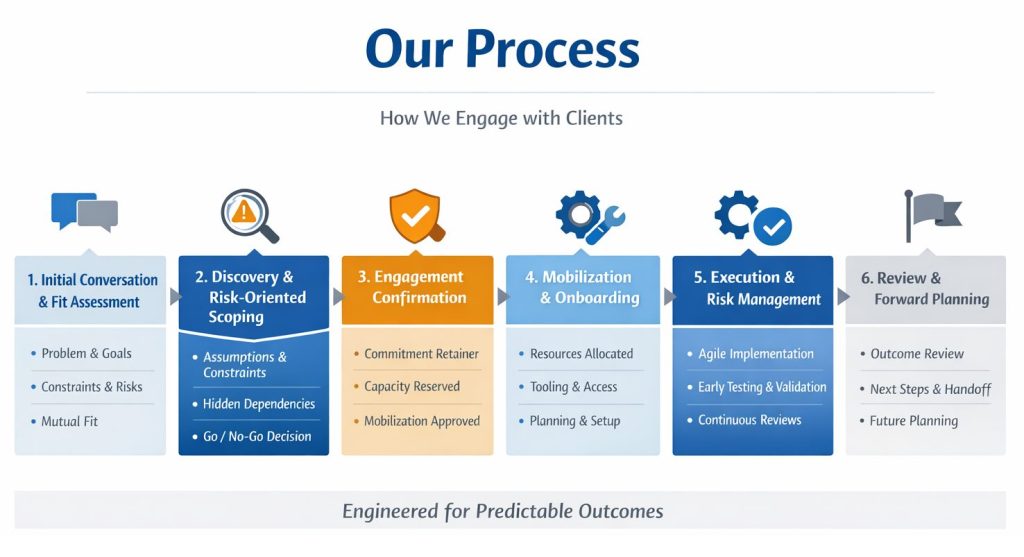
Sheridan Technologies works as an on-demand engineering and product-development partner. Our process is designed to ensure alignment, reserve the right expertise at the right time, and move quickly once a project begins.
1a. Initial Conversation & Fit Assessment
We start with a focused discovery discussion to understand:
- The problem you are trying to solve
- Technical, schedule, and risk constraints
- Whether the engagement is a good mutual fit
At this stage, we are validating that we can meaningfully help, not selling a predefined package.
1b. Discovery & Risk-Oriented Fit Assessment
Our initial conversations focus on more than requirements. We deliberately look for:
- Technical and organizational risk signals
- Schedule, dependency, and integration concerns
- Past failure modes and hidden constraints
We are transparent about what we see, even when it’s uncomfortable. If we believe a project is likely to stall or fail without changes, we will say so early.
Goal: Establish clarity, alignment, and an honest go/no-go decision.
2a. Scoping & Proposal
If there is a strong fit, we define:
- Project objectives and success criteria
- Scope, requirements, assumptions, and constraints
- Timeline, milestones, and commercial structure
You receive a clear proposal outlining deliverables, cadence, and expectations, eliminating ambiguity and downstream surprises.
2b. Collaborative Scoping & Assumption Alignment
Rather than presenting a fixed scope in isolation, we work collaboratively to define:
- Clear objectives and success criteria
- Assumptions and constraints
- Known risks and unknowns
- Clear decision owners and escalation paths to prevent stalled progress or late-stage surprises
This ensures both sides share the same mental model before work begins.
Goal: Eliminate ambiguity and prevent misalignment-driven rework.
3. Engagement Confirmation & Sign Off
To formally begin the engagement, we require an Engagement Retainer.
This retainer:
- Demonstrates mutual commitment
- Reserves dedicated engineering capacity in our schedule
- Allows us to decline overlapping or conflicting work
- Improves cash-flow timing at project start
- Enables immediate mobilization without delays
The retainer is not an added cost. The non-refundable retainer is fully credited to early invoices and ensures we can prioritize your project with focus and accountability.
Goal: Create commitment, momentum, and predictable execution.
4. Mobilization & Onboarding
Once the engagement is confirmed, we immediately mobilize:
- Allocate engineering resources
- Set up tooling, access, and environments
- Establish communication cadence and decision-making structure
- Align on documentation and change control
- Conduct deep technical and operational onboarding
From day one, clients have visibility into what we are doing, why we are doing it, and what risks we are actively tracking.
Goal: Build trust and momentum from day one.
5. Execution & Delivery with Proactive Risk Management
Work proceeds according to the agreed plan:
- Milestone-based or time-and-materials delivery
- Regular check-ins and progress updates
- Adjustments as requirements or constraints evolve
- Lightweight Agile planning, prioritization, and feedback loops
- Adjustments as requirements or constraints evolve
Execution emphasizes speed, clarity, and technical rigor, supported by:
- Continuous validation and early testing
- Regular progress and risk reviews
- Explicit surfacing of tradeoffs and emerging issues
- Rapid course correction when conditions change
We do not wait for problems to surface. Our experience allows us to anticipate common failure modes and address them early, when changes are cheaper and easier.
Goal: Prevent surprises, reduce rework, and protect timelines.
6. Review, Transition, and Forward Planning
At key milestones or project completion, we:
- Review outcomes against original objectives
- Outline any residual risks, deferred decisions, or technical debt (if applicable)
- Identify next steps, extensions, or follow-on work
- Support handoff, scaling, or long-term engagement if needed
This ensures continuity and long-term value, not just task completion. Many clients continue with us in phased or ongoing engagements as needs evolve.
Goal: Leave the project stronger than we found it.
What This Means for Clients
- No black boxes
- No surprise scope creep
- No late-stage “oh by the way” problems
- Early, honest communication when something needs attention
Sheridan Technologies partners with clients through a transparent, collaborative process that mobilizes quickly, delivers focused execution with minimal friction, and proactively identifies and prevents issues before they impact cost, schedule, or outcomes.
Client Responsibilities:
Successful engagements are collaborative. Timely feedback, access, and decision-making are critical to maintaining momentum and predictability.
How We Build Predictability Into Every Engagement
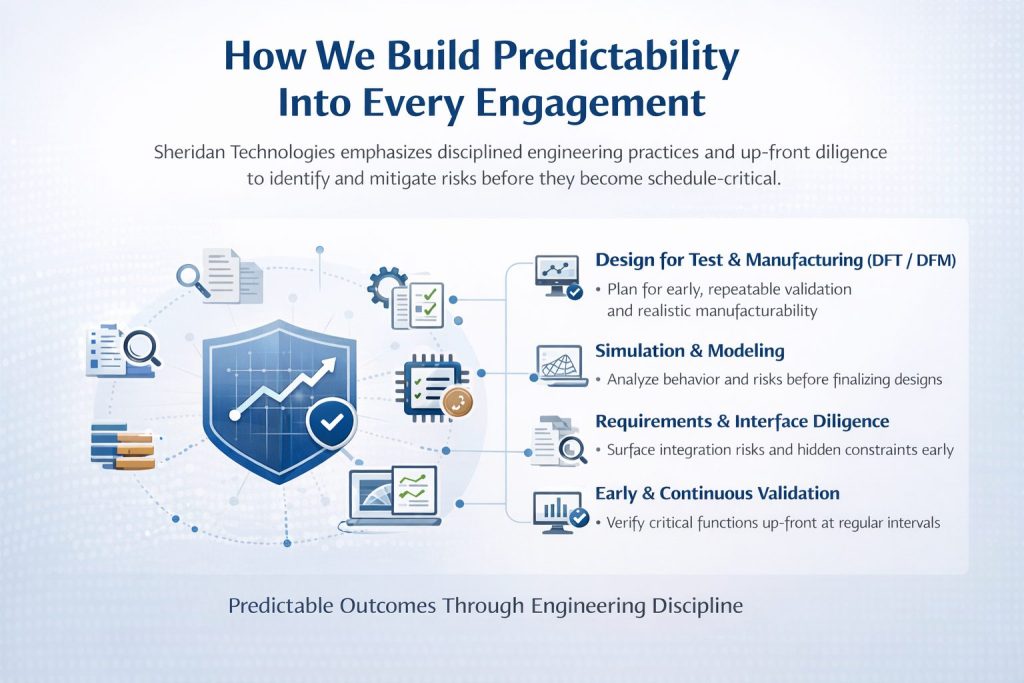
Sheridan Technologies applies disciplined engineering practices that improve predictability and reduce downstream risk. Our approach emphasizes front-loaded diligence, design for downstream realities, and early validation, so risks are identified and mitigated before they become expensive or schedule-critical.
Engineering Discipline as a First-Class Priority
From the start of an engagement, we intentionally apply practices that improve predictability and reduce downstream surprises, including:
- Design for Test (DFT) to ensure systems can be validated early and repeatedly
- Design for Manufacturing (DFM) to avoid late-stage manufacturability and supply-chain issues
- Simulation and modeling to evaluate behavior and edge cases before committing to hardware or code
- Requirements and interface diligence to surface hidden dependencies and integration risks
- Verification to ensure we are building the system right
- Validation to ensure we are building the right system
These practices are applied before irreversible decisions are made, not after problems appear.
Due Diligence Before Irreversible Decisions
We deliberately invest time up front to:
- Pressure-test assumptions
- Evaluate technical and operational tradeoffs
- Identify likely failure modes based on prior experience
- Align designs with real-world constraints, not idealized ones
This allows us to predict outcomes with greater confidence and recommend course corrections early, when they are cheaper and easier to implement.
Integrated Into Our Engagement Process
These disciplines are embedded into how we work:
- During discovery and scoping, we assess testability, manufacturability, and integration risk
- During mobilization, we establish validation, simulation, and review workflows
- During execution, we continuously validate designs against downstream realities
- During reviews, we confirm assumptions still hold and adjust proactively
Why This Matters to Clients
This approach:
- Reduces late-stage surprises
- Improves schedule and cost predictability
- Avoids rework and rushed fixes
- Increases confidence in decision making
We prioritize engineering rigor that prevents problems, rather than reacting to them after the fact.
In Short
Sheridan Technologies emphasizes front-loaded engineering discipline, including design for test, design for manufacturing, simulation, and early verification planning. By doing the hard diligence up front, we are able to predict outcomes more accurately, surface risks early, and prevent downstream issues that commonly derail complex technical programs.
SEND A MESSAGE
Get in Touch
We will respond to your message as soon as possible.